

About Tales of Symphonia
In Sylvarant, Lloyd Irving and his classmates join the Chosen One, Colette Brunel, on a journey to restore the world's dwindling mana. Their route through temples, towns and distant regions gradually reveals that Sylvarant's fate is tied to another world. Tales of Symphonia pairs this fantasy story with real-time party battles, dungeon puzzles and character-focused skits.
Tales of Symphonia begins in Iselia, a village in Sylvarant, where Lloyd Irving and his friend Genis Sage become caught up in the journey of Colette Brunel, the Chosen One expected to renew a world suffering from a shortage of mana. Colette's pilgrimage leads through a series of temples and seals, and Lloyd joins the expedition despite not being its central figure. That position gives the story a useful shape: the mission belongs to Colette, while the people accompanying her must decide what it means to help someone whose duty carries a cost. The early route presents Sylvarant as a place where everyday life is affected by a larger decline, and where the feared Desians exploit human communities. The adventure develops from a local group leaving home into a conflict whose reach extends across the world. Its premise uses familiar fantasy language about a chosen saviour, but the party's changing understanding of that role drives the dramatic tension. The story keeps the central question visible without requiring a new player to know the series or its later games.
Lloyd is impulsive and quick to act, while Genis is more academically minded; their friendship gives the opening journey a familiar point of view. Colette's optimism sits alongside the pressure of being treated as the person on whom the world's recovery depends. Raine Sage, Genis's older sister and a teacher, brings a more measured perspective and practical knowledge. Other companions join as the route broadens, each with a distinct place in the group and a different relationship to Sylvarant's institutions and history. Kratos provides experience and an adult counterpoint to Lloyd, while Sheena, Zelos, Presea and Regal complicate the party's first impressions as they enter the story. These are named personalities rather than interchangeable battle slots: conversations and optional skits let the group respond to events and to one another. Their disagreements and changing trust make the expedition feel like a group journey, even when Lloyd is the character usually seen moving through a map. The structure also means that supporting Colette remains a recurring concern, rather than a brief prelude before a conventional solo-hero quest takes over.
Travel alternates among a broad field map, settlements, dungeons and separate battle arenas. On the field, the party moves between recognizable locations and can approach towns or entrances directly; once inside, local layouts offer routes, rooms, people to speak with and objects to inspect. Dungeons are not only corridors between scenes. They use switches, movable blocks, environmental mechanisms and the Sorcerer's Ring, a tool whose function can change as the adventure progresses. These puzzles ask the player to look at how a room is arranged and use the available ability to alter or cross it. Towns provide a different pace: shops, conversations and short character scenes offer places to prepare and absorb what the group has learned. A world map keeps the journey legible as the number of destinations increases, while new transportation options later extend how far the party can travel. Exploration therefore has a repeated rhythm of choosing a destination, solving the local space, meeting its inhabitants and returning to the route with new context or capability.
Movement changes with the space the party occupies. Lloyd or another selected character walks across the field and through local areas, while map travel connects the larger points of the journey. Dungeons add short interactions and puzzles to that movement, so progress can depend on activating a device, using the Sorcerer's Ring, or finding a path through a room rather than defeating every enemy encountered. The cast can be changed as the visible map character, giving different members a place at the front of the group outside combat. Encounters with visible field enemies begin battles, and the player can sometimes use the Ring to affect an enemy before contact. This creates a distinction between moving through a space and fighting within it: most exploration is about navigation and environmental interaction, while battles shift to their own arena. Skits can be triggered as the party travels, providing brief optional conversations that add context to relationships or events. Together, these layers keep the journey from becoming a single uninterrupted sequence of battles and story scenes.
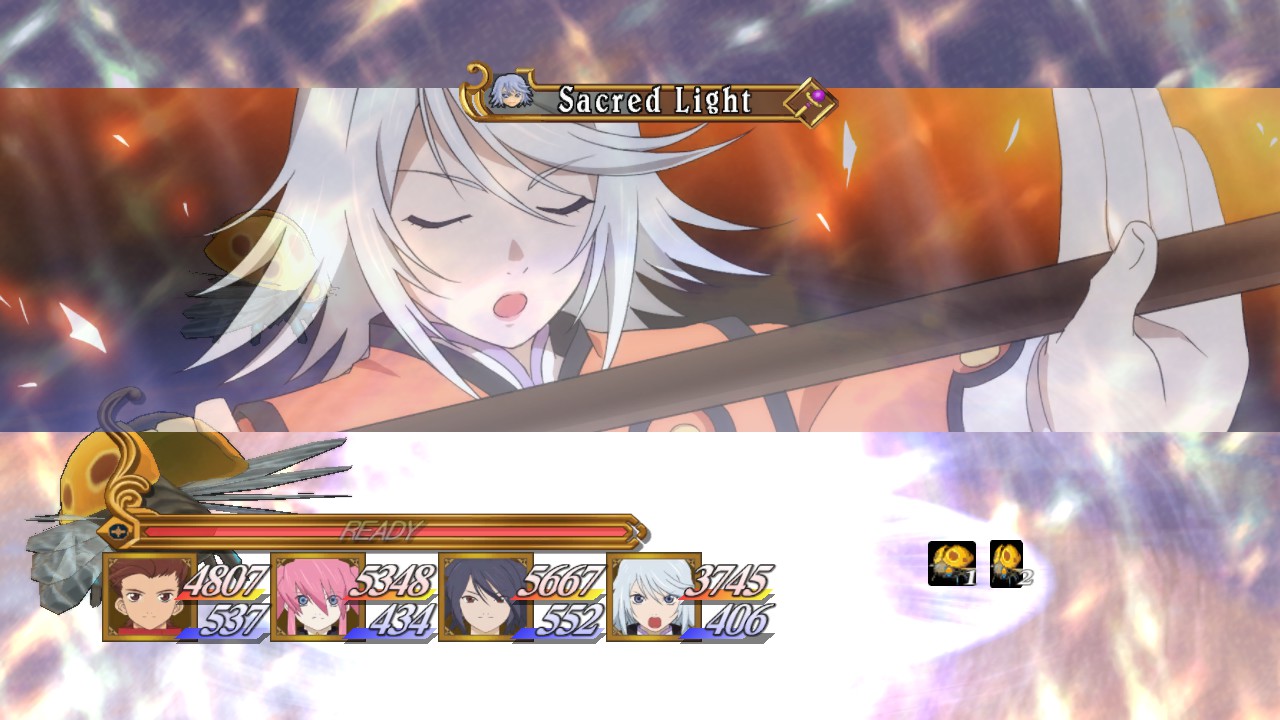
Combat is real-time and built around a directly controlled character acting with three companions. The system is a form of Linear Motion Battle System: the controlled fighter faces an opponent along a line, and attacks, techniques, guarding and positioning are chosen as events unfold rather than selected from a turn queue. The player can configure learned techniques to directional inputs, while the other party members can be set to automatic behavior or directed toward particular priorities. That arrangement leaves room to concentrate on Lloyd's movement while still deciding how the group should contribute. Physical attacks can lead into artes, including magical attacks from characters such as Genis and Raine; timing and enemy openings matter because an attack can be interrupted or defended against. As the shared Unison Attack gauge fills, the party can launch a coordinated burst that combines actions from multiple members. Local multiplayer allows additional controllers to take control of party characters in battle, up to four participants, while the wider journey remains a single-player exploration mode. The result is a party system where character selection and battle instructions shape a fight without turning each exchange into a list of turns.
The party grows through ordinary role-playing progression as well as choices about equipment and abilities. Characters gain levels and learn techniques, and their weapons, armor and accessories can be changed to suit their individual roles. EX Gems add another layer of configuration: each gem offers a choice of an EX Skill, and combinations can unlock Compound EX Skills with further effects. The system also influences whether a character develops toward Strike or Technical artes, which can affect the form of skills they learn. These choices let the player shape a fighter or a support character gradually instead of relying only on the newest piece of equipment. Cooking and item management add smaller preparation decisions between encounters, while the party's changing roster alters which techniques and tactical roles are available. Progress is tied to story access as well: new temples, travel routes and mechanisms make later regions reachable, and abilities learned or acquired for exploration can turn previously closed paths into usable routes. The systems are introduced across a long adventure, so equipment, battle setup and map access all develop alongside the narrative rather than arriving as a separate endgame layer.
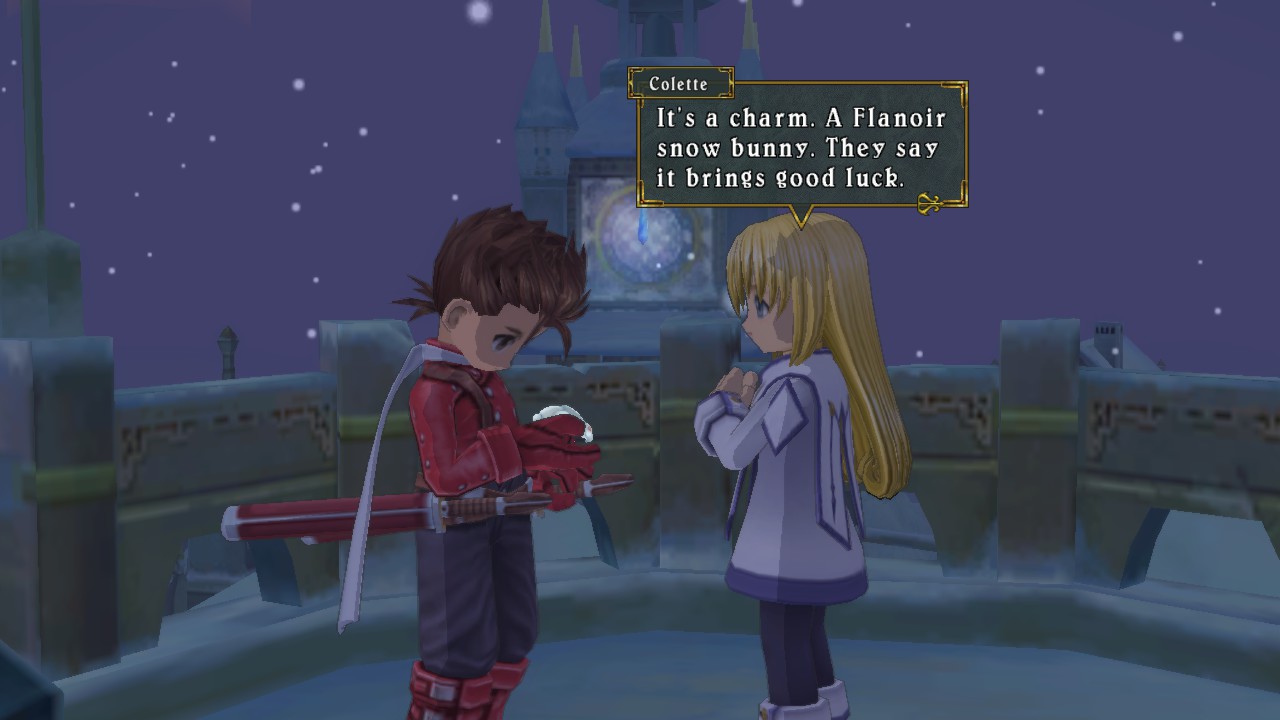
The game's visual language combines three-dimensional environments with cel-shaded character models designed by Kosuke Fujishima, and animated sequences mark selected story moments. The contrast between rounded character designs and serious events is part of the work's presentation: the party can move from warm banter to questions about exploitation, prejudice and the consequences of a world-saving mission. Skits provide a compact, optional way to hear the cast talk outside the main scenes; they can be humorous, but they also clarify motives or show how companions interpret a recent event. The score supports both the travel and battle portions, while voice acting gives the central story scenes a more performed feel than the text exchanges alone. Rather than treating its setting as a backdrop, the adventure repeatedly connects mana, the Desians and the world's institutions to who has power and who bears the cost. The story's turns expand the initial pilgrimage, but this profile avoids naming later revelations. Newcomers can follow the party's immediate aims while the wider relationship between worlds unfolds through play.
The Windows PC release of Tales of Symphonia arrived in 2016, based on the PlayStation 3 port of the original GameCube game. It tells Lloyd and Colette's original story, with English and Japanese voice options, several subtitle languages, Steam achievements and local co-op during battles. Friends can control additional fighters when combat begins, while travel across Sylvarant remains the main player's journey. This PC version contains the in-game content later carried into the separate 2023 console release, Tales of Symphonia Remastered. The newer edition adds visual and quality-of-life changes rather than a new story. Dawn of the New World is a sequel and a different game, even though it has sometimes been packaged with Symphonia. Knowing which release is under discussion helps make sense of the game's long platform history without changing the central adventure: Lloyd's party follows the Chosen's pilgrimage, learns more about the linked worlds and develops together through exploration, puzzles and real-time battles.
- Developer
- Namco Tales Studio (original; Bandai Namco Entertainment Inc. listed as developer on Steam)
- Genre
- Action role-playing game