
About Tales of Graces f Remastered
On Ephinea, Asbel Lhant, his childhood friends, and the mysterious Sophie are drawn into conflict among three kingdoms after a childhood promise binds their futures. Tales of Graces f Remastered combines real-time party combat with character growth and the included Lineage and Legacies after-story.
Tales of Graces f Remastered opens on Ephinea, a lush planet whose three great nations are tied to Eleth, the energy that underpins their power. In Lhant, Asbel is the heir to a local lord; Richard is the prince of Windor; and Sophie is a mysterious girl with no known past. When the children help one another survive an attempt on Richard's life, they make a promise of friendship. The story later follows Asbel and his friends as Lhant becomes a battleground in a struggle among Ephinea's nations. The childhood vow gives the conflict a personal centre: the characters must carry a promise made in danger into a world of political ambition, shifting alliances, and revelations about the threats surrounding them. The journey grows from the children's encounter into a world-spanning adventure, while keeping their bond at the heart of the stakes.
The setting gives the party a route through several layers of conflict. Windor and the two other great nations compete for control of a planet where Eleth is a source of power, and Lhant becomes an early point of pressure in that wider contest. Asbel's position as a lord's heir places him close to the local consequences, while Richard's royal status connects the childhood incident to Windor's rule. Sophie stands apart from both through the unanswered question of her origins. The group's travel brings these different starting points into one party, and the plot expands as their personal ties meet the interests of the nations. Bandai Namco describes the remastered story as an adventure about friendship and bonds across time; that framing is reflected in the promise made by the children and the responsibilities they later face. The overview leaves later revelations undisclosed. That structure makes the conflict more than a sequence of isolated encounters: the nations share a world and an energy source, while the party carries ties that cross the political lines. The publisher describes the three kingdoms as vying for control of Ephinea, and the Steam story summary locates the initial promise in Lhant. Together, those details explain why the childhood event has consequences beyond the children involved.
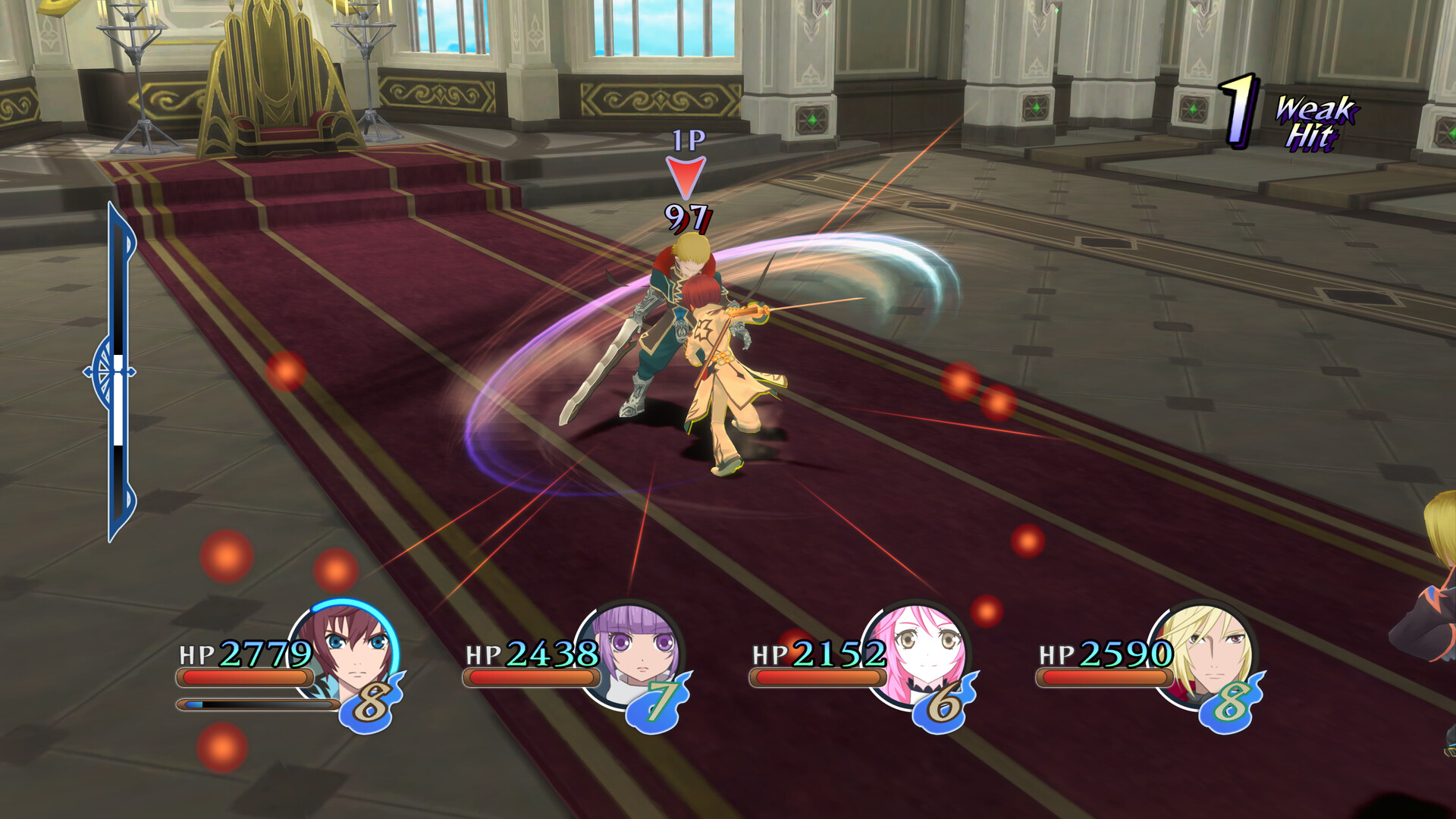
Battles use the Style-Shift Linear Motion Battle System, a real-time system in which the player moves a character and chooses actions as the encounter unfolds. Its defining choice is between Artes and Burst styles, two approaches with different moves and attack patterns. The Steam description identifies differences in attack strength, range, area, and the distance needed for best effect, so selecting an action involves position as well as timing. Rather than waiting through a sequence of menu commands, the player can connect attacks into combos and adjust the approach as an opponent moves. Each party member has a distinct set of abilities, giving the player a reason to switch the controlled character and vary the party's response. The result is a combat loop structured around close attention to the live exchange: where the character stands, which style is active, and how an opening can be extended.
Accel Mode adds another resource-driven choice to those style changes. The gauge fills during battle and, when ready, lets a character unleash a powerful ability. Its use sits alongside the ordinary sequence of attacks rather than replacing the Artes and Burst styles, so the player balances building a combo with deciding when to spend the available burst of power. Because the battle system supports rapid actions and linked hits, the timing of a style switch or special ability can shape how a sequence develops. The remaster's publisher highlights combo building and fighting-style changes as central features, while the Steam page describes the distinction between the two styles and the importance of attack range. The system is built around active character control and a party's collection of techniques, with Accel Mode providing a further high-impact option within that framework.
Titles form a substantial part of character development. The game offers more than one hundred equipable titles, and their ranks increase through battles. As a title advances, it teaches skills and techniques that strengthen character statistics. This makes title selection a continuing development decision: battles contribute to growth through the titles a character is working on, while equipment and party setup remain part of preparation. The Steam listing describes titles as rankable through battle, connecting character advancement to the encounters that make up the action RPG loop. Because titles can be equipped and developed, the system gives the player a longer-term progression track alongside immediate combat choices. A title is more than a label attached to a character; advancing it can add skills and techniques to the character toolkit. The large catalogue gives this track room to support development across the party as the journey proceeds.
Asbel, Richard, and Sophie anchor the story, but their childhood friendship becomes the foundation for a wider group of companions. The party relationships are shaped by the contrast between Asbel and his home in Lhant, Richard and his royal position in Windor, and Sophie and her unknown past. As the nations conflict draws the characters into a broader journey, the group bonds are tested against competing obligations and new information. These relationships give the political plot a personal scale, while the world-spanning quest puts the characters in contact with events beyond their original meeting in Lhant. The remastered version includes scenes newly localized in English, making those scenes part of this release presentation. The connection to Lhant, the royal position in Windor, and the uncertain origins of Sophie give the companions different points of connection to the unfolding events.
Lineage and Legacies is an after-story set six months after the main journey and is included in Tales of Graces f Remastered. Sophie is troubled by thoughts about her eventual future, while strange changes begin spreading through Ephinea again. She and her friends set out to investigate the anomaly, and Asbel worries about Sophie as events unfold. Its premise shifts attention from the original struggle among nations to Sophie's place in the world after the ending, continuing the same characters' story at a later point. The scenario follows the main story chronologically, so it is useful to distinguish this after-story from the central adventure when explaining the scope of the release. Further plot details are left undisclosed here. Placing this chapter six months later gives its premise a clear point of departure: Sophie must consider her future while the party responds to an anomaly that threatens the ongoing changes in Ephinea. The after-story keeps personal concern and world events in the same frame.
Tales of Graces f Remastered is the remastered release of Tales of Graces f, which Bandai Namco identifies as a 2010 game. The 2025 product brings the main scenario together with Lineage and Legacies, adds newly localized English scenes and improved graphics, and includes autosaving, skip functions, dialogue-speed adjustment, destination icons, and the option to disable general encounters in fields and dungeons. The base game also includes more than 80 packs and items released for the original. Standard Edition contains the base game; Digital Deluxe is a downloadable edition adding a Battle BGM Pack, Digital Artbook and Soundtrack, and Super Growth Support Herb Set. The remaster is available on PlayStation 5 and PlayStation 4, Xbox Series X|S and Xbox One, Nintendo Switch, and Steam. These product and feature details refer to the remastered edition, not automatically to the earlier release.
- Developer
- TOSE CO., LTD.
- Genre
- Action RPG