
About Tactics Ogre: Reborn
In the Valerian Isles, Denam Powell is drawn into a civil war shaped by old grievances among the Walister, Galgastani and Bakram peoples. His decisions redirect the story through branching routes, while grid-based battles ask the player to manage unit turns, terrain, classes, magic and contested battlefield bonuses.
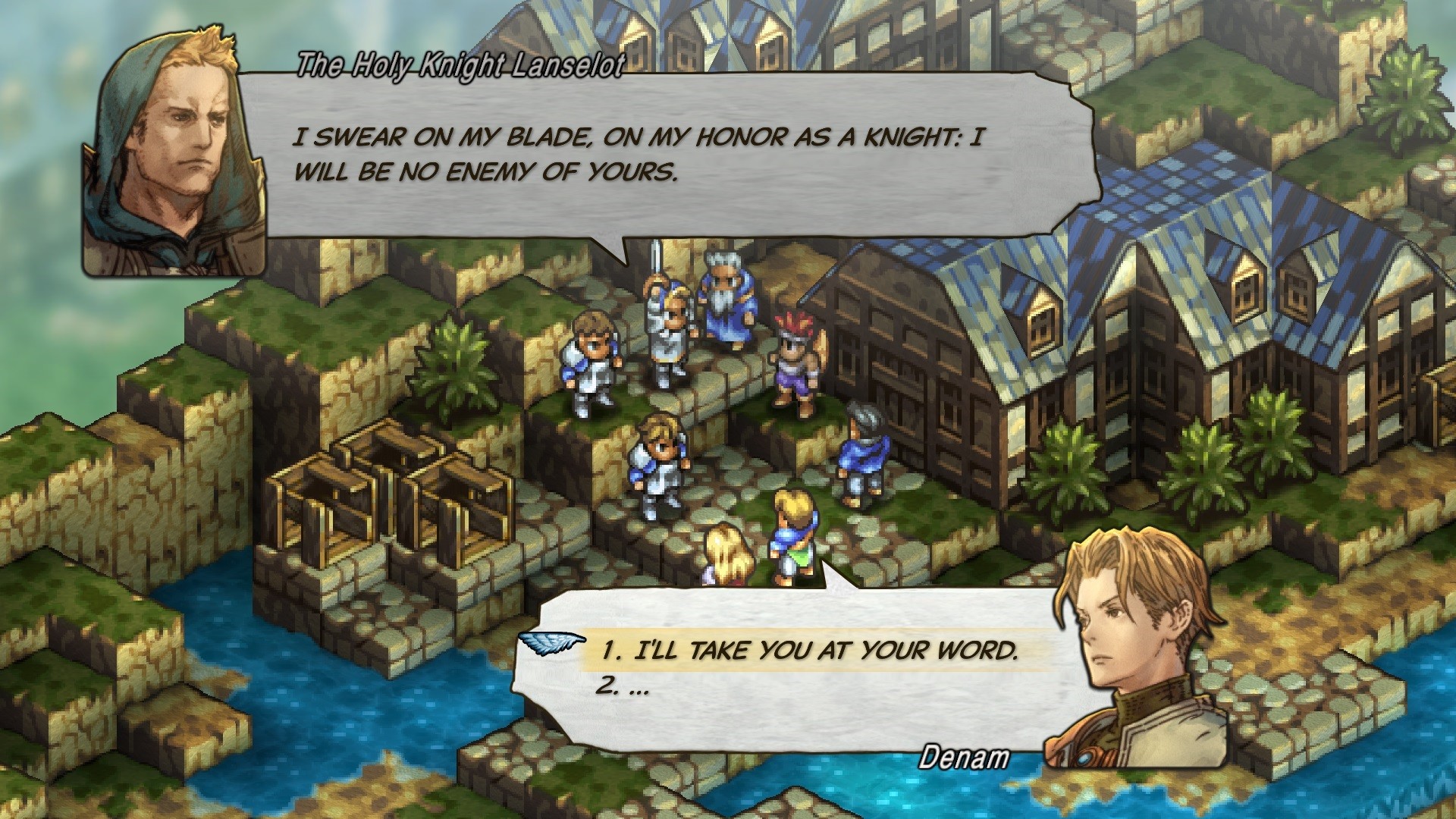
The Valerian Isles have been unsettled since the death of King Dorgalua, whose rule had held their rival peoples together. The Walister, Galgastani and Bakram now contest power, and a local conflict pulls Denam Powell into the wider struggle. His sister Catiua and friend Vyce stand close to him, but their relationships and political loyalties do not always point in the same direction. Denam’s decisions affect how events unfold, producing branching story routes and multiple endings rather than a single fixed sequence. The central question is how to pursue justice and protect the people around him in a war where every faction has its own account of the past. The narrative is presented through a world map linking locations and battles, with conversations and story scenes advancing the conflict between engagements. Character portraits and dialogue establish the participants’ motives, while the campaign’s choices can change which events and allies appear. The setting is a cluster of islands rather than a continuous open landscape: the player follows a strategic route through the conflict, revisiting the map as new destinations and battles become available. The story’s political scale is reinforced by the tactical scale of play, because each confrontation asks the player to commit a particular group of soldiers to a concrete objective.
Battles take place on three-dimensional maps divided into squares, where slopes, elevations, obstacles and unit facing affect how a force can operate. Before deploying, the player can scout an enemy formation to inspect its units, levels, classes and equipment, then select an appropriate party and formation. This information can change preparation: a group facing numerous spellcasters may need different resistances or a quicker approach than one confronting heavy armor. Each unit has its own movement range, influenced by its class and equipment, and height differences determine whether a target can be reached or seen. The player moves individual units around the map and chooses when to attack, use an ability, cast a spell, consume an item or wait. Objectives vary by battle and can require defeating a leader or clearing the opposing force. Movement is therefore a sequence of local decisions: which ground to claim, which allies to keep within reach, and whether to advance before the enemy gains a favorable position. Enemy units assess the terrain and respond to the player’s formation, so a narrow route, elevated firing position or exposed flank can shape the opposing force’s behavior as well as the player’s.
The turn order is governed by the Wait Time system rather than alternating team phases. A unit’s speed, class and equipment affect when it acts, and the battle display shows the sequence so the player can plan around the next allies and enemies. A fast unit may take another turn sooner, while heavier equipment can change how quickly it returns to action. Each character can equip a limited selection of skills, magic and consumable items, making preparation part of combat rather than an afterthought. Weapon range, movement, healing, status effects and elemental attacks offer distinct ways to influence a developing engagement. The eight elements—earth, water, air, fire, lightning, ice, light and darkness—interact with unit affinities and equipment, allowing a character’s element to support or complicate particular matchups. Terrain can strengthen an elemental attack, and equipment can increase resistance or damage. Units can also use finishing moves that consume magic points, giving the player a reason to balance ordinary attacks and special techniques over a battle. The resulting system rewards attention to turn order and position: a powerful ability may be less useful if its user cannot reach a safe location before opponents act.
A distinctive battlefield objective comes from buff cards that appear on the map. A unit can move over a card to claim its effect, which might improve an attribute such as attack or magic. These bonuses are contested: an enemy can collect them too, and the opposing formation may move toward a useful card rather than simply attacking the nearest target. Multiple cards can accumulate on one unit, up to the system’s limit, so a character carrying several bonuses can become a priority to protect or remove. Their presence gives movement a second purpose beyond reaching enemies or objectives. The player must judge whether to divert a unit for a temporary advantage, deny a card to the opponent, or maintain formation. Battle-specific bonus objectives can also grant extra rewards, creating optional tasks alongside the main victory condition. The Chariot Tarot feature allows the player to rewind recent actions during a battle and try a different sequence, which is useful when a move exposes a character or an attack resolves poorly. It does not replace planning: the player still needs to understand turn order and threats, but can test alternatives without restarting the entire encounter. The feature makes tactical experimentation part of the battle flow while keeping the consequences of the final chosen sequence in view.
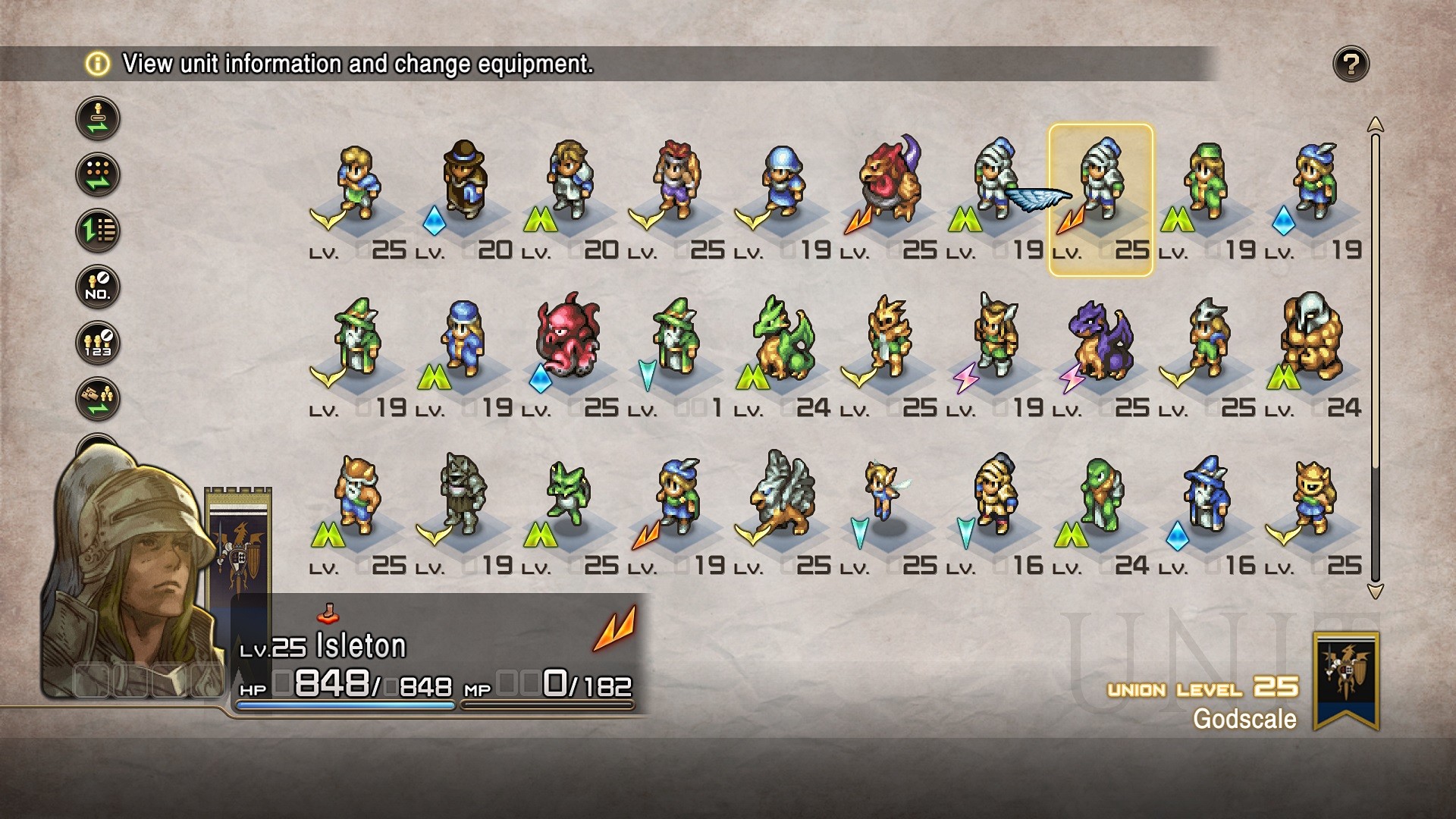
Characters develop as individual units, so experience and levels belong to each soldier rather than being shared across everyone in the same class. The Union Level sets a ceiling for the army and rises as the story advances, keeping training within the campaign’s current progression. At training locations, the player can stage practice battles to build experience; these encounters are separate from random enemy skirmishes on the world map. Classes define a unit’s battlefield role and access to particular skills, weapons and magic, while equipment and learned abilities let the player shape how that role contributes. Charms provide another way to adjust attributes, experience, level or elemental affinity, and can be used when a recruit or existing unit needs to fit a different plan. Between battles, the party can review equipment and arrange skills, spells and items within each unit’s available slots. This makes recruitment and preparation consequential: a new character is not merely added to a roster, but needs a suitable class, gear and place in the deployment plan. When a unit falls in a story battle, a counter gives allies a chance to revive them; if it expires, the character is permanently lost. Training avoids that consequence, while the Chariot’s rewind offers a chance to reconsider a dangerous tactical sequence before committing to its outcome.
The presentation combines detailed three-dimensional terrain with compact pixel-art characters, preserving a clear view of the grid while emphasizing differences in height and map layout. Unit portraits and voiced dialogue give the large cast individual identities during story scenes, and both Japanese and English voice options are available. The soundtrack was rerecorded with live performance, while the battle presentation was adjusted to move more quickly than earlier releases in the series. These elements frame the player’s focus on the battlefield: the camera can show the terrain from an angled view, and unit turns, attack ranges and status information remain visible as the engagement develops. The base game follows Denam’s campaign through the Valerian conflict; it does not require a separate expansion to present that central story. As the narrative opens additional routes, the World Tarot later allows the player to return to key points and revisit decisions while carrying forward recruited units and other progress. Previously cleared battles can be revisited with a level-sync option, helping the army take part in those encounters without relying solely on its current strength. Together, the route system and tactical tools let the player approach the campaign as a connected sequence of political choices, party preparation and turn-based battles.
- Developer
- Square Enix
- Genre
- Tactical role-playing game