

About Sumerian Six
In an alternate World War II, the Enigma Squad—a team of scientist-commandos—sets out to stop former member Hans Kammler from using the occult substance Geiststoff for the Third Reich. Infiltrate guarded sites and combine the squad’s specialized abilities in real-time tactical stealth missions.
Sumerian Six follows the Enigma Squad, a team of scientists turned commandos operating in an alternate-history version of World War II. The team’s former member Hans Kammler has joined the Nazi regime and is using Geiststoff, a mystical substance, in an occult-scientific weapons program. The squad’s missions take it across occupied territory to disrupt Kammler’s plans and confront forces altered by the substance. The setting mixes recognizable wartime locations and events with Sumerian artifacts, conspiracy lore and supernatural threats. Its tone is pulpy and comic-book-like, with the scientists’ distinct personalities and banter set against the scale of the Nazi project. Geiststoff also gives the squad a reason to investigate laboratories and artifacts as well as ordinary fortifications: Kammler’s operation connects supernatural experiments to the military sites they must enter. The story supplies a reason for travelling between bases and for assembling a varied team, while the moment-to-moment play is built around infiltrating those locations, bypassing guards and using the characters’ unusual expertise to reach mission objectives.
The playable team’s defining feature is that its members solve the same tactical problem in different ways. Sid can enter an enemy’s mind and move around while hidden inside the host; his abilities let the squad exploit access that ordinary movement would not provide. His sister Isabelle can swap positions with an enemy, repositioning herself or exposing the target to an ally. Chemist Rosa Reznick applies compounds that can lure guards from posts, daze them, dissolve a body or cause an enemy to explode after a delay. Wojtek’s transformation into a werebear turns a careful stealth approach into direct force, including attacks against groups. The esoteric psychoanalyst Siegfried von Adelsberg uses mentalist techniques, while other squad members bring their own science-rooted powers. The roster is not a group of interchangeable soldiers with different weapons: each ability changes where a character can go, what an enemy can perceive and what combinations the team can arrange.
Missions play out in real time from an isometric view. Guards watch routes and areas of vision, and detection can bring reinforcements and alarms, so the player studies patrols before moving the squad through a compound. Characters can move, hide, attack and use special skills in a shared space; each operative’s limits and powers matter when selecting a route. The tactical command mode pauses the action so the player can issue orders to several squad members and then see them resolve together. This supports coordinated plans such as distracting a sentry, moving another character into position and triggering an ability before nearby enemies can react. It does not turn the campaign into turn-based combat. Time continues normally during execution, and the pause is a planning aid for managing simultaneous actions and timing.
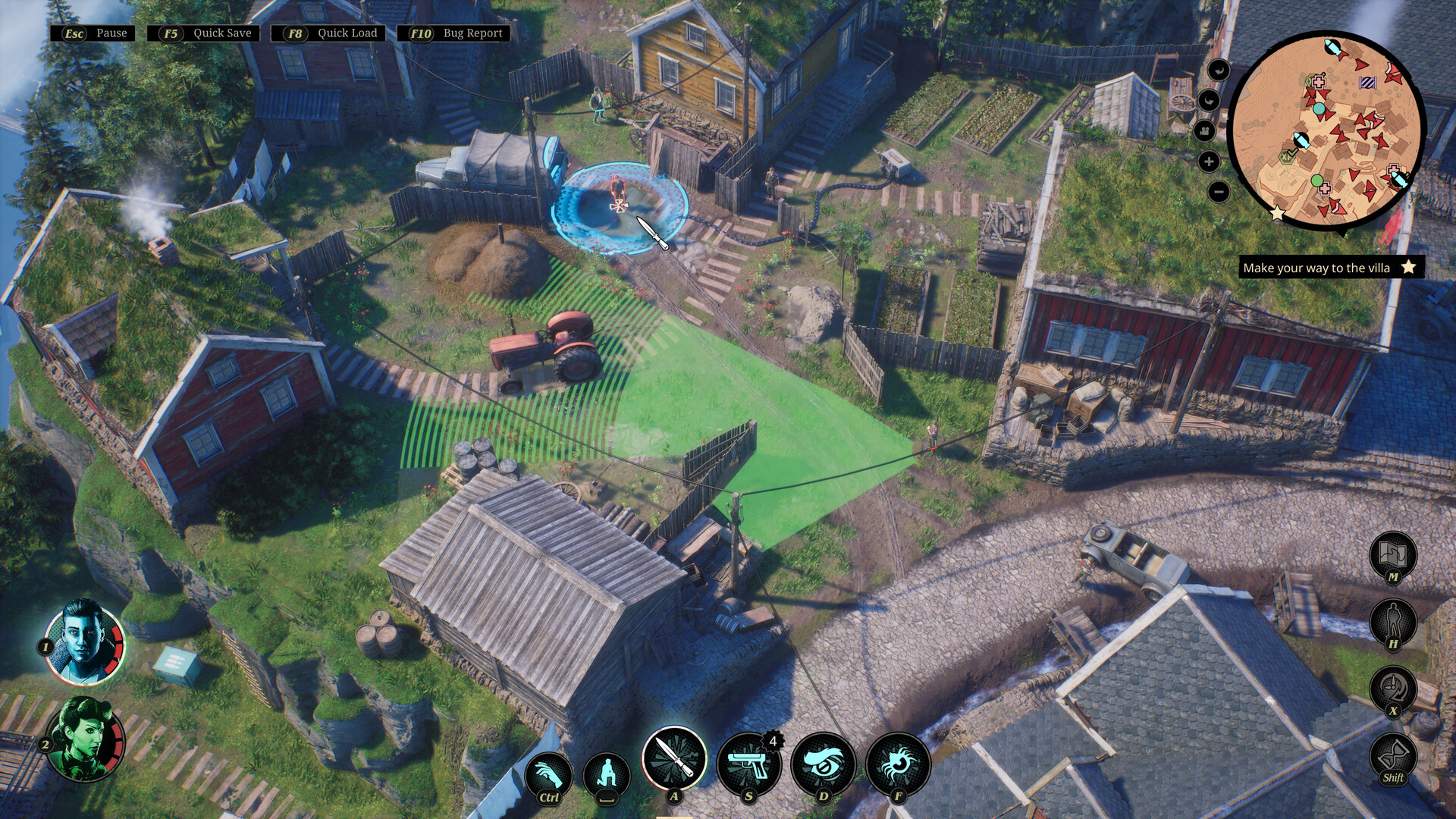
Stealth is a way to shape encounters, but the team’s abilities support several forms of improvisation once a plan begins. A guard can be drawn away from a post, removed quietly, used as cover for Sid’s possession, or swapped into the reach of a stronger ally. Rosa’s delayed chemical effects can create a window for movement or affect nearby enemies, while Wojtek can finish an encounter with a sudden close-range attack. Each action has to be considered in relation to sightlines, patrol paths and the position of other enemies. An ability that solves one problem may create another if its noise or effect alerts witnesses. Chaining powers is the central tactical puzzle: the player learns what a skill does individually, then combines its position, timing and effect with the other operatives’ tools. The game encourages experimentation with those combinations within its authored levels rather than relying on a universal attack that works everywhere.
The levels are bases, castles, laboratories and other occupied sites with routes guarded by sentries and more serious threats. Their spaces are arranged as linked tactical challenges: the player identifies an entry point, reads the surrounding patrol pattern and chooses how the squad can get past it. Some abilities can open routes or reach a different level of the environment, while others let a character cross a dangerous area by using an enemy as an unwitting vehicle. Optional routes and mechanisms reward looking around, and obstacles are designed around enemy placement and the team’s skill set. As the campaign moves between continents and locations, it introduces new environments and adversaries tied to the occult program. The player’s task remains focused on moving through these mission spaces and completing objectives; the game does not ask them to manage a wartime base or conduct a broad strategy campaign between operations.
Progress grows from adding team members and learning their skills. The six scientists become available over the course of the missions, widening the set of solutions the squad can attempt. Individual abilities have upgrades, and the levels include opportunities to find experience boosts that improve those skills. This creates a practical connection between exploration and tactical options: investigating a side route can provide growth, while new powers change the kinds of combinations available in later encounters. There is no single character build that replaces the group’s complementary roles. The player instead learns which abilities can isolate a guard, move an operative, control attention or deal with a cluster of enemies, then chooses how to sequence them. Because the game is real-time, selecting a good team arrangement and deciding when to pause for coordinated orders are both parts of the same progression in player understanding.
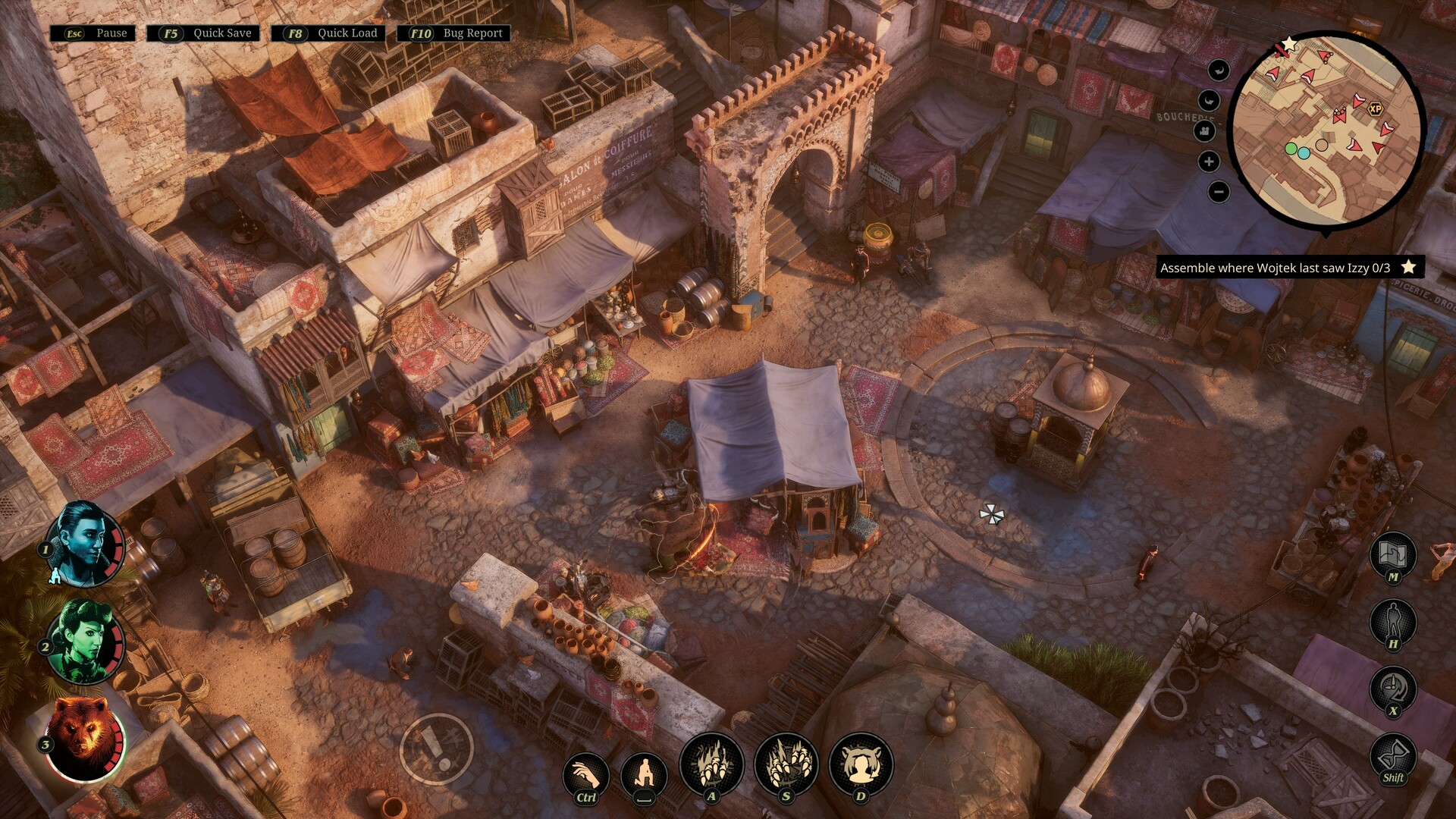
The opposition ranges from ordinary watchmen to heavily armed, mutated and supernaturally charged soldiers. As the Enigma Squad’s actions attract attention, alarms and enemy responses can change the immediate situation, making concealment and timing valuable even when the game offers forceful powers. The more dangerous threats put pressure on the player to combine abilities instead of repeating one technique. A stealth plan can remove a few sentries at a time, while a coordinated burst of actions can address several threats at once. The game’s real-time command pause makes that distinction tangible: the player can stop to consider the whole space, queue a sequence and then watch whether the combined plan works. The possibility of detection gives the encounter a risk that pure puzzle solving would lack, while quick tactical retries let the player revise a route or combination after a failed attempt.
Artificer and publisher Devolver Digital describe the game as a real-time tactical stealth adventure. The Steam edition presents its story through comic-book-style sequences, isometric mission environments and character dialogue that gives the group a deliberately pulpy register. The alternate history uses real-world inspirations as a base for supernatural conspiracies, occult technology and ancient Sumerian artifacts, rather than attempting to reproduce a strictly historical campaign. The soundtrack and visual effects help distinguish ordinary occupied sites from the Nazi experiments and otherworldly forces connected to Geiststoff. Artificer developed the PC game, published by Devolver Digital. The store listing describes a single-player campaign; its missions focus on one player directing the squad through increasingly complex guarded spaces. The abilities also give the cast tactical identity beyond their story roles. Sid’s low-profile movement and possession support access, while Rosa’s chemistry can change how a guard or body affects the surrounding space. Wojtek’s transformation offers a conspicuous answer to clustered threats, and Alastair and Siegfried contribute additional tools to the squad’s plan. Their differences encourage the player to consider who should approach a location and who should remain ready to assist.
- Developer
- Artificer
- Genre
- Real-time tactical stealth