
About Styx: Shards of Darkness
Styx accepts a human officer’s offer to steal an ambassador’s scepter, drawing the goblin thief into a conflict involving Dark Elves, Dwarves and a valuable source of magical power. Across large, vertically arranged environments, he combines stealth, Amber abilities, clones and crafted gadgets to infiltrate, bypass or eliminate those guarding his targets.
Styx: Shards of Darkness sends the goblin thief back into a world of competing powers after his earlier work in Akenash. While operating in Thoben, the City of Thieves, Styx makes a deal with Helledryn, a human officer who wants him to steal an ambassador’s scepter. The object has attracted the attention of several parties, and the job pulls Styx into a wider web of intrigue. Helledryn’s promised reward is Amber, the magical substance that fuels his abilities and holds a personal pull for him. The central objective gives the campaign a clear heist structure: identify a route to the target, penetrate guarded spaces and get out with the object. The story moves among factions whose interests overlap around the scepter and Quartz, another source of magical power, while Styx remains a mercenary thief trying to turn danger into a worthwhile exchange.
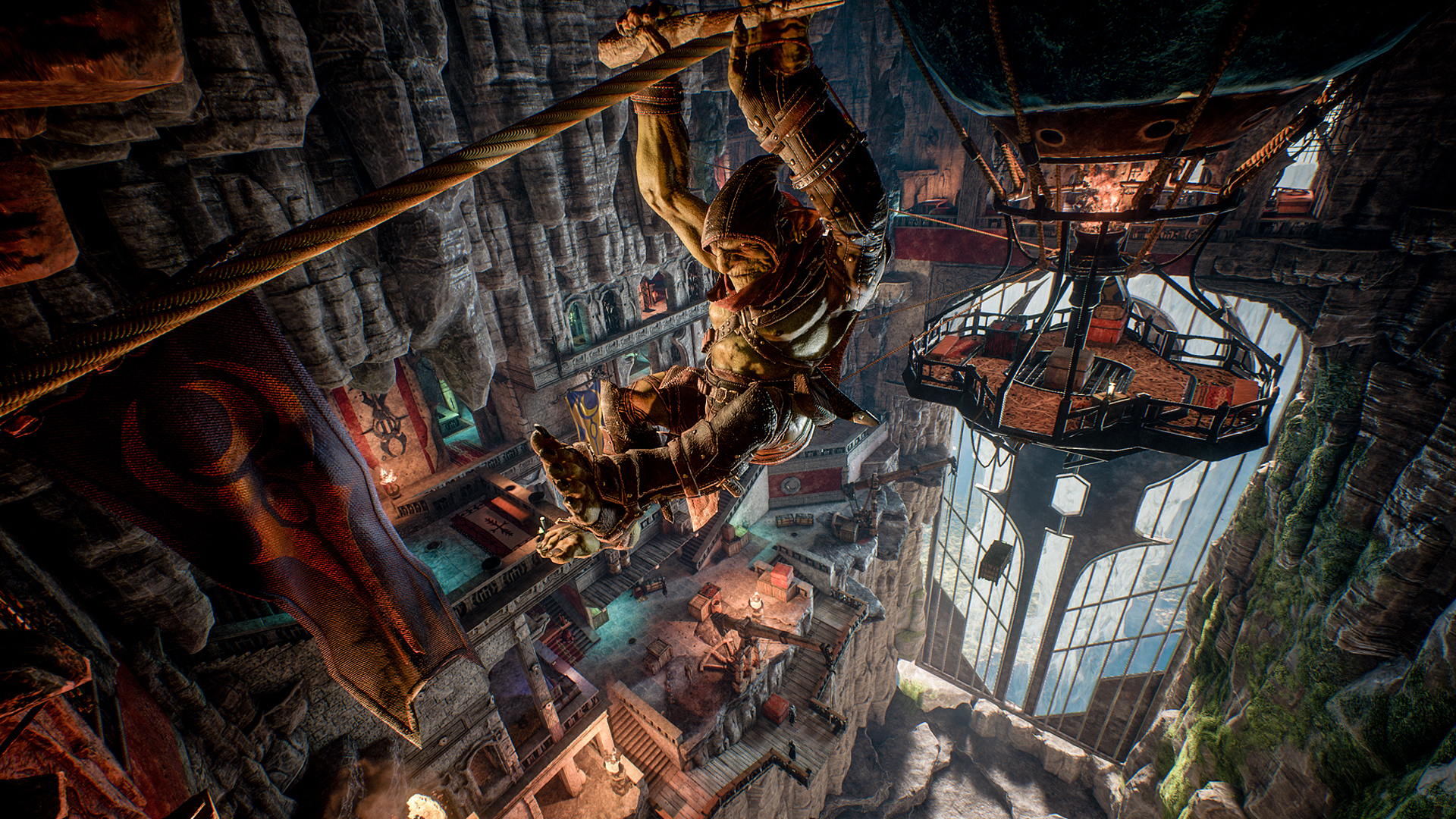
The campaign moves through distinct environments rather than staying inside one fortress. Thoben’s crowded streets, the Port of Korangar, Wildoran’s hunters’ village and the hidden Sanctuary within the Dark Elf city of Korrangar all place different obstacles between Styx and his goals. These are large levels with multiple routes, and the geography includes ground-level shadows as well as walls, ceilings and elevated structures. Styx can climb, swing from ropes and reach attack positions above a patrol, making height part of navigation and concealment. The same space may support different approaches: remain low and avoid a guard circuit, take an overhead route, or use a distraction to cross an exposed section. Optional side missions add objectives beyond the central thefts, and exploration can reveal equipment that expands the available toolkit. The setting’s mix of Elven, Dwarven and human spaces also changes the kinds of threats Styx must anticipate.
Stealth is built around reading a patrol and choosing how much risk to take. Styx can crouch through shadow, observe guards with Amber vision and use the environment to distract or remove threats. A dagger handles some targets, while traps, thrown objects and environmental hazards can create a diversion or a more decisive opening. A chandelier can be released above enemies, and the crossbow can hit a guard, disable one with a non-lethal poison bolt or detach an object from its support. The player can avoid direct confrontation or kill along the route; either way, bodies and noise can expose an infiltration. Foes do not all respond alike: Dark Elves are trained to hunt goblins, and Dwarves can track Styx by scent even while he is invisible. Concealment therefore depends on enemy type, position and timing rather than a single power that makes him universally safe.
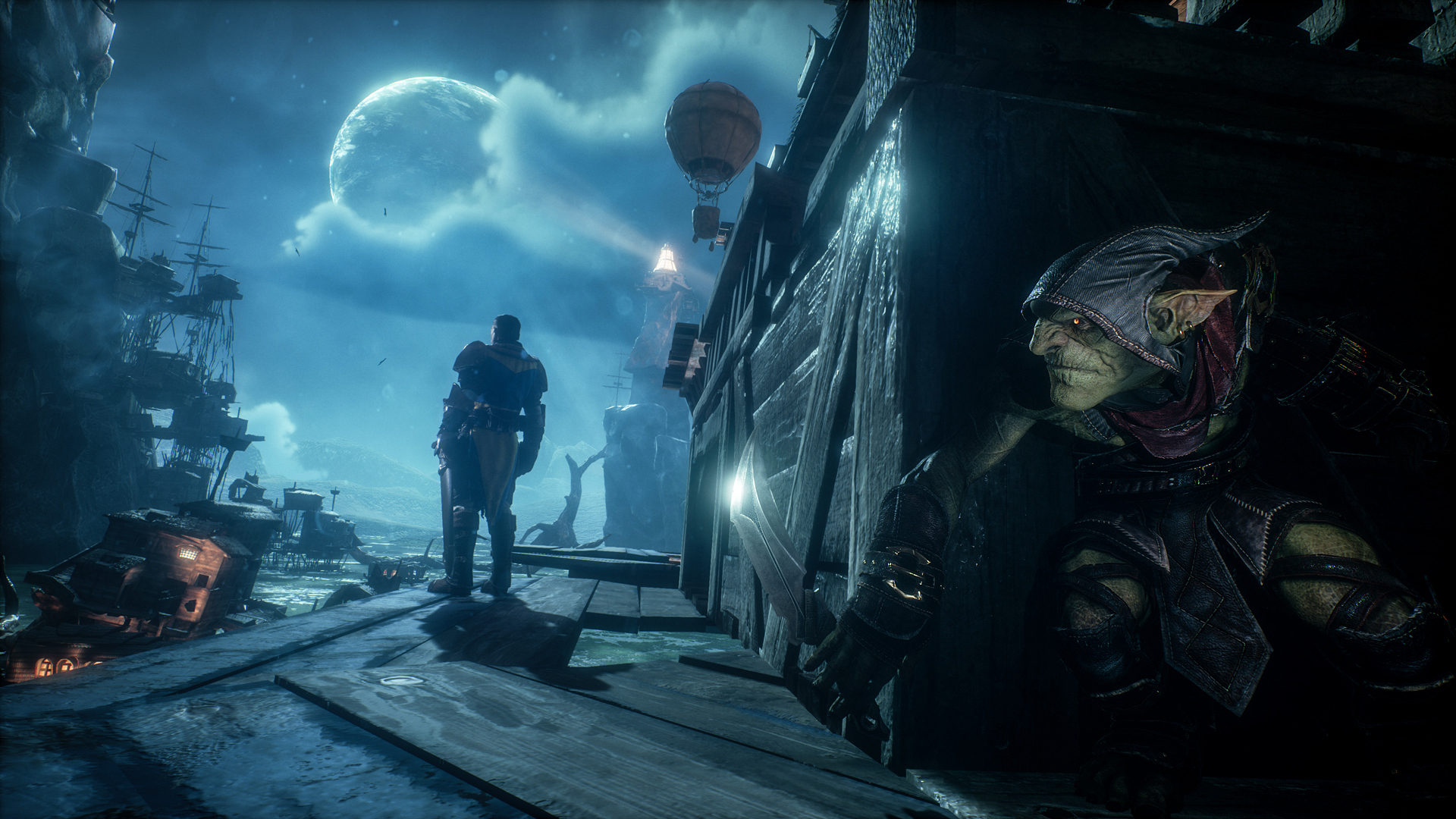
Amber abilities carry forward the series’ signature mix of perception, invisibility and cloning. Amber vision marks useful points of interest and threats, helping Styx inspect a room before committing to a route. Invisibility is temporary and consumes Amber, so it is most useful for crossing a watched gap or escaping a sightline at the right moment. It does not erase every trace: Dwarves can still smell him, and sound can draw attention. A clone can distract an enemy or interact with simple objects, creating space for Styx to move. The upgraded clone system also adds the craftable cocoon, which can be thrown to spawn a double at a distance. Rebirth lets Styx teleport to that clone’s location, sacrificing it in the process; this turns a decoy into a remote foothold or an emergency exit. Each trick creates a tactical opening, but its duration, resource cost and surrounding patrols still shape what can safely follow.
Crafting makes preparation another part of the infiltration loop. Materials found while exploring can be used to create gadgets that distract, disable or kill, and the crossbow offers several types of bolt for different situations. A crafted cocoon supports long-distance cloning, while a player who develops Styx’s crafting skills can unlock an Acid Trap that dissolves a body when an enemy steps on it. That trap matters in situations where a dagger cannot penetrate armor or a body is too heavy to carry away. Finding equipment in a level can enlarge the set of solutions available later in the same mission, so searching a room can have practical consequences beyond collecting a token. The item wheel and the limited nature of consumable tools make selection meaningful: a noise-maker or incapacitating device can clear a route without a kill, while a lethal option may be chosen when a guard blocks the only usable path.
Character growth uses skill trees and mission rewards to tailor Styx’s capabilities. Skill points from story missions, side missions and mission insignias can be spent at a skill table, following linked branches through abilities; the player can also reset points and distribute them differently. Insignias reward mission objectives at Bronze, Silver and Gold tiers, and replaying a mission can earn an insignia that was missed before. Quartz is a separate requirement for unlocking the ultimate ability at the top of each skill tree: the first crystal appears as a story item, while later crystals are found through side missions and must be broken open. This progression connects exploration and optional work to the power ceiling. It also means Styx’s build grows through both broad completion and deliberate searches, while the immediate task remains grounded in the route, guards and tools of the current level.
- Developer
- Cyanide Studio
- Genre
- Stealth action-adventure