
About Styx: Master of Shadows
A goblin thief and assassin climbs the Tower of Akenash to reach the Heart of the World Tree, whose Amber grants extraordinary power. Styx uses stealth, vertical movement, alchemical tools and magical clones to navigate a fortress shared by humans and elves, where each route presents another way to avoid or eliminate its guards.
Styx: Master of Shadows follows Styx, a goblin thief and assassin, through the Tower of Akenash, a fortress built around the World Tree. Humans and elves protect the tree and its golden sap, Amber, while Styx wants to reach its Heart for his own purposes. His immediate path runs through the tower’s security and political structure: he seeks the plans left by the mysteriously absent architect and the key held by Governor Barimen. This is a stealth adventure in a dark fantasy setting, with Styx’s small size and agility shaping how he approaches guarded spaces. The story also ties his pursuit of Amber to the strange power that lets him create a clone of himself, so infiltration and his personal fixation are linked from the outset. The tower’s inhabitants and architecture make the ascent a series of connected security problems rather than a simple march toward a final room.
Akenash is arranged vertically, and its districts signal the power structure Styx has to cross. Sunlit upper levels contain the ruler’s apartments, an embassy, a great library and airship docks; beneath them sit military quarters, prisons and alchemy laboratories around the dome enclosing the World Tree. The deeper route brings Styx closer to the tree and the elves who protect it, while the upper reaches concentrate guards, officials and residents. Movement uses ledges, beams, hiding places and routes above ordinary patrol paths, giving a nimble goblin access to spaces that larger occupants do not use in the same way. The level layouts offer multiple approaches between objectives, so a visible doorway is only one possibility. Looking upward, finding cover and tracing a route around watched ground are part of reading each space. The contrast between the tower’s opulent heights and its oppressive lower reaches also gives the climb a clear physical direction.
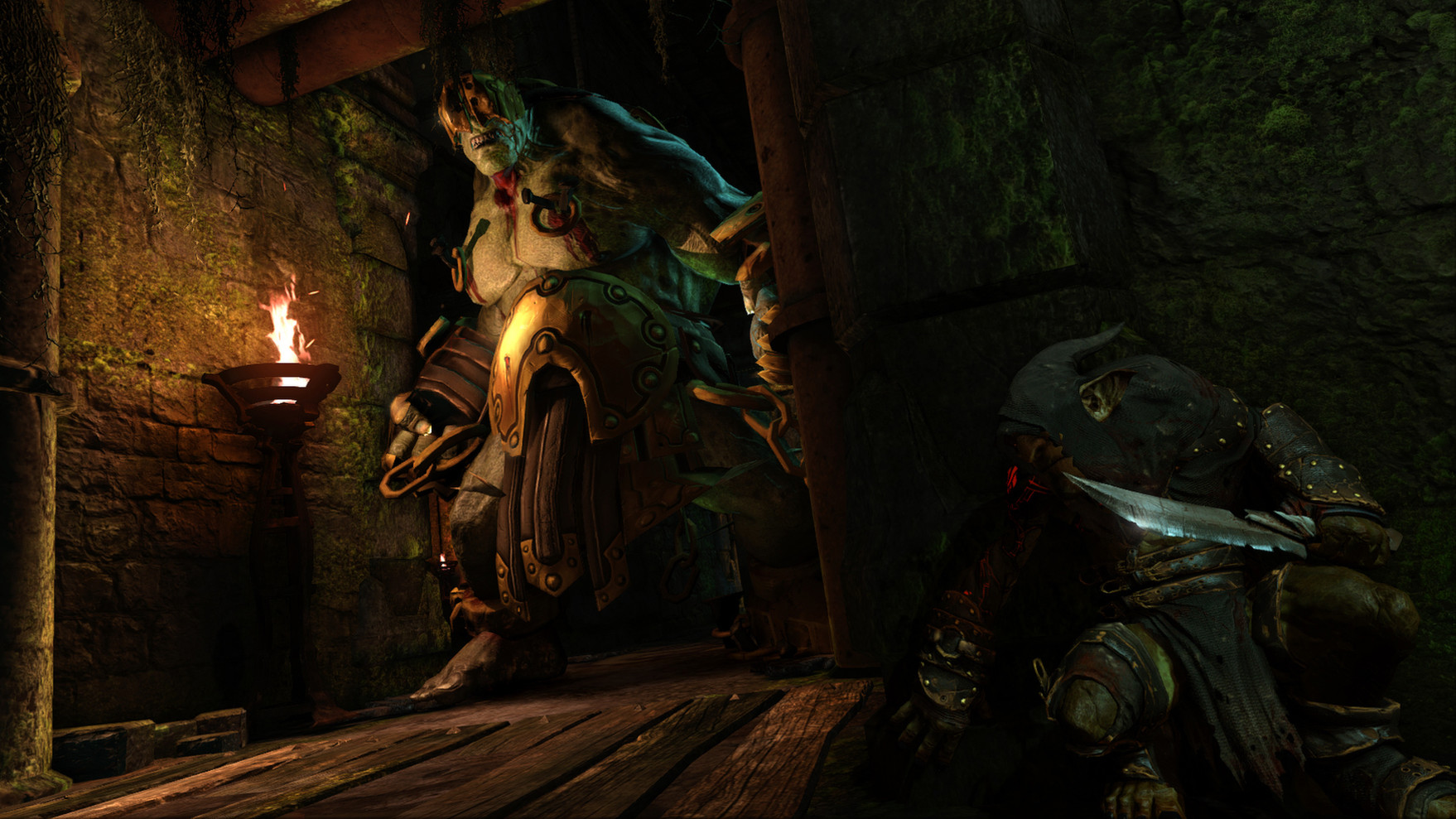
The central play loop is observation followed by controlled movement. Styx can crouch, climb and cross a room by using cover, shadow and elevated paths, then pause to watch patrols before choosing when to move. Guards respond to a detected intruder, and bodies can betray a route if left where others will find them, so a quiet takedown creates a second task: hiding the evidence or disposing of it. The environment contains places to conceal Styx and positions from which he can approach a target, including hanging from an edge or dropping from above when those abilities are unlocked. Direct combat is possible but Styx is an infiltrator rather than a conventional warrior; the tools and skill trees emphasize avoiding notice, separating a target or slipping past a group. The player’s practical work is to manage sightlines and exposure, not to clear every occupied room in an open fight.
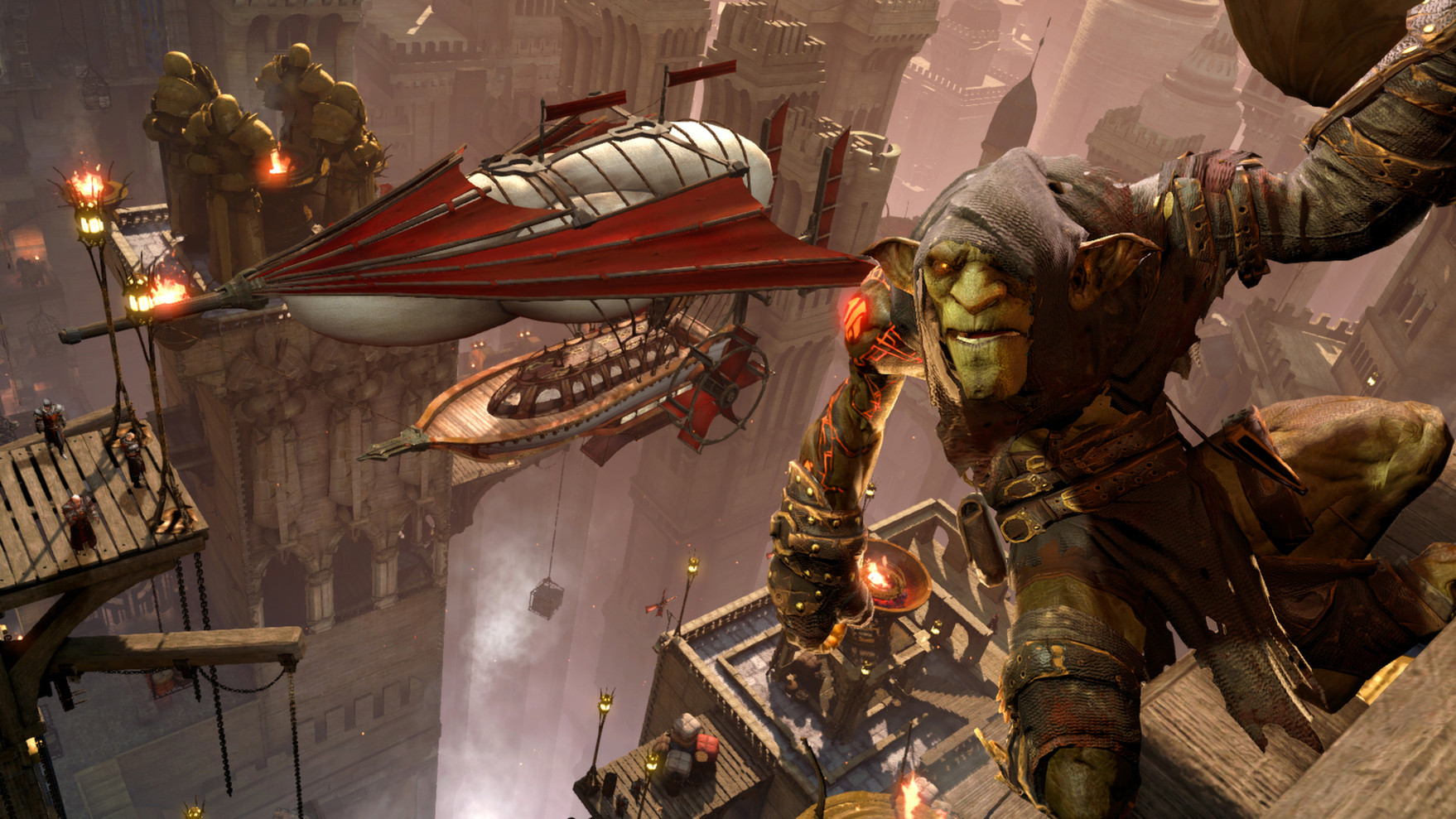
Amber powers perception and short bursts of supernatural concealment. Amber vision helps Styx inspect his surroundings, locate objects and read the disposition of nearby threats; upgrades can extend its reach or duration and reveal more about enemies. Invisibility lets him cross a watched gap or reposition, but it draws on a limited Amber supply, making it a resource to spend at a chosen moment. Its upgrades change how long it lasts, how it can be used while moving and whether remaining still preserves the effect. Cloning adds a separate kind of deception: Styx can create a disposable double to distract a guard, perform simple actions or create an opening elsewhere. Some clone skills add a diversionary attack or a smoke effect, while advanced abilities allow more elaborate use of the duplicate. These powers do not replace route planning; they create brief opportunities inside it, and their resource costs make timing matter.
Progression expands Styx’s options through six skill trees covering stealth, agility, cloning, Amber perception, equipment and assassination. Experience earned during the adventure can be invested in abilities such as quieter movement, better detection awareness, longer-lasting invisibility, additional throwing knives or attacks from cover and ledges. Equipment upgrades affect a limited kit: knives can reach a target at range, health phials provide recovery, Amber phials replenish magical use, and acid can remove a body that cannot safely remain in a passage. The assassination branch supports approaches from different heights and hiding positions, while the equipment branch broadens what Styx can carry or prepare. These improvements make a later infiltration more flexible, but they do not turn the character into a heavily armed fighter. Choosing what to unlock changes the ways a player can handle patrols, cover a mistake or clear a route without drawing wider attention.
The game also includes a Challenge mode that lets players replay a mission to improve its score, separate from continuing the story. Its presence gives the same vertical spaces another use: familiar routes can be approached again with a different emphasis on speed, stealth or the handling of guards. In the story campaign, missions send Styx through distinct parts of Akenash and advance his attempt to reach the World Tree, while exploration can reveal objects and alternate routes along the way. Difficulty settings alter how quickly enemies detect him and how much damage they inflict, allowing the challenge to be adjusted without changing the core tools. A run is therefore shaped by both the mission’s layout and Styx’s current abilities: the player studies patrols, uses the architecture, spends Amber or equipment when needed, and reaches the objective while limiting the evidence left behind.
- Developer
- Cyanide Studio
- Genre
- Stealth action-adventure / infiltration