
About Styx: Blades of Greed
Styx returns to the Iserian Continent in pursuit of Quartz, a powerful resource coveted by the Inquisitors. The goblin’s stealth campaign crosses three large, vertically layered regions, where traversal tools, supernatural abilities and careful route planning help him slip past human, orc and elven forces.
Styx: Blades of Greed is a stealth adventure starring the goblin Styx, whose pursuit of Quartz drives him across the Iserian Continent. This is the third main Styx game and follows a character already familiar with the series’ dark fantasy world; it also brings him into contact with a crew of fellow adventurers during the search. Quartz matters both as a prize in the conflict and as a source connected to Styx’s powers. The Inquisitors are using the material toward their own political ends, while Styx is unusually able to handle it. Styx leads his crew aboard a zeppelin, pursuing a goal for profit and power while the Inquisition sets traps across hostile territory. The story’s central pursuit therefore links the world’s factions to the resources and abilities that shape the player’s progress.
Three open regions give Styx different kinds of terrain to cross. The Wall marks the border of human territory and rises through a vertical fortified settlement; Turquoise Dawn is a lush orc village among towering trees, and Akenash is the ruined elven capital. The structures and vegetation make height a practical part of navigation: rooftops, strongholds, tree platforms and gaps separate routes at different levels. Styx’s changing equipment turns those landmarks into routes rather than scenery. A place that appears sealed off from ground level may be reachable by climbing or grappling from a higher ledge, while a glider can carry him across a gap or down toward a lower entrance.
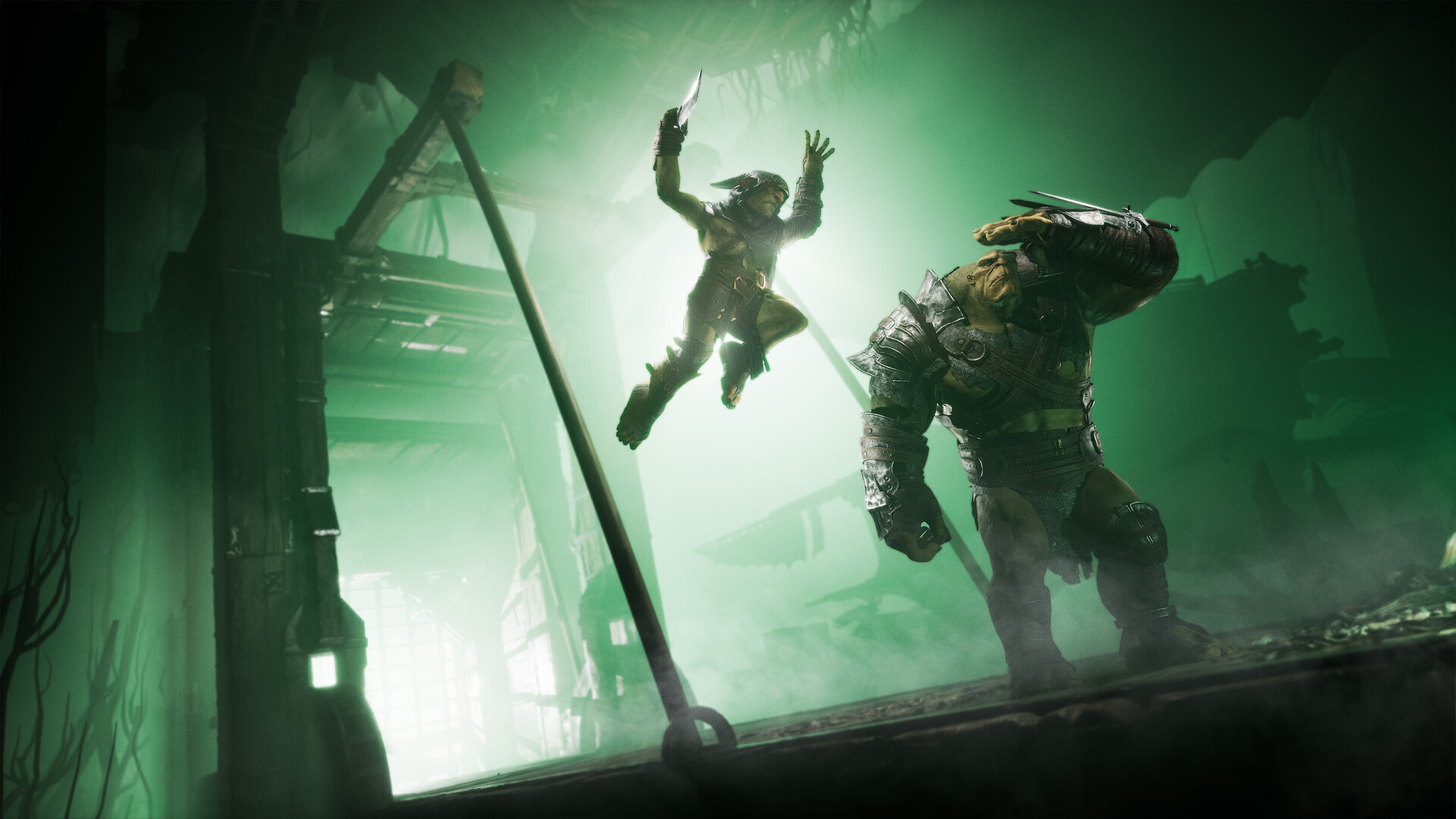
Stealth remains the main way Styx deals with armed opponents. He is a small goblin with limited ability to survive a direct fight, so getting close without detection and moving away when a plan breaks down are central to the loop. Each region offers several paths into guarded places, including elevated ledges and concealed spaces that can change how an approach unfolds. The layout encourages scouting a target, identifying where patrols and sightlines leave openings, and choosing when to cross exposed ground. Open combat can be attempted, but it quickly becomes dangerous when nearby guards hear a fight and join in. The player’s advantage comes from controlling when and where an encounter happens.
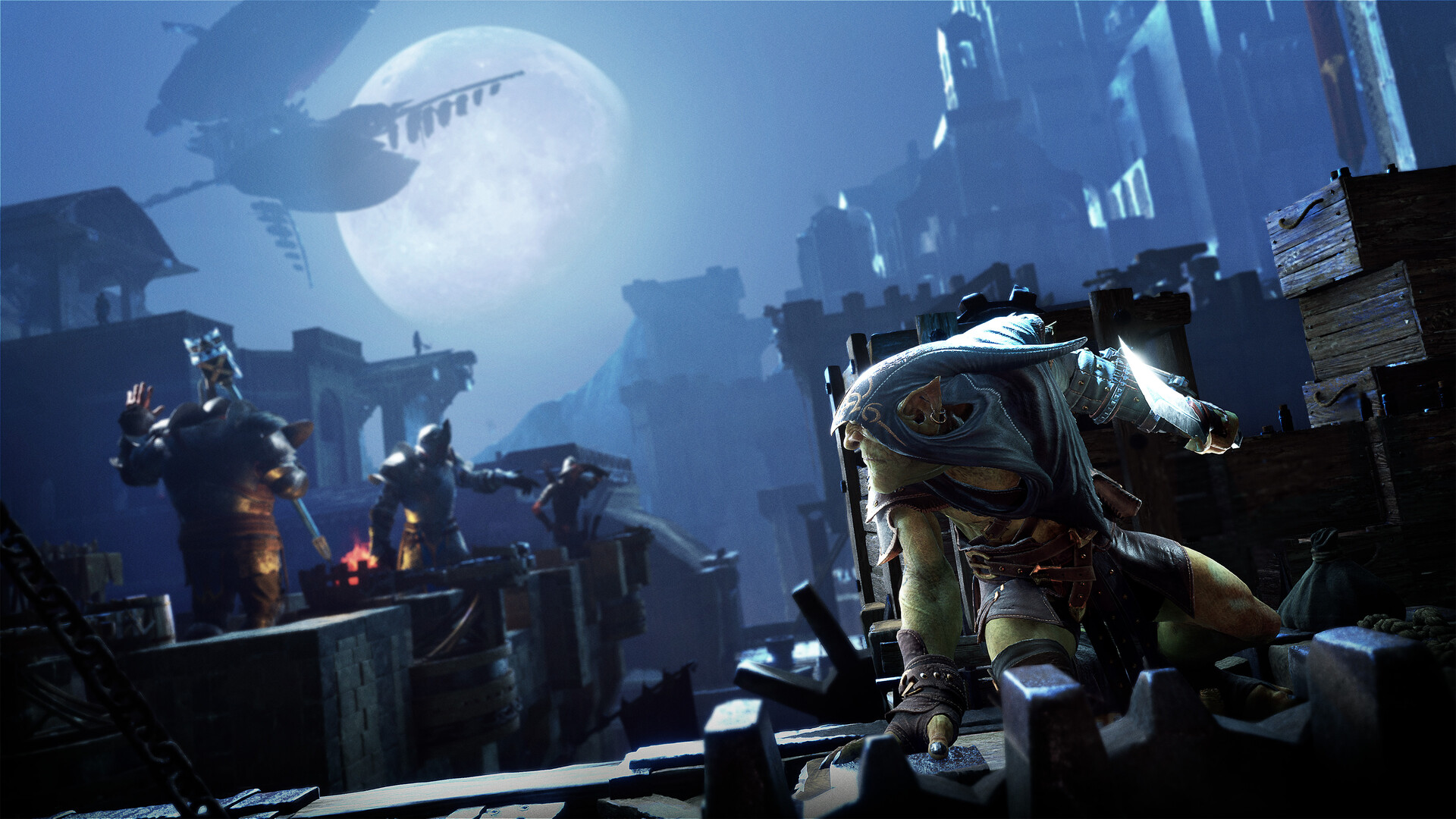
Traversal changes as the campaign unlocks equipment. Styx can grapple toward heights that would otherwise be out of reach and use a glider to travel across gaps or descend from high ground; claws provide another way to scale large surfaces. These tools serve both navigation and infiltration, letting the player enter a guarded structure from a roofline or reach routes that were inaccessible on an earlier visit. Story progression grants traversal abilities at particular moments, while other parts of the regions open as the set of available tools grows. This creates a return-and-discover rhythm: a landmark visible from below may become an entry point only after Styx has gained a suitable way to climb or cross to it.
The upgrade tree keeps the two magical resources distinct: Amber grants familiar cloning and invisibility skills, while Quartz unlocks mind control and time shift. Styx can possess adversaries that would otherwise be too powerful to defeat, slowing time to escape a closing patrol. Clones can be thrown to distract or disrupt an opponent, and basic equipment such as bottles and acid mines adds other ways to influence a patrol. These abilities give the player options for situations where a simple crouched approach is insufficient, but they do not remove the need to read the space: a power can create a momentary opening, while Styx still has to use it to reach cover or continue the infiltration.
Searching the regions is part of the Quartz pursuit, not a separate sightseeing mode. Story objectives send Styx into these large areas to find the material the Inquisitors want, and side quests and collectibles give further reasons to investigate paths away from the most direct route. The spaces contain puzzles and environmental obstacles, so reaching a Quartz objective involves more than crossing a marker on a map. New traversal abilities can make earlier routes worth reconsidering, because a ledge or gap that once blocked the way may become manageable later. The resulting progression alternates between broad navigation and focused stealth problems: travel to a target, study its approaches, then work through the local obstacle while avoiding the forces guarding it.
Three difficulty levels are available alongside a small accessibility menu. The settings include color-vision filters for deuteranopia, protanopia and tritanopia, an option to disable controller vibration, and subtitles that are on by default throughout. That menu provides distinct adjustments for challenge, color presentation, controller feedback and dialogue text. It gives players several practical options before they begin navigating the game’s dark, vertically layered environments.
The campaign also gives Styx an instant quick-save function, which makes short experiments easier to repeat. A guard catching him, a fall from a ledge or a fatal contact with water can end a route quickly, so setting a save after meaningful progress limits how much of the approach must be repeated. From that point, the player can try a different hiding place, wait for a patrol to turn, or test whether an item affects the situation as expected. The save-and-retry rhythm suits the game’s stealth puzzles: failure returns Styx to a recent position, giving the player room to reconsider how to cross the same space.
- Developer
- Cyanide Studio
- Genre
- stealth adventure