
About Stray
Separated from its family, a stray cat falls into a sealed cybercity inhabited by robots and searches for a way back to the surface. With B-12, a small flying drone, the cat crosses dense districts, solves environmental puzzles, meets the city’s residents and avoids threats that make the route home dangerous.
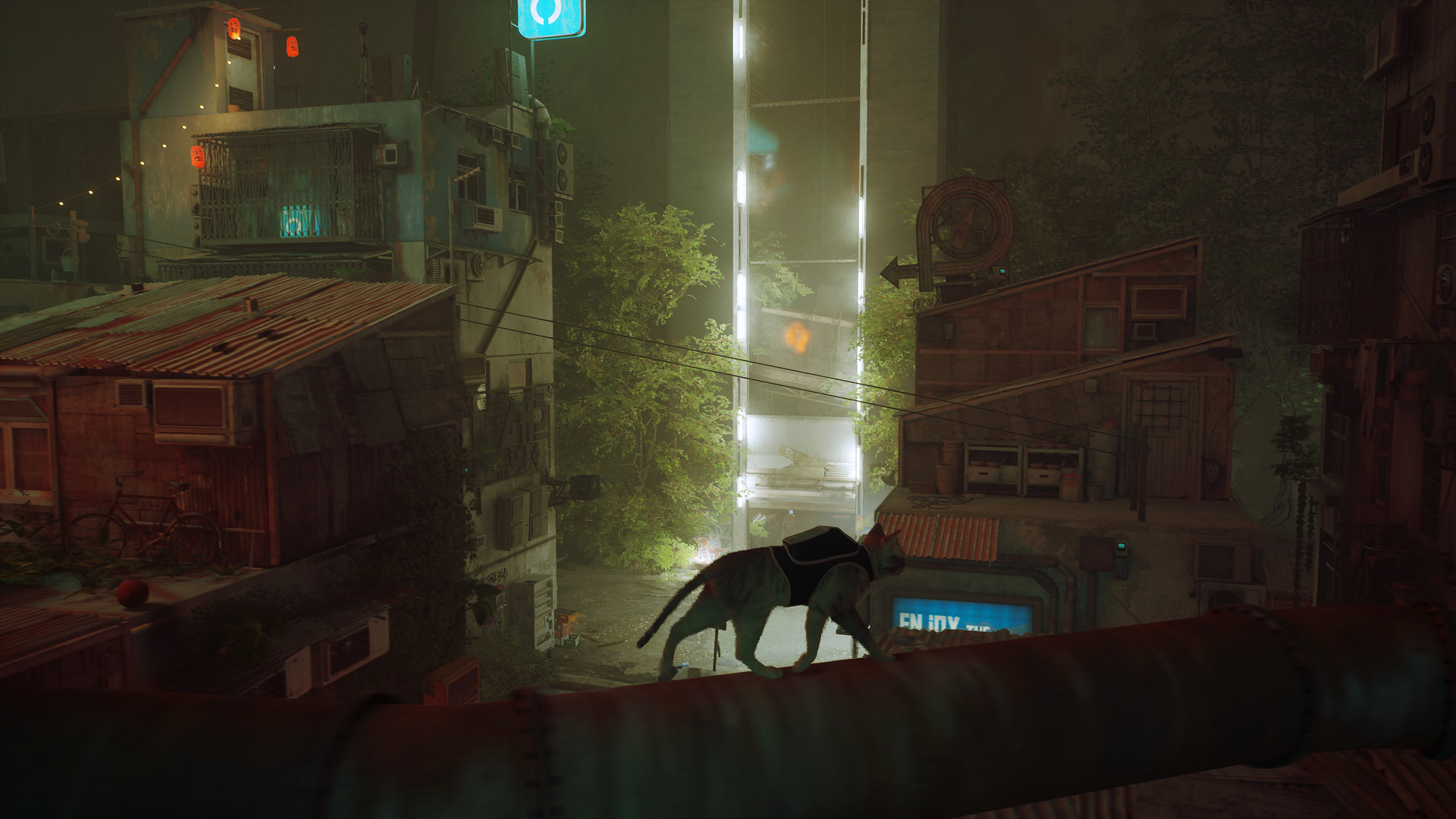
Stray begins with a cat travelling alongside its family before a fall leaves it alone in the depths of a sealed city. The route back towards the surface gives the journey a clear direction, but reaching it means learning how this unfamiliar place works. Neon alleys, pipes, rooftops, apartments and industrial passages form a dense vertical environment rather than a broad open wilderness. The cat moves through spaces at ground level and overhead, finding ledges, beams, air conditioners and other routes that a human-sized character would not use in the same way. Its small scale changes what counts as a path: gaps, shelves and narrow structures become links between streets and buildings. The city’s architecture is both obstacle and navigational language, guiding progress through changing heights and connected interiors.
The residents are robots who have built routines and communities among abandoned human structures. The cat encounters individuals such as Guardian, Momo, Seamus and Clementine as it passes through districts including the Slums and Midtown. Their concerns give local goals a social shape: conversations and requests can send the cat across nearby spaces to find an object, deliver it, or open a route forward. An item may be above a shop, inside an apartment or beyond a passage that first needs to be reached. Small environmental actions also matter: the cat can squeeze through openings, knock objects down, meow to draw attention, scratch surfaces and settle in safe places. These interactions help it communicate without human speech and make exploration part of the story’s everyday texture. The neighborhoods offer pauses between more dangerous routes and introduce the robot society through its ordinary lives.
A small drone called B-12 becomes the cat’s companion after it discovers the device in an abandoned dwelling. B-12 interacts with electronic systems such as doors and computers, translates the robots’ language and carries objects the cat finds. Its light illuminates dark interiors, while stored memories provide fragments that can be revisited to learn more about the city. The partnership divides tasks according to what each character can do: the cat reaches awkward routes and interacts physically with the environment, while B-12 handles technology and communication. The drone can also remind the player of the current objective. These functions make B-12 more than a guide; the companion becomes an active tool for solving access problems and understanding why the city has been left in its present condition. Its later combat ability is limited, so traversal and hiding remain important when danger returns.
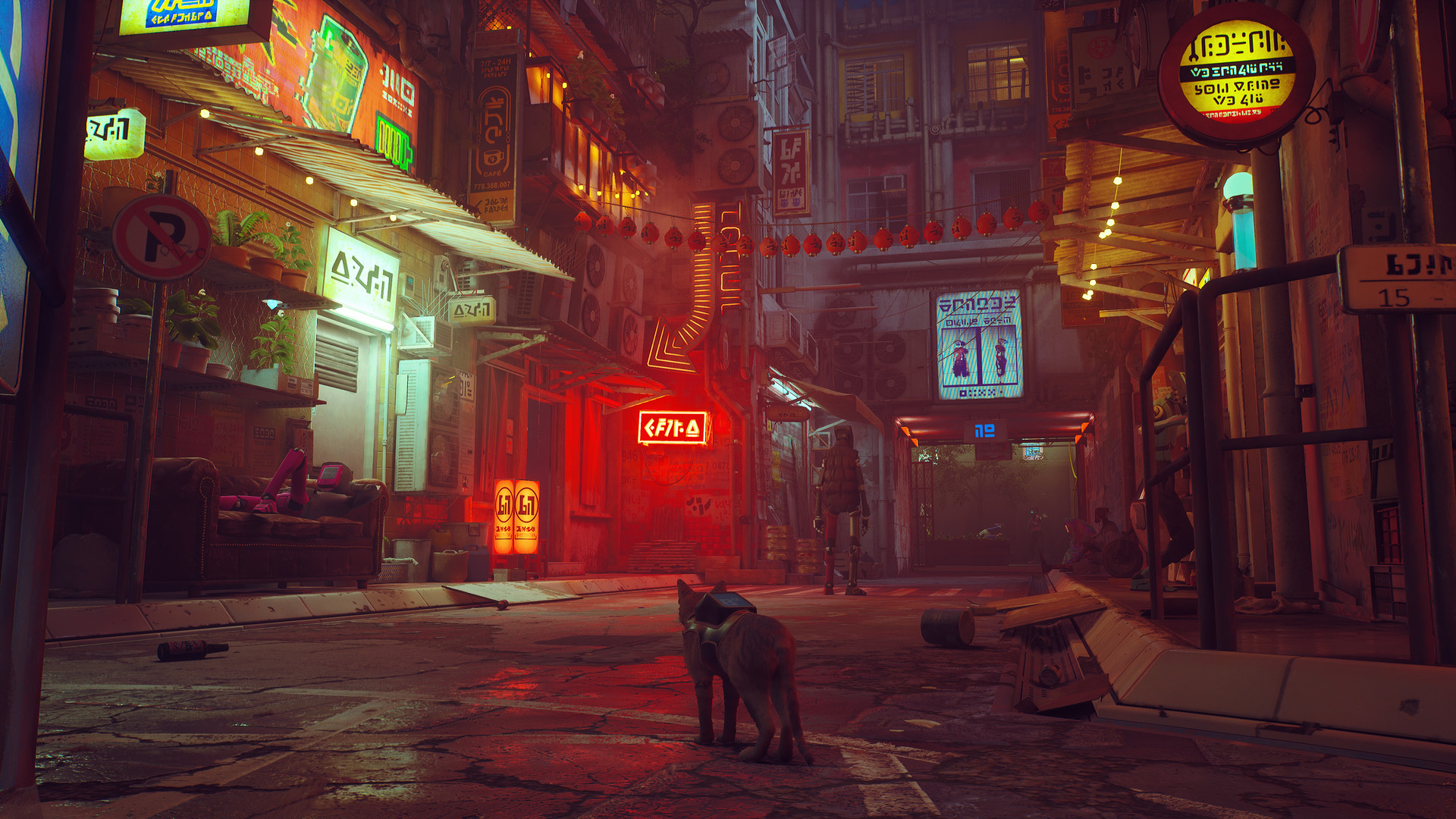
Movement is built around contextual jumps rather than a free-jump button. When a nearby ledge or object can be reached, the game presents an action cue; the player chooses a route among available surfaces and guides the cat along it. Rooftops, pipes, signs, hanging cables and interior furniture combine into climbs that shift between street, building and room scales. Environmental puzzles use that same physical vocabulary. Barrels can be pushed into position as stepping points, moving or tilting structures can bridge a gap, and objects can be shifted to change access or distract a pursuer. The game introduces these ideas in clear situations, then recombines them in more demanding sequences. Signs, lighting and sightlines help indicate routes through crowded spaces, while revisiting familiar lanes makes the city’s layout easier to read as errands connect one resident or location to another.
The city is not uniformly safe. Zurks are small, fast creatures that swarm and cling to the cat, turning some passages into chase routes where speed, direction changes and nearby obstacles matter. The cat can shake off a latch and use the environment to break pursuit, but it remains vulnerable. Later, B-12 gains a limited means of fighting these creatures with a light-based device; it is a specific answer to a specific threat rather than an all-purpose weapon. Other sequences introduce Sentinels, security drones that search for the cat and punish being seen. These encounters ask the player to read patrol paths, use cover and time movement through exposed areas. The shifts between climbing, evasion and stealth change the rhythm of exploration while keeping the cat’s small size and reliance on escape central to the challenge.
Progress follows a directed journey through distinct parts of the Walled City, with more open neighborhood sections giving room to talk, explore and complete requests between tightly guided passages. Conversations, found objects and B-12’s discoveries gradually clarify the history behind the empty human-built world, while the immediate aim remains helping the cat find a route out. The mysteries emerge through surroundings and short encounters rather than a separate exposition system, so details in signs, rooms and robot behavior carry context. Optional activities and small discoveries can deepen a visit to a district, but the central route continues onward through new environments and threats. The story stays focused on the cat’s separation, its developing bond with B-12 and the effort to reach the surface, leaving the larger revelations about the city for the player to encounter during the adventure.
- Developer
- BlueTwelve Studio
- Genre
- Third-person adventure