
About Strangeland
A man wakes in a nightmarish carnival where a golden-haired woman repeatedly falls into a bottomless well and a Dark Thing looms above the park. As the Stranger explores its rooms, he questions its bizarre inhabitants, gathers otherworldly tools and searches for a way to break the cycle.
Strangeland begins with a man waking in a carnival that feels both familiar and impossible. A golden-haired woman cries out before throwing herself into a bottomless well; the fall repeats, and a shadow called the Dark Thing shrieks from the top of a towering roller-coaster. Other characters call the protagonist the Stranger, and his first task is to understand this place well enough to change what keeps happening to the woman. The park’s booths, rides and tents resemble a decayed fairground, but its inhabitants and machinery follow nightmare logic. Jeering ravens, an eyeless scribe, a living furnace and a mismade mermaid offer clues, obstacles and warnings. The game leaves the relationship between the carnival and the waking world as its central mystery. Rather than explaining that connection at the outset, it lets the Stranger move among the park’s strange people and objects, gradually assembling a sense of what the recurring scene means.
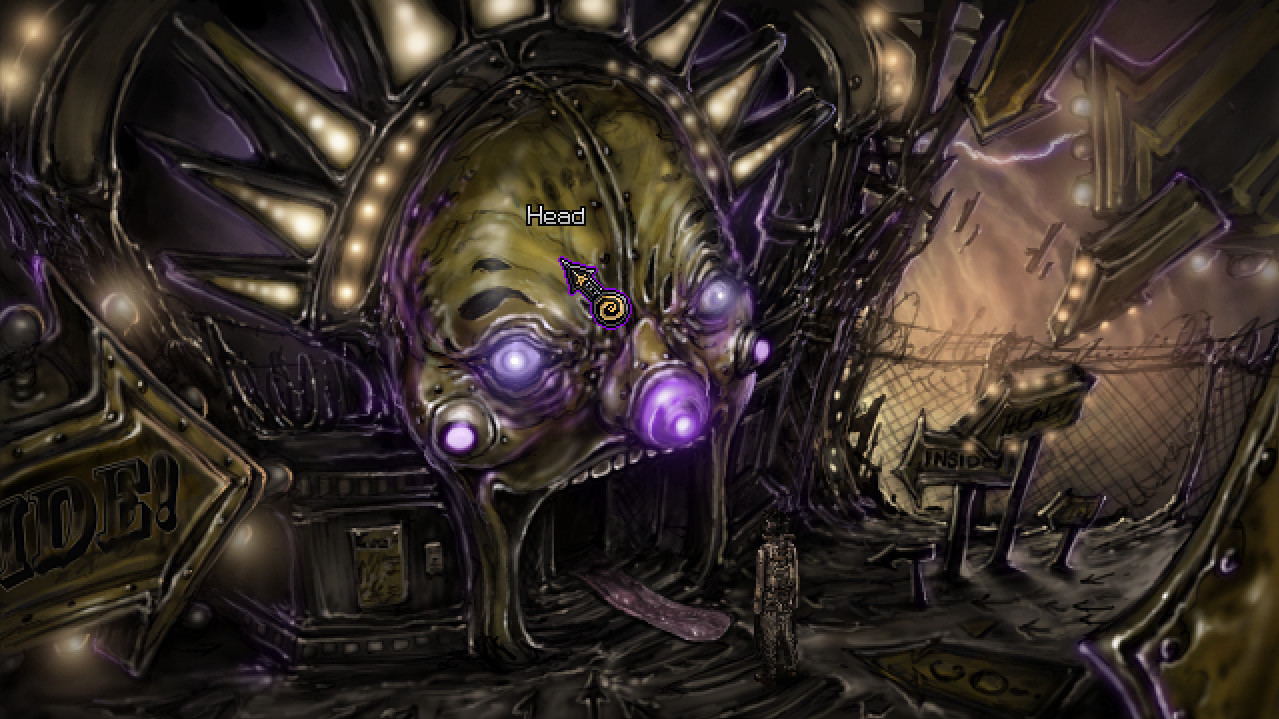
The carnival is built from recognizable pieces made unsettling. There are run-down rides, peeling wagons, dingy game booths, funhouse mirrors and sideshow attractions, but the park also holds monsters and devices that could not belong to an ordinary fair. Its cast includes a telepathic starfish, an animatronic fortune-teller and a trio of masqueraders. Rooms can have variant versions as the carnival grows more twisted, so returning to a familiar route can reveal a changed image or a different condition. This variation makes exploration part of the story’s progression: the player compares the place as it appears now with what earlier encounters established. The Stranger is not charting a broad open world. He moves through a compact network of connected scenes, looking for characters to question, objects to use and clues that make a blocked path intelligible. The park’s distorted geography keeps its real-world references uncertain without making each screen an unrelated puzzle room.
As a point-and-click adventure, Strangeland asks the player to inspect the scene, collect tools, talk with inhabitants and apply what has been learned to an obstacle. The useful answer may be an inventory combination, a piece of wordplay or a visual detail hidden in the environment. Puzzles support different approaches: a player can win a carnival game through sharpshooting or electrical engineering, while a prophet’s riddle can be untangled through wordplay or visual clues scattered through the environment. The point is not to choose a permanent character build. It is to understand what a particular obstacle is asking and decide which evidence matters. The game also includes an optional in-character hint system for when a clue remains elusive. Its structure leaves room to explore and try an approach without the traditional adventure-game traps of irreversible dead ends or fatal mistakes. When a location contains several possible interactions, the player can inspect objects for descriptions before committing to a solution, then use the inventory to try parts against the relevant mechanism. The carnival game, for example, can be approached through either marksmanship or improvised electrical engineering.
Tools and allies are tied to the carnival’s own grotesque logic. The player can forge a blade from iron taken from a ravenous hound and refine it with wrath and grief, or persuade a ten-legged teratoma to surrender an eye. A giant cicada can carry the Stranger into the abyss. These are not presented as ordinary crafting recipes or a general equipment tree; each object or creature belongs to a specific problem in the park. Death also has a different role here than in a conventional horror game: the Stranger’s immortality can be used to gain an advantage over foes. Encounters therefore connect action-like imagery to puzzle reasoning, asking what a tool, an ally or an unusual property can do in this setting. The world also stages a confrontation with a vast crab made of black lightning. These set pieces make the carnival’s threats part of its puzzle language, while the game’s central mystery remains open as the Stranger searches for a way to reach the Dark Thing. The optional hint system keeps help within the fairground fiction, allowing the Stranger to seek a clue without leaving the story.
The people and creatures in Strangeland each carry a different kind of clue. The ravens jeer, the eyeless scribe writes, the living furnace and mermaid point toward problems that require more than searching for a matching key. Their dialogue can be strange or indirect, so the player has to weigh a character’s words against objects and changes in the surroundings. Some puzzles are variations on familiar inventory use, while others hinge on a code, a machine or a detail noticed across multiple rooms. Several obstacles allow different solutions, and these choices can alter the route through a challenge and contribute to different endings. The story does not reduce every character to a clue dispenser: the developer frames the carnival as a way of exploring loss, loneliness, self-doubt and redemption through a particular mindscape. Understanding the park’s inhabitants and working out what their odd requests have to do with the Stranger’s situation are part of the same task. The shifting rooms make the fairground less reliable as a map: familiar attractions may change as the Stranger returns, so earlier observations must be tested again.
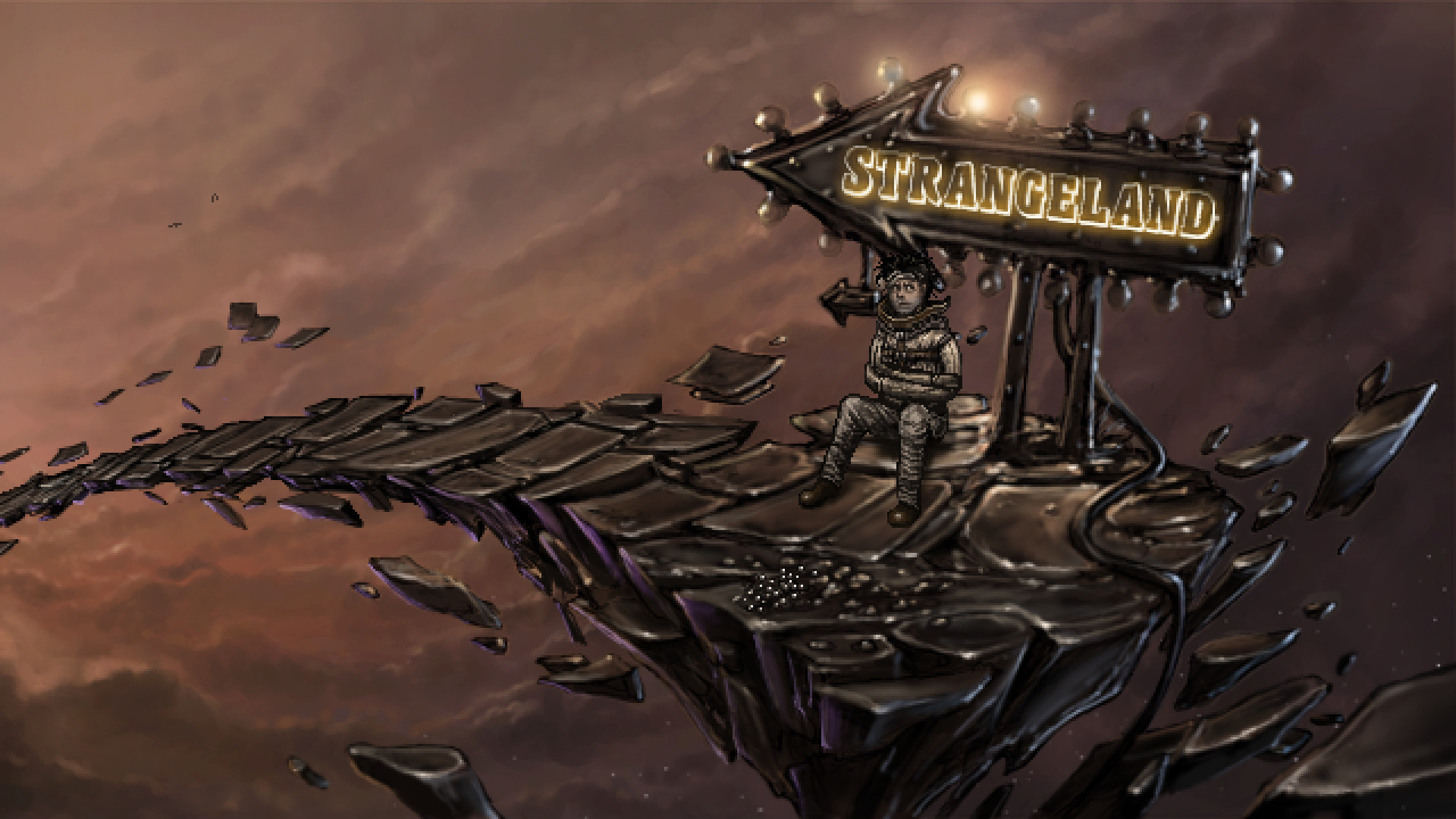
Strangeland’s pixel art works at 640 by 360, twice the resolution used for Primordia. The added space supports its detailed carnival rooms, expressive monster designs and altered versions of familiar locations, while the palette and composition keep the world dreamlike rather than realistic. Full voice acting and hours of original music give the characters distinct presence, from the park’s jeers and warnings to quieter exchanges that complicate the horror. The game also offers developer commentary and an annotation mode that explains references on screen; these are optional extras around the main adventure. The park has dozens of rooms and an optional, in-character hint system, alongside replay value from different puzzle solutions and endings. Those presentation choices support a story that can be read as both a nightmare mystery and a personal inward journey, without turning the scenes into straightforward exposition. Movement follows linked carnival scenes and their changing entrances, keeping attention on observation and choice rather than reflexes.
On Steam, Strangeland is a single-player adventure by Wormwood Studios and publisher Wadjet Eye Games. The listed release is the complete game, with full English audio and a set of subtitle languages; the store lists Windows, macOS and SteamOS/Linux requirements. The complete story runs roughly five hours, but the important structure is how each room adds a new view of the carnival or a new way to approach a problem. The Stranger gathers tools, listens to its inhabitants, experiments with different solutions and follows the path toward the Dark Thing. The repeated fall at the well keeps the opening question present while the park’s other mysteries widen around it. This is an adventure about moving through a hostile symbolic place, not about mapping its secrets in advance. A room may be a sideshow, a machine, a riddle or a changed version of somewhere already visited; each gives the player another piece to interpret. The Steam edition has English voice acting and subtitles in English, French, German, Hungarian, Turkish and Korean. Its soundtrack is separately listed as an optional purchase; developer commentary and annotations are features of the adventure itself.
- Developer
- Wormwood Studios
- Genre
- Point-and-click psychological horror adventure