
About Stranded Deep
After a plane crash leaves a survivor alone in the Pacific, Stranded Deep makes the ocean an obstacle and a route forward. Search islands and wrecks for supplies, balance health, hunger, thirst and sun exposure, then turn gathered materials into tools, shelter, fresh water and a raft capable of carrying the next expedition.
Stranded Deep begins in the aftermath of a mysterious plane crash, with the player stranded among islands in the Pacific and no means to call for help. The opening situation is deliberately small: an emergency raft, a few supplies and a nearby shore give the survivor somewhere to begin, but the horizon is filled with other islands, wrecks and open water. The game is a first-person survival sandbox rather than a character-driven campaign, so the continuing objective comes from staying alive, making equipment and reaching farther parts of a procedurally generated world. Each island becomes a temporary foothold between stretches of ocean.
The survival watch tracks health, hunger, thirst and sunstroke. Those measures make exposure and injury part of planning a trip, not just a consequence after the fact. Water is a recurring problem because seawater cannot be drunk safely, while sun exposure can become a threat during long periods outdoors. The player can gather coconuts for water and food, but repeated reliance on them has a cost; a Water Still provides a renewable way to produce drinkable water from leaves and rainfall. Keeping it supplied and carrying enough water for a crossing turns a basic need into a small chain of work: find materials, craft the still, tend it and plan what to take when leaving camp.
Food comes from several activities, each with its own demands. The player can hunt animals, fish, trap creatures and harvest plants, then cook food over a fire. That requires tools and time as well as ingredients, and an injury or poisonous animal can make a meal less urgent than treatment. The watch helps flag physical problems, including poisoning, broken bones and bleeding; the game provides ways to cure or bandage these conditions. Preparing food and water at a shelter therefore helps stabilize a routine, while exploring for supplies can disrupt it through hunger, thirst, sunstroke or encounters in the water.
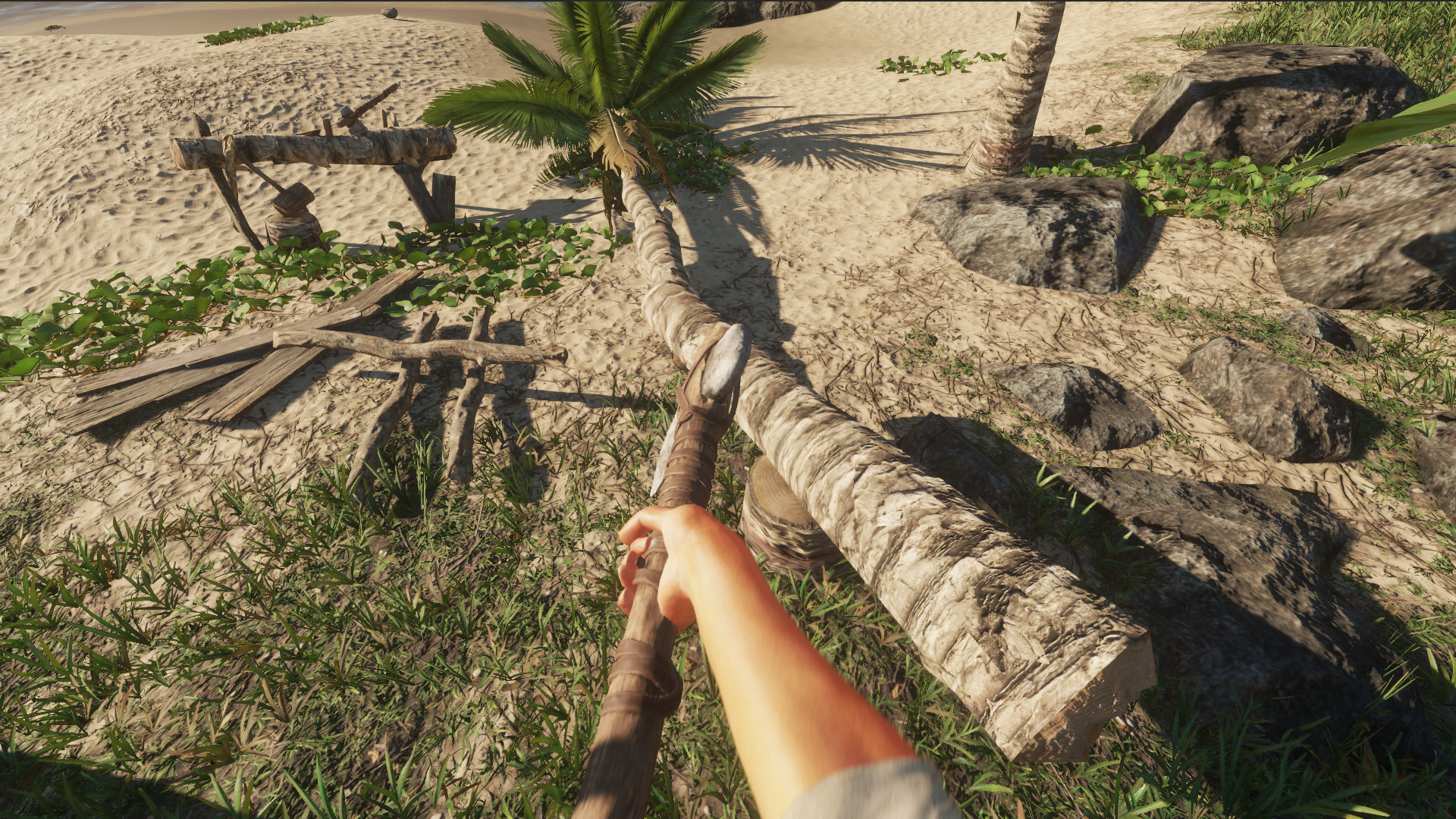
Crafting is organized around the materials near the player as well as those carried in the inventory. Sticks, rocks, lashings and other found objects can become basic tools, weapons, shelter pieces and useful survival equipment. The player makes items through a crafting menu or quick selection wheel, while more involved buildings call for the right tool and need to be placed piece by piece. Gathering and crafting also feed a skill system: harvesting, craftsmanship, cooking, physical activity and hunting can improve over time, with skills increasing efficiency or opening additional crafting combinations. The result is gradual capability rather than a single jump from stranded to self-sufficient. Ingredients can come from both the inventory and items lying nearby, so the crafting area is defined by what the survivor has collected around them as well as what they carry.
A raft changes the scale of exploration. The starting life raft is useful for reaching shore, but a constructed craft can be tailored with a sail, rudder, storage, canopy, anchor or motor as parts become available. Bringing it ashore, keeping it from drifting away and loading it for a trip are practical parts of the journey. A better raft creates access to distant islands and shipwrecks, where useful supplies may be found underwater or in abandoned shelters. Diving adds its own risk: the player must watch for dangerous sea creatures and avoid running out of breath while scavenging. Returning with resources can then expand a base or prepare another voyage.
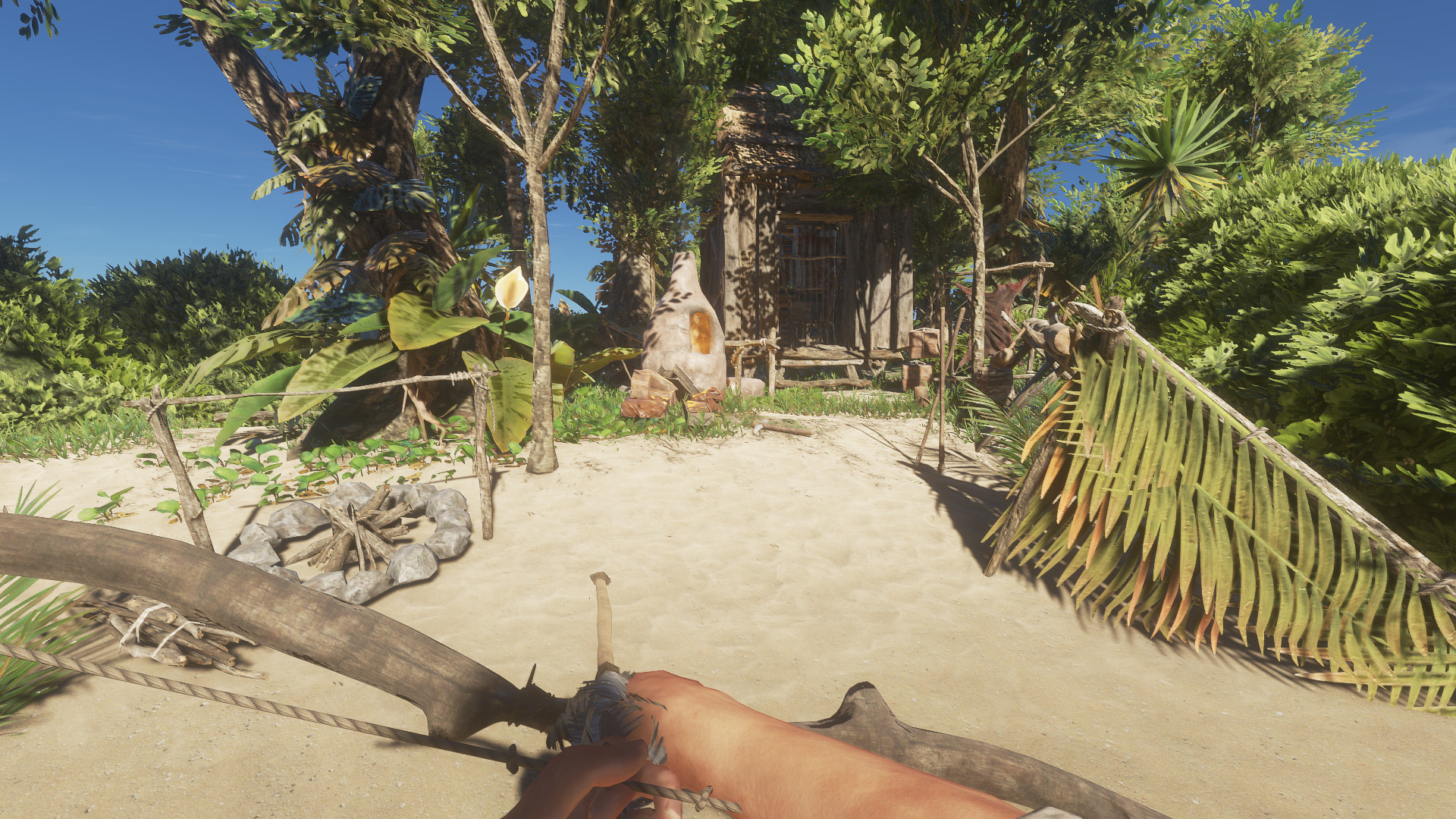
Settling on an island gives gathered materials a longer purpose. Construction ranges from a palm-frond shelter to more substantial homes built from available pieces, and containers let the player keep supplies for another expedition. Farms add a recurring system of water management and plant growth, so maintaining them can provide crops over time. Crafted furniture and decorations, along with objects recovered during journeys, can furnish a settlement. The base therefore links day-to-day survival with longer projects: prepare resources, maintain food production and decide when to sail out again.
A longer-range goal is to escape the Pacific by completing a set of objectives and facing three major creatures that rule its waters. Defeating these bosses provides trophies and important rewards, while shipwrecks, abandoned shelters, rare sea life and distant islands continue to offer reasons to travel. This objective gives the sandbox a possible direction without turning each crossing into part of a fixed story sequence. Players can keep building and exploring after establishing a routine, or pursue the challenges connected to leaving the island chain.
The Steam release supports solo play as well as online and split-screen co-operative modes, so survival can be shared across the same island world. Its editor also lets players create custom islands by shaping terrain and placing trees, rocks and creatures, then share those environments with friends. These options extend the central loop in different ways: co-op adds another survivor to the work of gathering and traveling, while the editor changes the land available to explore.
- Developer
- Beam Team Games
- Genre
- First-person open-world survival adventure