
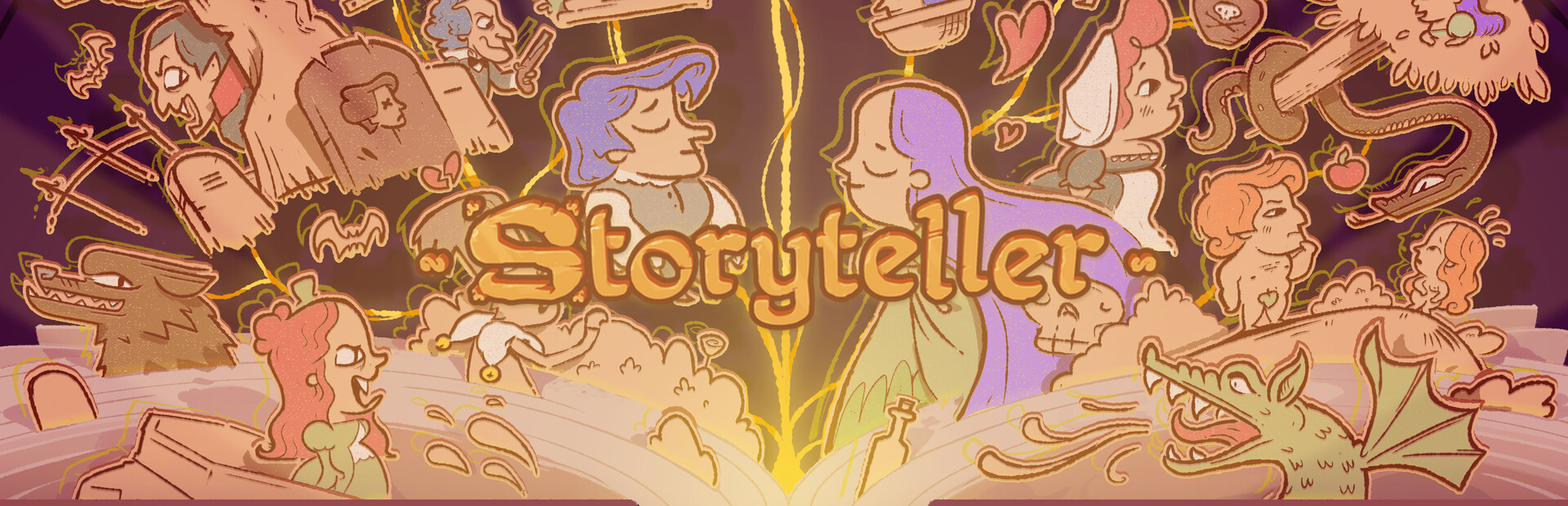
About Storyteller
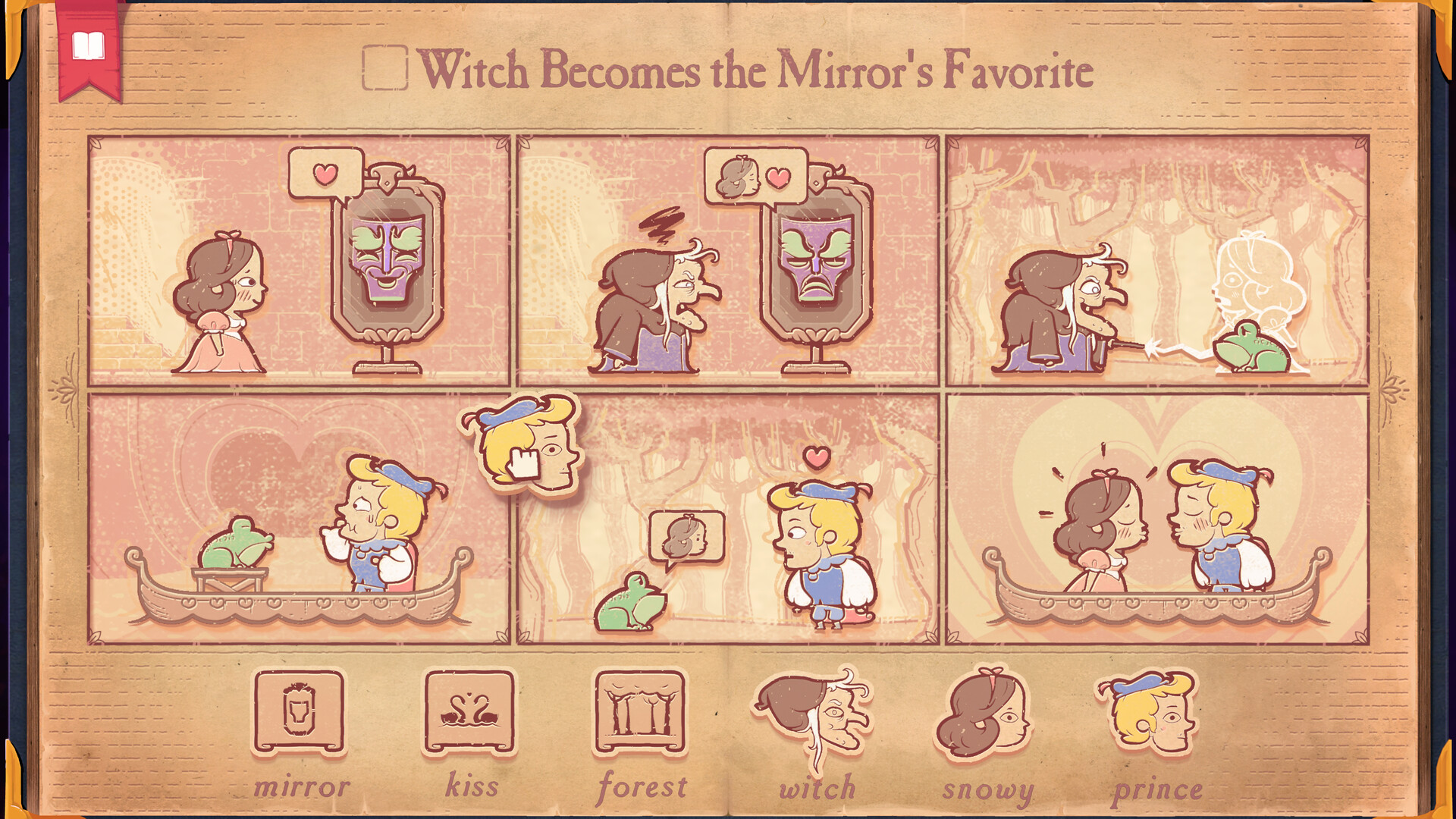
Storyteller gives the player a title, blank comic panels, settings and a cast of characters. Dragging those pieces into place creates a short tale whose relationships and events must satisfy the title. A change to an earlier panel can alter what someone feels or does later, turning love, jealousy, betrayal and monsters into the rules of a puzzle.
Storyteller opens a storybook at a blank sequence of comic panels and asks for a particular tale. The heading might call for love, betrayal or a ghostly turn, but the player is not given a finished plot to trace. Instead, there are characters and places to arrange until the little scenes make the requested idea happen. This is not the biography of one hero moving through a fixed fictional country. Each puzzle can cast familiar figures in a new set of relationships. A lover in one arrangement may become a mourner in another; a villain or a monster changes a page by entering it at the right point. The setting matters because it gives those people a place to meet, part or act. The title tells the player what the completed narrative should express, while the available pieces decide which routes are possible. The gap between that instruction and a working comic is the game. Making a story of jealousy is not as simple as placing two people next to each other with an unhappy expression. Something needs to happen that gives a character a reason to feel it, and the panels before and after must support that change.
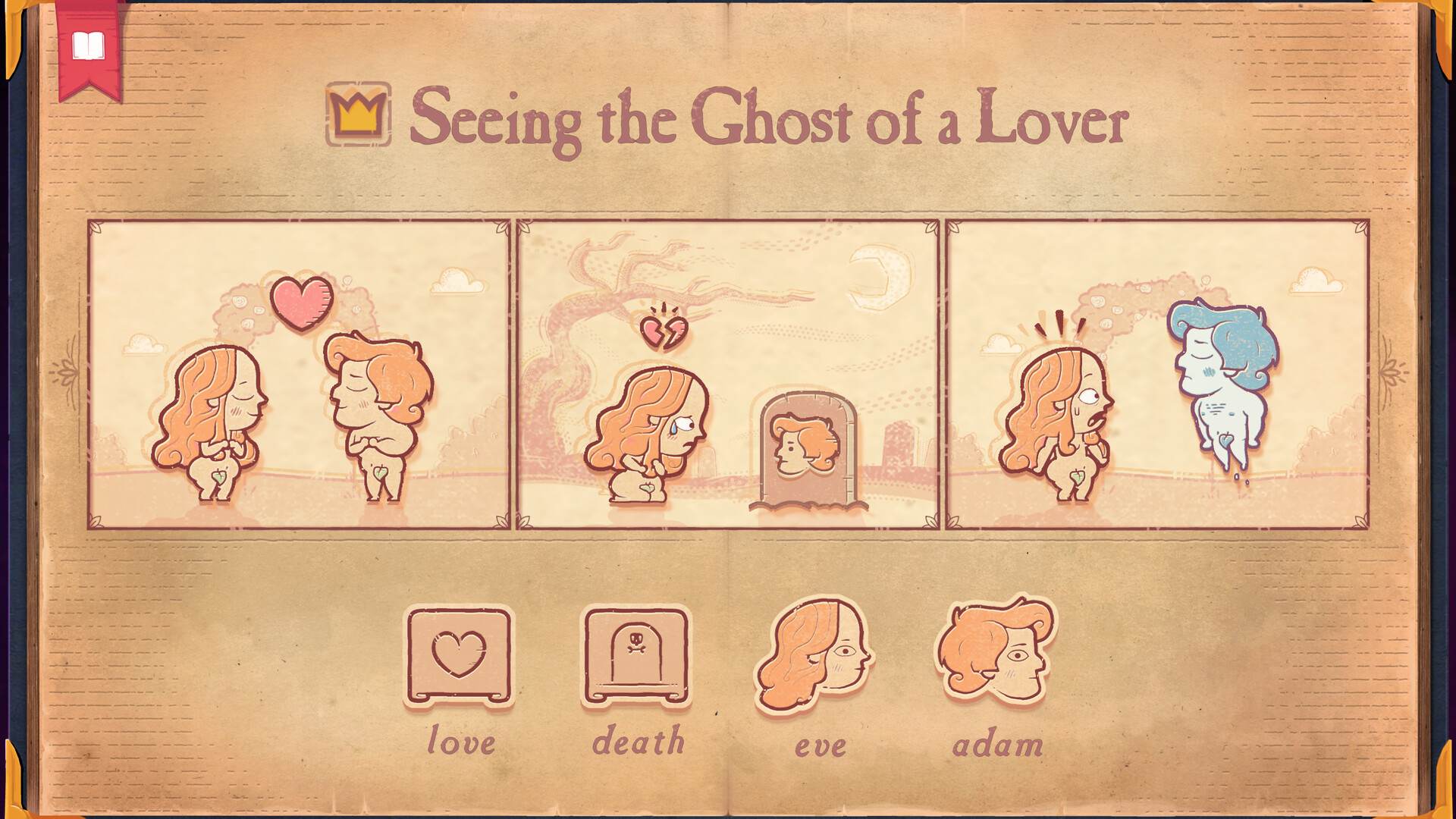
The direct action is drag and drop. The player puts a setting into a panel and places one or more characters in it, then watches the illustrated figures react. Moving a person to an earlier frame changes the state carried into a later one. A meeting can establish affection, a separation can change it, and a new arrival can turn what looked like a simple pairing into a triangle. If the title remains unsatisfied, the page can be rearranged and read again. This makes the panels both a workspace and a compact timeline. The player can place the same figure more than once, but the later appearance is not automatically a fresh start. What that person has witnessed or experienced in the earlier drawing gives the later reaction its context. A scene of affection can establish a bond that another scene puts under pressure; moving the second encounter to the first slot removes the reason for the response the player wanted. The limited number of frames makes that dependency visible, because there is little distance between cause and result. There is no avatar to steer through a town and no equipment loadout to prepare for a battle. The important movement is between frames: which character appears where, beside whom, and after what earlier encounter. A reader might understand an event from a single drawing, but building a page that reliably produces it requires attention to order. The animation provides immediate feedback when a combination changes a relationship or an action. A revised first panel can make the last panel tell a different story even if the final setting and cast appear much the same.
Character behaviour supplies constraints that prevent the blank page from being an unrestricted drawing program. A desired event has to follow from what the actors have experienced, rather than from a sentence typed beneath the panel. Daniel Benmergui built the concept around story roles and rules: love, death, marriage and betrayal are material for puzzles because they alter what people can plausibly do next. If a character needs to be jealous, the page must first establish something to lose. If a later scene calls for remorse, a preceding action has to give it meaning. The player can experiment with the same pieces in a different order to learn those rules. Their reactions are the evidence that a proposed chain of events makes sense inside the game's logic. Some titles can invite more than one coherent arrangement, but that does not make every sequence an accepted story. The cast and settings available for a puzzle define a small field of possibilities; the challenge is to discover a path through it that produces the named situation. Storyteller turns knowledge of familiar plot devices into practical reasoning about cause and consequence.
The book draws on a wide shelf of tale-making material. Heroes and villains, dragons and vampires can share space with stories about lovers, lies, remorse, revenge and madness. Those subjects are not presented as one continuous war or a role-playing campaign in which each new monster must be defeated with a stronger weapon. A dragon may be a figure in a panel; its presence matters to what the other figures do and to the kind of tale that can be constructed around it. A romantic arrangement can become a crime story when a later frame changes an allegiance. That breadth lets the same simple act of placing characters produce very different kinds of plot. The Nintendo listing also gives the game content descriptors for blood, sexual themes, alcohol use and violence, reflecting material that may occur inside the short illustrated stories. Those depictions do not turn the player into a combatant. The game asks who encounters whom and under what circumstances, then makes the cast respond. Its dramatic material is handled as narrative cause and effect, with the player testing those connections on the page.
The comic form is essential to how much the game can imply with few moving parts. A panel shows a scene; the space before the next one lets the viewer infer what changed in between. Benmergui's early design work drew on that property of comics to avoid acting out every moment between important events. In the finished game, hand-drawn figures and short animations make a character's response legible without a paragraph explaining their inner life. A wedding scene, a grave or a meeting place can carry an established meaning, but its meaning on this page depends on who has already appeared and what happened in the previous frame. Moving an actor is therefore also an act of editing: the player decides which facts the imagined reader will know before seeing the next picture. A convincing page has to read from left to right as a story, not merely contain all the right props somewhere on it. The visual brevity helps the player compare attempts. One change in a first encounter may be enough to explain why the closing image now expresses betrayal instead of reconciliation.
Daniel Benmergui developed Storyteller and Annapurna Interactive published it in 2023. Steam lists a single-player PC edition, while the publisher also links Mac, iOS, Android and Nintendo Switch versions. On Switch, it supports touch input as well as TV, tabletop and handheld play, a fit for placing story pieces directly into panels. The Steam storefront also lists an original soundtrack product; that is audio content, not another book of playable tales. The original design was explored for years before release, but the game available now has a clear playable centre: each title is a challenge to make relationships and events emerge from a limited set of settings and people. Progression is through new story problems rather than a character's experience levels. Solving one page teaches a small part of the cast's logic, which can help when a later page uses the same kind of affection, loss or deception in a different arrangement. The player can see an attempted answer immediately in the comic itself, revise it and watch the consequences change.
- Developer
- Daniel Benmergui
- Genre
- Single-player reactive comic-panel puzzle game