
About State of Decay 2: Juggernaut Edition
State of Decay 2: Juggernaut Edition follows a small survivor community trying to rebuild after a zombie apocalypse. Recruit people with different skills, scavenge for supplies, establish and improve a home, and push back against the Blood Plague. The edition combines the open-ended campaign with Heartland, Daybreak, Independence and Homecoming content.
The outbreak has shattered ordinary life, leaving groups of survivors to build small pockets of safety among abandoned towns and open country. State of Decay 2 frames the player as the caretaker of one such community: each expedition is made by a person who can be injured or lost, while decisions about the group’s home affect everyone who stays behind. You begin with a small set of people and a foothold on one of the game’s maps, then decide whom to recruit, where to settle and how to handle nearby groups. The setting is not a fixed sequence of missions so much as a living survival sandbox. Requests, supply needs, hostile infestations and encounters with other enclaves give the community competing priorities, and the player chooses which can wait while the group secures the basics it needs to continue.
A survivor is more than a health bar and a weapon slot. People bring personal traits, skills and specializations that can make them useful at home or in the field, while their community standing develops through the work they do. The active character can be switched at the base, which lets the player rotate away from someone tired or hurt and choose a better fit for the next outing. A melee specialist, for example, approaches a search differently from someone whose skills support the settlement. Those individual profiles matter because the community’s future rests on a roster, not a single protagonist: an injured survivor needs time and support, and a death removes that person’s abilities from the team. As members advance, a hero can be selected as leader; leadership type shapes the late community goals and the facilities available to build.
Scavenging turns the surrounding map into a practical network of destinations. Houses, shops and public buildings can be searched for food, medical supplies, ammunition, crafting materials and equipment, while larger rucksacks carry valuable resources back to the home base. A run may also uncover a vehicle, a weapons cache, a survivor in need or another enclave whose request can lead to trade and assistance. The player can scout from higher ground, use the radio to locate a specific resource or contact another group, and spend Influence for those services. Search sites are not automatically safe: clearing infected from a building, fitting the right gear and leaving room in a survivor’s inventory are all part of preparing to bring something useful home. The loop links short-term errands to longer needs, since supplies can maintain daily community functions or be consumed by a chosen facility project.
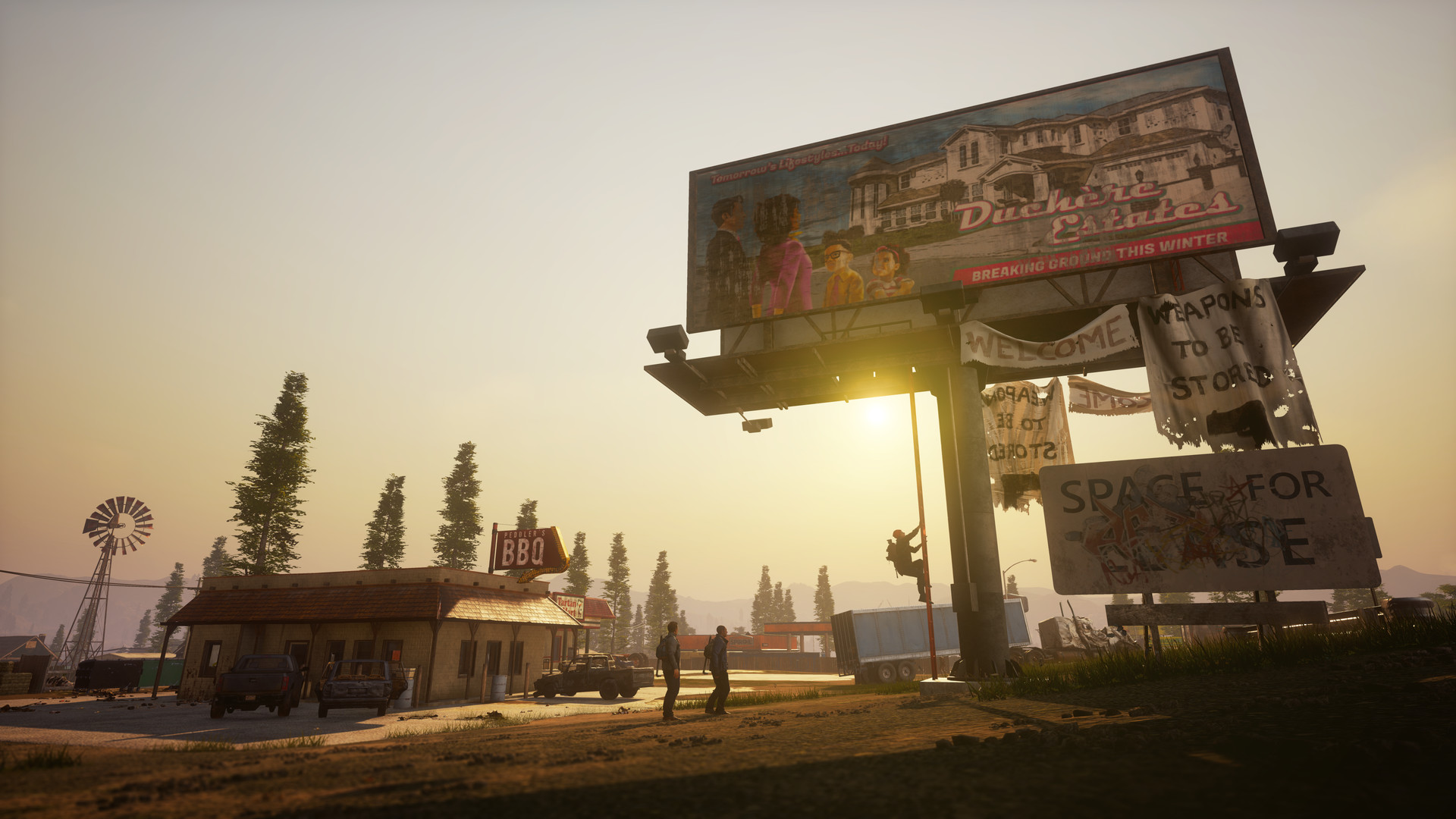
The Blood Plague gives the open-ended campaign a central threat to push against. Plague Hearts occupy infected areas and are a primary long-term target as the community works to clear a town. Plague territories tie the infected threat to decisions about where the group can expand, while upgraded outposts can improve the support those sites provide. These systems came with Update 25; Homecoming arrived later as Update 26 and brings Trumbull Valley back as an open map. Destroying hearts advances the campaign, but each assault calls for preparation and can draw more infected into the fight. Ordinary zombies can overwhelm a survivor through numbers, while special infected change how an encounter unfolds: a fast Feral pressures aim and movement, and the larger Juggernaut takes sustained effort to bring down. The player can work around a threat with firearms, melee weapons, explosives or a vehicle. Clearing a heart is both a combat objective and a strategic change to the map.
A base turns scavenged goods into a functioning settlement. The player chooses a home site, builds facilities into available spaces, and balances useful production against the material and upkeep costs of keeping the place running. Resource outposts can supply necessities over time, while facilities provide functions such as storage, care or crafting; the available footprint and community size influence which larger homes can be occupied. Enclaves add another layer: radio requests can become trade relationships, sources of help or new conflicts, and Influence can pay for specific services. As survivors gain standing, leadership paths such as Warlord or other specializations open additional facilities and questlines. A community can move on to a different map, taking its established survivors and equipment into a new territory, so the campaign’s work combines immediate repairs and supply runs with the longer plan for where the group can safely live next.
Juggernaut Edition brings the core sandbox together with several distinct additions. Providence Ridge is a new map for community survival, while Homecoming restores Trumbull Valley as a full-sized open world for the core game, with additional locations to explore. Heartland is a separate, story-focused campaign set in a familiar town; Daybreak shifts to a cooperative siege in which players defend against waves of undead; and the Independence Pack adds a celebratory set of explosive weapons and items. The edition also includes remastered presentation, a revised introduction, updated controls and heavy two-handed weapons with their own melee moves. These parts do not form one continuous story: the main community campaign emphasizes recruitment, settlement growth and the Blood Plague, Heartland supplies a directed narrative, and Daybreak makes holding a line against a horde its central task.

- Developer
- Undead Labs
- Genre
- Open-world zombie survival simulation with action role-playing systems