
About STASIS: BONE TOTEM
Salvagers Mac and Charlie discover an abandoned oil rig in the Pacific and a secret connected to Cayne Corporation. STASIS: BONE TOTEM follows the married pair and their Super-Toy, Moses, through an underwater science-fiction horror adventure where players switch among three characters, share inventory and solve puzzles across a large submerged facility.
STASIS: BONE TOTEM begins with Mac and Charlie, a married couple who make their living salvaging from the ocean. Their work brings them to an abandoned oil rig in the Pacific, where they uncover a secret that Cayne Corporation wants kept hidden. The discovery draws the pair into a story beneath the waves, with their trusted Super-Toy, Moses, alongside them. The three characters form the centre of this adventure: Mac and Charlie are partners with a shared life and occupation, while Moses is a small robotic companion who becomes a playable member of the team. The underwater location gives the story a different physical scale from an ordinary point-and-click setting. A huge base, the derelict rig and deeper ocean spaces connect human industry with an older mystery. The narrative’s tension comes from investigating what happened and why it matters, while the family relationship gives the investigation a personal stake.
The game belongs to the STASIS anthology, but it tells a new story with new characters and an underwater environment. Mac and Charlie are distinct from John Maracheck, and their salvage work gives the expedition its own starting point: an abandoned oil rig and a secret tied to Cayne Corporation. The submerged world is built around places to explore, mechanisms to understand and clues that connect the rig to a much older history. An ancient mystery lies deep beneath the ocean, but the story’s immediate pressure comes from the corporation’s interest in keeping the discovery hidden. Corporate secrecy and family resilience therefore sit alongside the science-fiction horror, giving the investigation both a present human conflict and a much older question. The underwater setting shapes how the team travels, what spaces they can reach and what evidence is concealed within them.
BONE TOTEM retains the isometric, point-and-click foundation of the series. The player examines rendered scenes, selects points of interaction and moves through a sequence of connected spaces. Within them, puzzles ask for attention to machinery, clues and the items available to the group. The underwater facility is described as massive, so exploration involves more than a single room or set-piece; finding a route forward means understanding the different areas and the systems that join them. Objects and information can carry significance beyond the place where they are found, encouraging the player to make connections across the environment. Full-motion video cut scenes and voiced characters support the narrative presentation, while the isometric view keeps interacting with the surroundings central. The central actions are investigation and puzzle solving, with horror shaping the circumstances around them rather than replacing the deliberate pace of a classic adventure game.
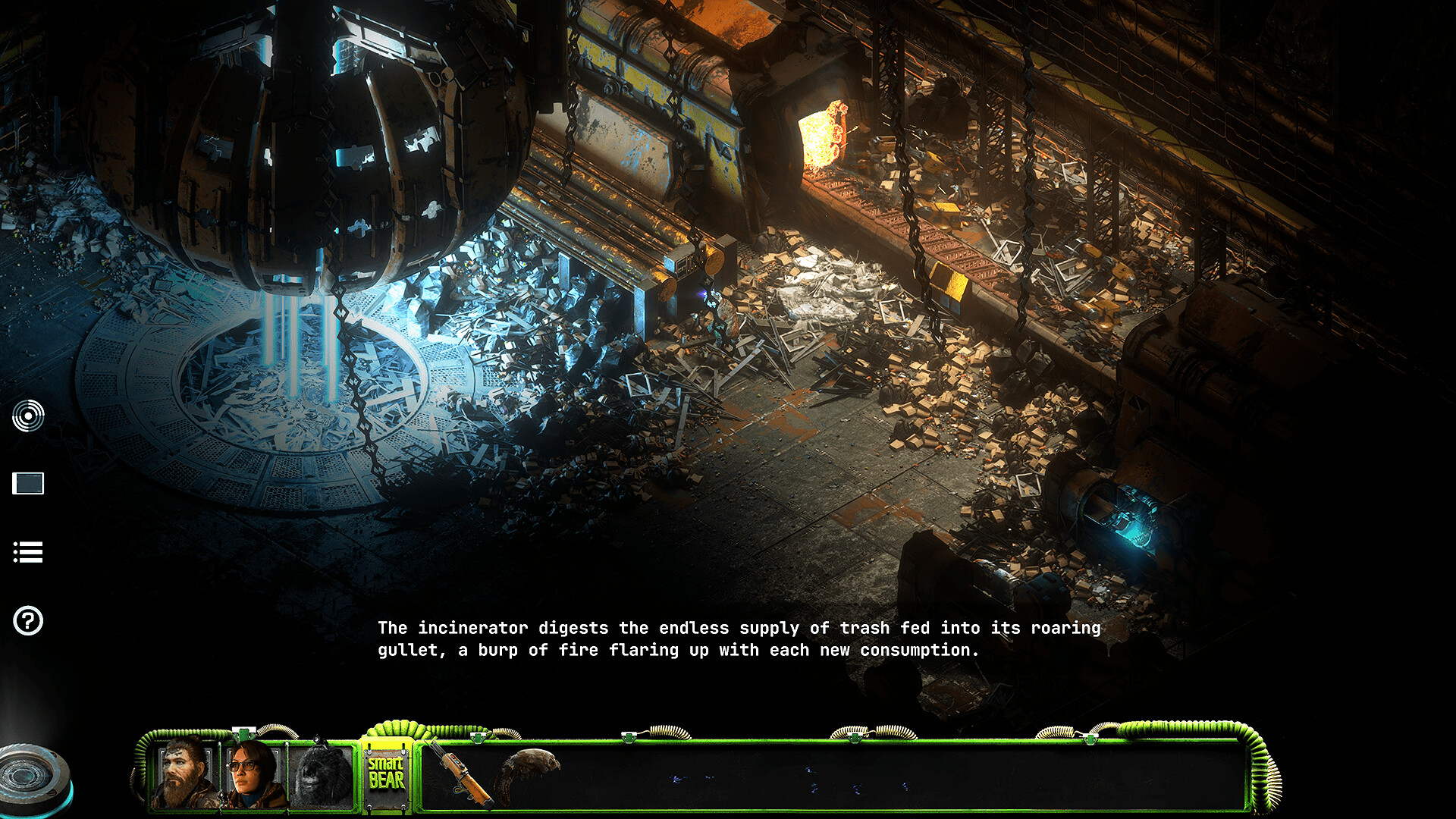
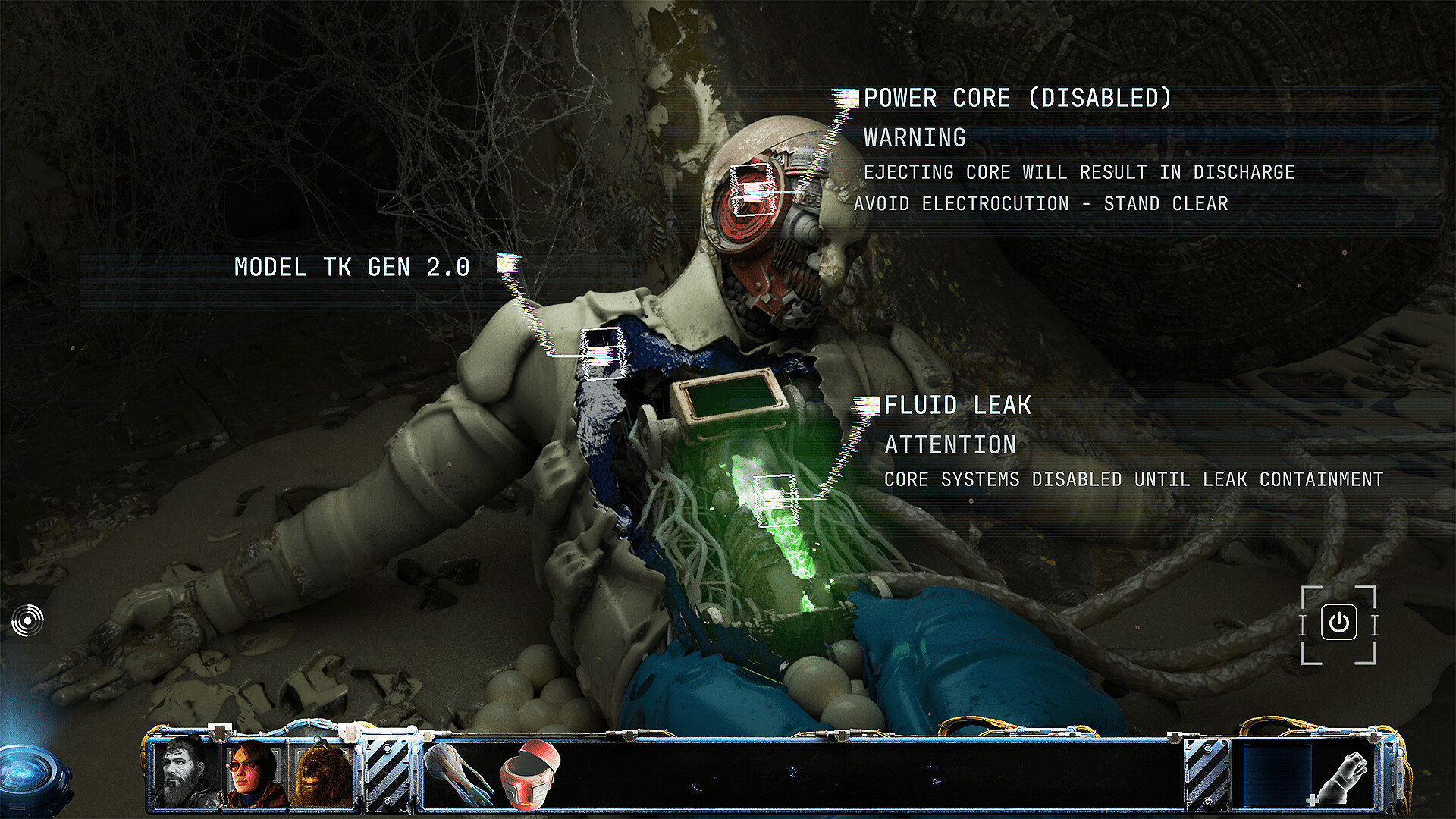
The three-character system changes how the player approaches each problem. Mac, Charlie and Moses can each be controlled, and the developer describes them as having unique skills. Switching between them is not simply a cosmetic change of viewpoint: the team’s different abilities support progress through obstacles. Their inventory is shared, so an object collected by one character can contribute to a plan involving another. This lets a puzzle operate across the group, asking the player to notice what each person can do and how their discoveries fit together. Moses, as a Super-Toy, has a distinct place beside the human salvagers, while Mac and Charlie’s partnership is embedded in the story and in the way the team functions. The game does not present three unrelated campaigns; it coordinates the characters within one expedition, using their collaboration to make the underwater spaces and puzzle logic feel connected.
The setting combines industrial structures with an ocean environment that hides older traces. The abandoned rig gives the opening discovery a concrete location, and a large underwater base expands the field of investigation. Beyond these spaces, the journey points toward a secret buried at the ocean’s bottom. The visual presentation remains isometric, with rendered scenes and cut scenes carrying exploration and story moments. Mark Morgan’s score and voiced characters support the conversations and shifts in tension. The adventure also includes depictions of blood, reflecting its science-fiction horror tone. The ocean’s depth functions as more than scenery: it conceals the places, evidence and history that Mac, Charlie and Moses must investigate, while the rig links the team’s salvage work to the corporation’s secrecy. Their route through these spaces turns the physical act of exploring into a gradual investigation of what the company wants kept from view.
Progress depends on coordinating the trio’s abilities and discoveries. A puzzle may require the player to notice an object, switch to the character suited to act on it, then use a shared item to complete the next step. Because the inventory belongs to the group, the solution can involve cooperation across different locations rather than a single character carrying every tool. Conversations and voiced scenes provide narrative context, while clues and environmental interactions carry the investigation forward. This gives the player a repeated cycle of observing, testing an approach and reconsidering which character should handle the task. Mac, Charlie and Moses remain part of the same expedition, so even moments focused on one character contribute to their common effort. The arrangement makes the party itself a puzzle resource: the player must understand both the environment and the distinct capabilities available within the team.
- Developer
- THE BROTHERHOOD
- Genre
- Isometric point-and-click science-fiction horror adventure