
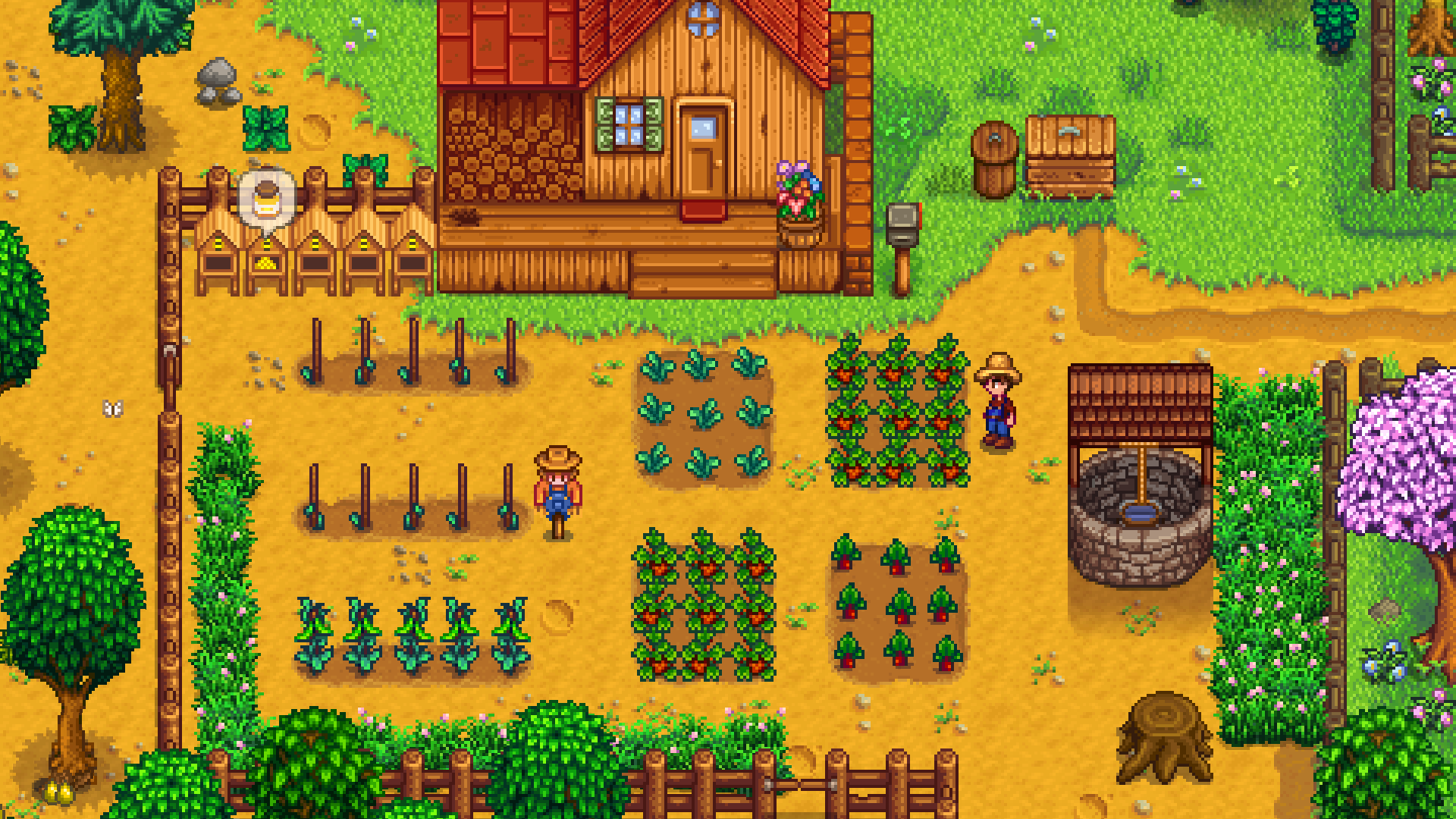
About Stardew Valley
It's a country-life RPG from 2016 that has been patched and expanded for a decade, and it still starts the same way: you inherit a run-down farm and a set of second-hand tools. An opening quest walks you around the town, and everything after that is a decision about how to spend a day.
A day, a season, a year
The first thing the game hands you is a calendar. A day runs from six in the morning until two the next morning, and almost everything you do costs either energy or time. Water the crops, feed the animals, break rocks, fish, talk to the neighbours, or stay in the mine until you collapse, and it all comes out of the same small pool of hours. Choosing to do one thing is choosing not to do another. That is the whole game in a sentence.
Each season is about a month of in-game days, and the farm turns over with it. Most crops wither on the first of the new season. A handful keep going instead: corn, wheat, sunflower, ancient fruit and coffee bean are planted across two or three seasons, so they survive the change as long as the new season is one of theirs. A late planting is still a gamble, and a bed you cannot water today is a later harvest rather than a lost one. Winter grows almost nothing outside. None of this is background. The calendar is the pressure that gives every other decision its weight.
Nothing forces you forward and nothing can take the farm away. Your grandfather's letter leaves you a wrecked plot, and the rest is yours to define: a tight profit machine, a greenhouse full of out-of-season crops, or a meadow with two chickens and no ambitions at all.
The farming rhythm
Watering is the metronome. Miss a day and a crop does not die, it simply does not grow that night, so a skipped morning costs you position instead of the season. That is a generous rule, and it is why the early game feels busy rather than punishing.
Quality arrives as the farm grows up. Fertilised soil and a rising Farming skill push a harvest from plain to silver and gold, and the higher grades sell for more and restore more energy when eaten. Iridium crops are a late-game thing, because they only turn up with Deluxe Fertiliser. Sprinklers are the upgrade that buys your mornings back. Until you have them, the watering can is the first thing you pick up and the last thing you put down.
Animals work on the same principle. A coop or a barn produces goods, and an animal that is petted and fed builds up both friendship and mood. A large egg or a large milk needs both: friendship high enough for the animal to qualify, and mood high enough for it to be allowed to roll for one. Petting and feeding are real chores rather than flavour. Machines are the next step: a preserves jar, a keg or a cheese press turns a cheap harvest into something genuinely worth shipping.
The greenhouse is the long-term answer to the seasons. Unlock it through the Community Center, or buy it with a Joja membership, and you can grow any crop in any season, which quietly rewrites the whole economy. The Ginger Island farm does something similar later, on a patch that never cares what month it is. I would take the greenhouse over almost anything else the town offers.
Pelican Town is the second game
The town is where Stardew grows a personality. More than thirty residents live in and around the valley, and many of them keep a schedule, a birthday and a list of things they like. You build friendship with those ones by talking and by handing over gifts. Hearts fill, cutscenes open, and the neighbours you ignored for a season will quietly cool on you.
Twelve of them are romanceable, and those are the friendships that freeze at eight hearts until you offer a bouquet. Marrying one takes ten hearts, a house upgrade and a Mermaid's Pendant before the wedding happens, and afterwards there is a spouse routine around the farm and children if you want them. It is the most human part of the game, and it runs on exactly the same clock as everything else. A morning spent courting is a morning not spent mining.
That trade is the point. The game never tells you whether to be a farmer, a miner or a good neighbour, it just charges you time for each of them. If you like a game that lets you choose a life instead of completing a checklist, this is the part that will hold you.
The mines, the water and the bar
Exploration lives underground and on the water. The mines open in the first week of Spring and drop you into a run of themed floors with an elevator checkpoint every five, ore to smelt and monsters that would rather you turned back. The action stays light, a swing of a pickaxe or a sword and a bite of food to heal, but the mines are where the metal for your tools and machines comes from.
The Skull Cavern in the desert is the serious version, and it wants a key before it will let you in. There is no elevator down there, every attempt starts from the top, and the deeper you go the better the iridium, along with everything that would like to take it off you. Collapsing at 2am only costs you gold, and dropping to zero health is the thing that puts items in your bag at risk. That gap between the two is what turns greed into a real decision rather than a joke.
Fishing is the love-it-or-hate-it system. Cast, wait for the bite, then hold a green bar over a moving fish until a meter fills. It is genuinely hard at the start and genuinely satisfying once the bar widens. If it never clicks for you, the Training Rod widens that bar to the size a level-five fisher would have, which is the game quietly admitting the first hours are rough.
Underneath all of it sits one idea: everything you find feeds the farm, and the farm pays for what you find next.
Progression is the actual plot
Five skills, farming, mining, foraging, fishing and combat, each level to ten, and each offers a choice of two professions at level five and again at ten. Those choices change how your farm and your fights work, which is why a second save can feel different without touching anything else, and if you change your mind the Statue of Uncertainty in the sewers will run the choice again for 10,000g.
Tools upgrade at the blacksmith through copper, steel, gold and iridium, and every step costs you two mornings without the tool you handed over. Finish the Community Center by collecting bundles and the town repairs itself around you. Buy a Joja membership instead and the Center becomes a warehouse, so those two routes do not both happen on the same farm.
Version 1.6 added a mastery layer on top. Once all five skills are maxed, surplus experience feeds perks claimed from a new area in the forest. There is also the Perfection tracker, which gives completionists a single number to chase, and reaching the top of it opens the last stretch of the game.
None of it is compulsory. You can farm, marry and never set foot in a dungeon, or spend save after save optimising a single season. The game's idea of freedom is that it will let you be wrong about how to spend a year, and then let you keep going.
Co-op changes the maths
Multiplayer turns the farm into a group project. On PC and the Switch 2 edition you can bring up to eight players into one world; on PlayStation, Xbox and the original Switch it is four, with split-screen on most of them. Mobile has multiplayer as well, though it is still experimental.
Every player keeps their own energy, skills, tools and friendships while the farm itself is shared. Some progress is communal, mine floors and the museum fill in for everyone, and some is personal, which is exactly the imbalance that makes a co-op farm fun. Someone always ends up as the miner.
To stop four players simply getting four times richer, the host can set a profit margin when the farm is created that scales what produce sells for, and the wallet can be shared or split later through the town ledger. Cabins go up and come down as people join and drift away.
Where it stands now
Stardew Valley came out in 2016 and has been updated ever since. The current version is 1.6 on PC, console and mobile, and it is still being patched. The Switch 2 edition arrived at the end of 2025 with extras of its own, including eight-player online and mouse controls. It has sold more than fifty million copies, and its modding scene on PC is a second hobby layered on top of the first.
A 1.7 update is in development with no release date. The developer has said the aim is to add depth to parts of the game that feel thin rather than pile on more systems, and that it will add two more marriage candidates. Until it actually ships, 1.6 is the game.
A decade on, what still makes it work is that it asks nothing of you. You can leave for a year, come back, and the farm will be waiting for the next morning.
Should you play it
Yes, if you want a game to live in rather than finish. The farm, the town and the mines each stand up on their own, and together they build the rare sense of a place that keeps existing between sessions.
It is also one of the better co-op games around, because a shared farm gives a group something to build that no single player would finish quickly.
Skip it if you need a story to pull you forward, if a day with a fixed number of hours sounds stressful, or if the fishing bar is the sort of thing you already know you will resent. Nothing in Stardew Valley will rescue you from finding it slow, because slow is the design.
Go deeper with V4mp
- Developer
- ConcernedApe
- Genre
- Farming & life sim
Explore Stardew Valley further
Explore the wiki for detailed reference pages on the game's world, systems, items and locations.