
About Star Wars: Knights of the Old Republic
Four thousand years before the Galactic Empire, the Republic faces a Sith campaign that has scattered the Jedi across the stars. Create a hero, travel with a changing party aboard the Ebon Hawk, and decide how to confront the conflict. Character development, dialogue, and choices on the light or dark side shape the journey.
Set roughly four millennia before the films, Knights of the Old Republic places the Republic in a war against Sith forces led by Darth Malak. Jedi numbers have been badly reduced, and the conflict reaches ordinary settlements as well as military fronts. The player creates a central character and begins amid the danger surrounding the Republic, then becomes involved in a search for a way to answer the Sith threat. Bastila Shan, whose battle meditation is important to the Republic effort, and Republic soldier Carth Onasi are among the early figures connected to that struggle. The larger journey expands beyond one battlefield: the Ebon Hawk becomes the group’s transport between worlds, and each stop brings local disputes, unfamiliar cultures, and information about the war. Its ancient-era setting leaves room for new worlds and species while keeping the central question focused on the Republic’s survival and the player character’s relationship to the Force.
Character creation begins with one of three non-Jedi classes. A Soldier gains vitality and combat feats quickly but has fewer skill points; a Scout develops at a middle pace in both areas; and a Scoundrel advances skills quickly while gaining combat feats more slowly. These starting roles shape what the protagonist can do before Jedi training becomes available during progression. The later Jedi classes specialize in different directions: Guardian emphasizes direct lightsaber fighting, Consular develops Force powers, and Sentinel balances both with a steadier skill progression. Attributes connect the build to practical outcomes. Strength improves melee attacks, Dexterity benefits ranged weapons and defence, Wisdom strengthens Force capacity and resistance, Intelligence provides more skill points, and Charisma supports persuasion and Force use. Level increases let the player choose skills, feats, and powers, so one character can be tailored toward conversation, technical problem solving, combat, or a mix.
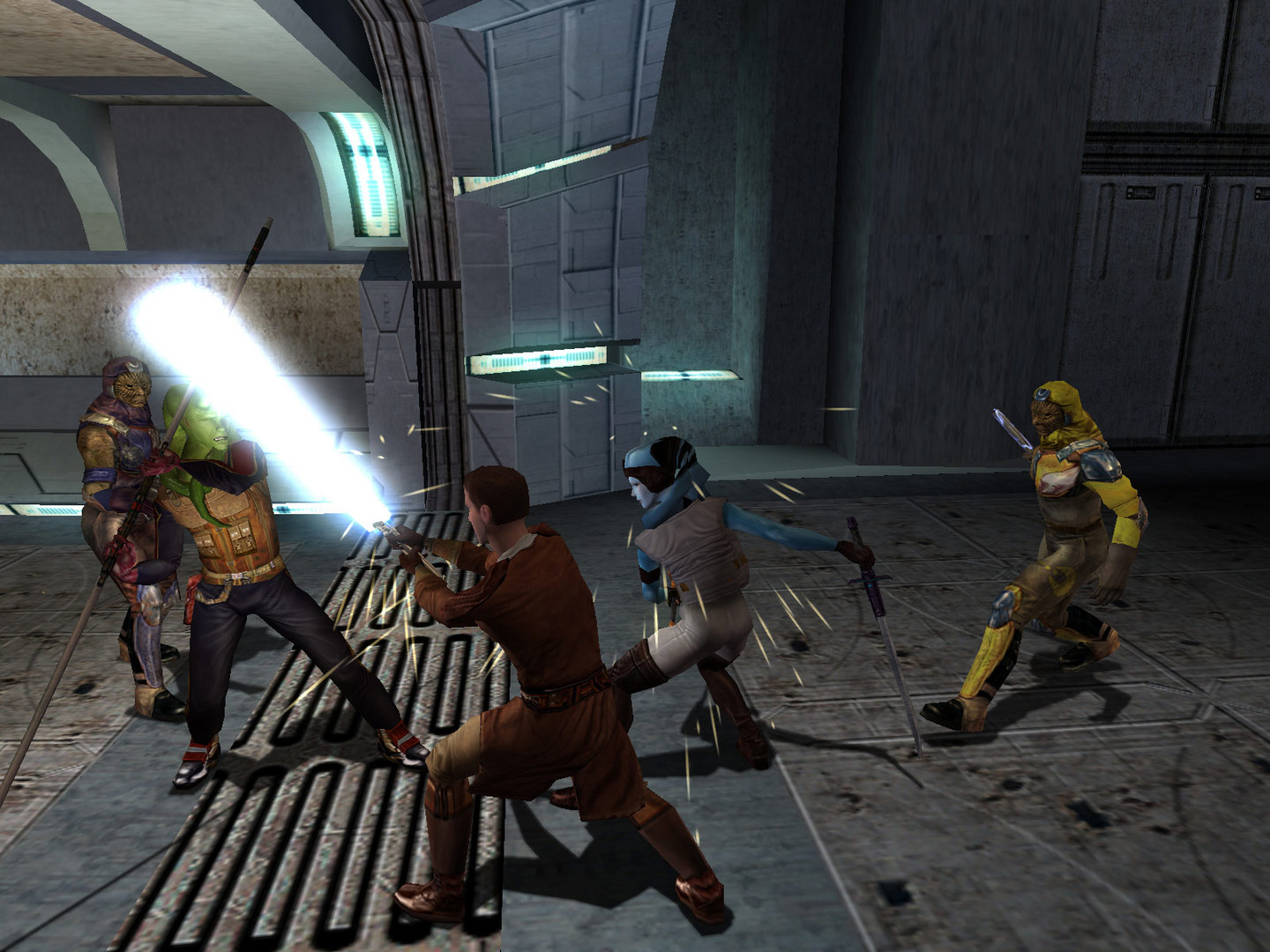
The party supplies capabilities the protagonist may not have. Up to two companions accompany the lead character in the field, and the player can switch control among active members. Carth is a soldier and pilot; the Twi’lek Mission Vao brings underworld experience, while her Wookiee companion Zaalbar contributes strength in combat. The group also includes droids and other allies encountered as the route through the conflict widens. Their skills matter outside fights: one member may be better suited to slicing a terminal, repairing a disabled droid, spotting a mine, or opening a security door. Party selection is therefore a practical choice about tools and combat roles as well as a way to hear different characters’ reactions. Companions can be equipped and developed, and the Ebon Hawk provides a recurring place to regroup, manage the party, and talk with the people travelling alongside the protagonist.
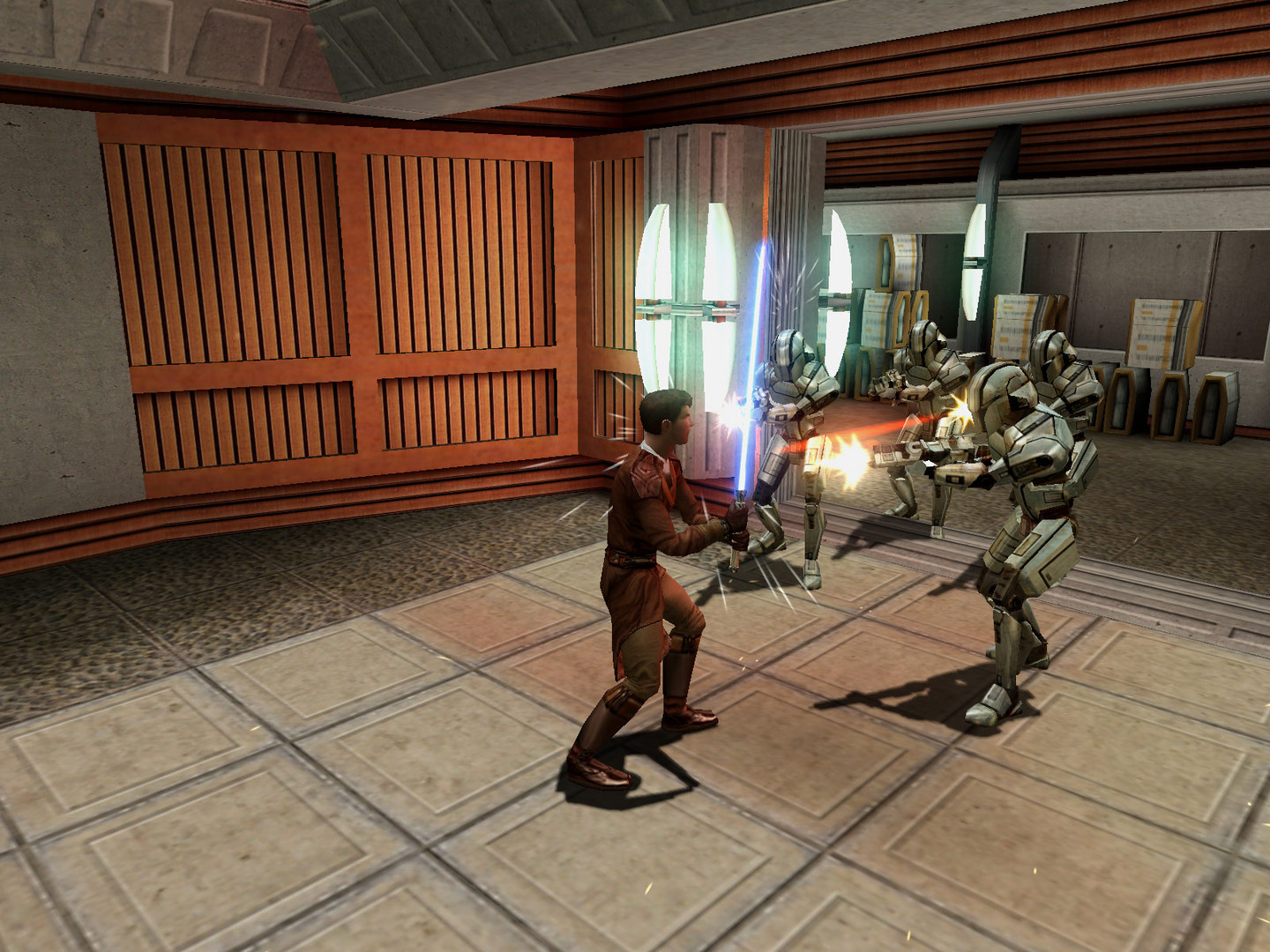
Combat runs in real time but uses discrete, queued actions that give the player room to direct a response. Targeting a hostile pauses the action interface so the player can select an attack, feat, item, or Force power; pausing the encounter allows additional commands to be entered before play resumes. The main character and companions can be switched directly, while the rest of the group will usually join the attack automatically. Vitality measures health, and Force points limit how often Jedi can use their powers before replenishing outside combat. Weapons and feats create different attack options, while grenades, medpacs, stimulants, shields, and powers provide situational answers. Skills can affect the encounter before a weapon is drawn: stealth requires both training and a stealth field generator, and mines can be detected through Awareness or handled with Demolitions. Combat cancels stealth, making sneaking a way to position or bypass a problem rather than a combat stance.
Moving between planets combines main objectives with local stories and smaller tasks. Tatooine and Kashyyyk are among the worlds visited, and conversations often reveal what a settlement needs, who controls access, or what evidence is missing. Persuade can press an argument or defuse some confrontations; Computer Use spends computer spikes at terminals, and Repair uses parts on droids or machinery. Demolitions handles mines, Security opens electronic locks, and Awareness can expose hidden threats. These checks are built around the protagonist’s skill ranks and related attributes, so character development has visible consequences in exploration. When an obstacle offers several approaches, the party can sometimes resolve it through dialogue, a technical skill, stealth, or a fight. The journey also includes diversions such as swoop racing and Pazaak, a card game played against other characters, giving stops aboard ship and on populated worlds activities beyond the main conflict.
Choices establish the protagonist’s alignment and affect how dialogue and Force use develop. Responses can show patience, generosity, pragmatism, intimidation, or cruelty, and actions can add light-side or dark-side points over time. This is a continuous track rather than a single character-creation selection: later decisions reinforce or complicate the direction already established. Force abilities are grouped by alignment, and powers associated with the opposite side cost more to use, so alignment can influence both role-playing and resource planning. The available conversation lines also depend in part on skills such as Persuade, and decisions can change how people respond or which resolution follows. The game’s light-versus-dark framework sits alongside everyday decisions about helping residents, settling disputes, or choosing how to treat a captured opponent. Each route across the galaxy brings the player back to the same interconnected loop: investigate a crisis, talk or act through it, grow the party, and carry the consequences forward.
- Developer
- BioWare
- Genre
- Role-playing game