
About Star Wars: Knights of the Old Republic II - The Sith Lords
Five years after the first game, Jedi are nearly extinct and the Old Republic is close to collapse. As the Jedi Exile, reconnect with the Force, travel with companions aboard the Ebon Hawk, and confront the Sith threat. Choices shape the Exile’s alignment, party relationships, and the allies who join the journey.
Five years after the earlier game, The Sith Lords opens in a Republic still scarred by war. Jedi have been hunted nearly to extinction, the Order is in ruins, and the Republic is close to collapse. The player is the Jedi Exile, a lone figure trying to reconnect with the Force while being pursued by the Sith. The opening at the remote Peragus mining facility establishes a more isolated starting point, before the journey widens to settlements and worlds with their own disputes. Kreia, a mysterious Jedi, and Atton Rand, a pilot encountered at Peragus, are among the people drawn into the Exile’s path. The story’s central concern is how a damaged Republic and a nearly vanished Jedi tradition might survive.
The Exile travels with companions and can take two of them into hostile areas at a time. Choosing the active pair affects both combat options and the conversations that can unfold, while other companions remain available to talk with at safer points. Kreia’s perspective on the Force, Atton’s guarded history as a pilot, and the different abilities of droid, soldier, and Jedi allies give the travelling group contrasting ways to interpret events. Conversation frequently presents choices about how to answer a companion or an outsider. The Exile’s skills and attributes can open additional responses: Persuade can press for information or avert a fight, Awareness can expose hidden motives, and a strong Repair skill can identify a false claim about a droid. Companions may also comment when their knowledge applies.
Character creation selects one of three Jedi classes. The Guardian progresses quickly in feats and vitality, the Consular develops Force powers and Force points more rapidly, and the Sentinel advances skills at a faster rate while balancing combat and Force abilities. Attributes tune each build: Strength supports melee attacks, Dexterity improves ranged accuracy and defence, Wisdom increases a Jedi’s Force capacity and resistance, and Intelligence adds skill points. Levels earned through quests and combat allow the player to choose skills, feats, and Force powers, then a later class specialization expands that role. Prestige classes reflect the Exile’s alignment and include different balances of weapon combat, skill development, and Force mastery. Alignment is not a cosmetic label: light- and dark-aligned powers have different Force-point costs depending on the character’s direction. As the Exile moves toward one side, the selected abilities and the party’s response to the character can develop together.
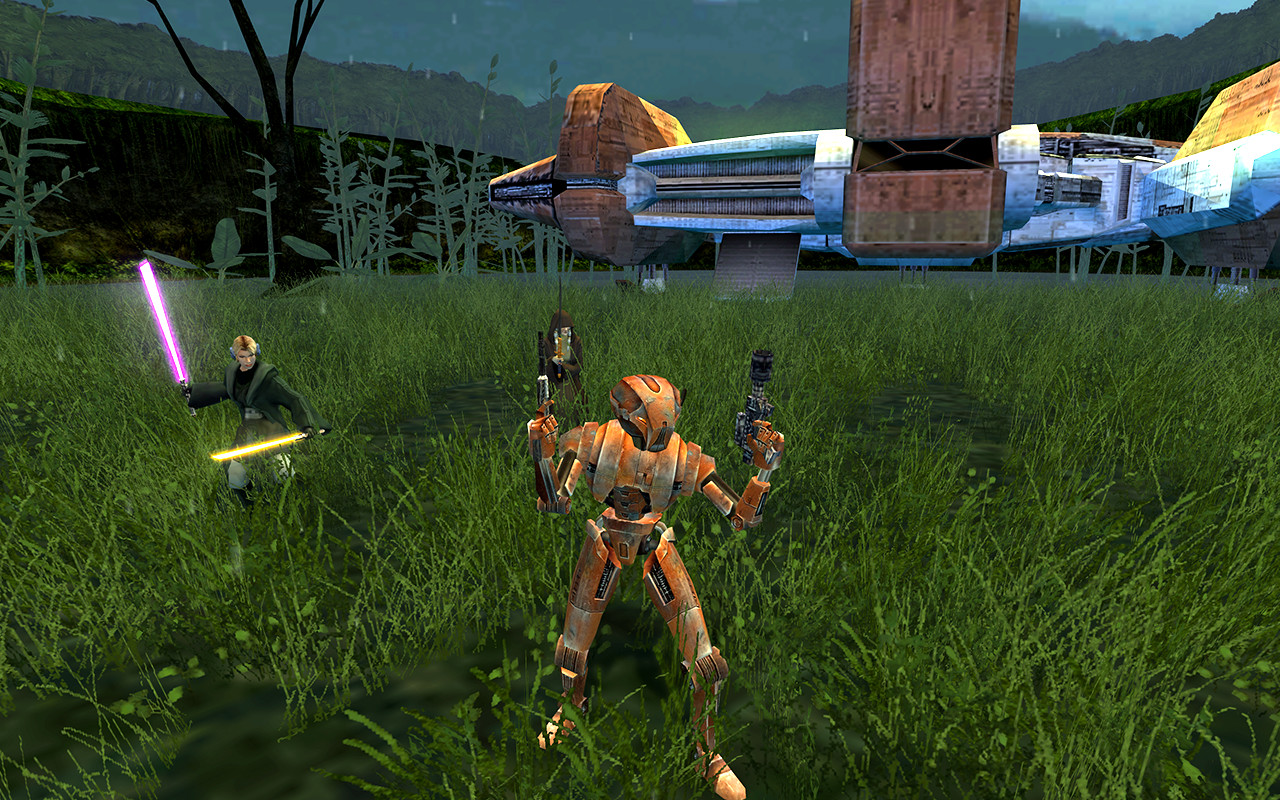
Combat uses real-time action with a pause and command queue. The player can stop the fight, choose a target, and line up a sequence for each active character, such as using a medpac, applying a Force power, then returning to an attack. Companions normally enter combat when the Exile engages an enemy, but their behavior can be set to aggressive, defensive, stationary, ranged support, Jedi support, or grenade use. Switching between party members lets the player direct a specialist or choose another target. Weapons include melee arms, blaster pistols and rifles, lightsabers, and grenades; armor protection can restrict Dexterity bonuses or prevent use of many Force powers. Jedi lightsaber forms add tactical trade-offs: a form suited to blaster deflection or a single opponent can be less useful against groups or another lightsaber user. Force powers cost points, and alignment makes powers associated with the opposing side more expensive.
Skills reach into both obstacles and equipment. Computer Use spends spikes at terminals, while Repair spends parts on disabled droids and also governs how many components are recovered when items are broken down. Treat Injury affects medpac healing and the chemicals gathered when items are dismantled at a lab station; Demolitions covers mines and explosive equipment, and Security handles electronic locks. At workbenches and lab stations, materials can be turned into useful gear, so some items can be converted into components for weapons, armor, or equipment that suits the Exile’s equipment setup. Weapon and armor upgrades offer choices among different effects, and lightsabers have more upgrade options than in the earlier game. The system gives the Exile a way to improve equipment when a new find does not fit the party’s needs.
Companion influence is a system that makes the Exile’s conduct matter within the group. When companions express an opinion or expertise during a conversation, the response may increase or decrease that individual’s influence. The relationship affects what the companion is prepared to explain, and at higher influence some companions can be trained in the ways of the Jedi. The Exile’s light- or dark-side alignment also changes companion dialogue and can affect who becomes available to travel with the party. This means that repeated decisions have consequences beyond a single conversation: the group can reveal more of its history, develop new abilities, or respond differently to the protagonist. The game’s decisions often concern the method as much as the outcome, including how the Exile treats people who are frightened, compromised, or simply opposed. This expanded companion relationship system is one of the sequel’s clearest differences from the first game.
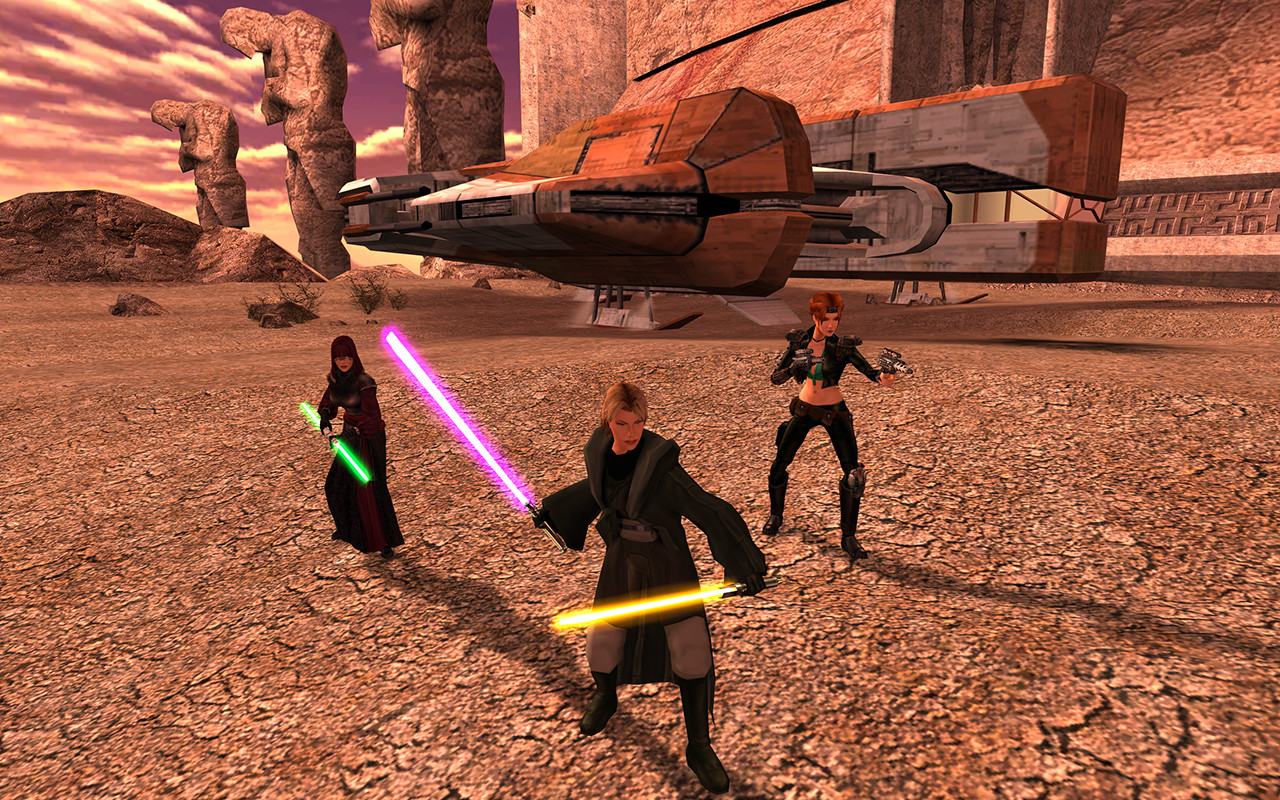
After the initial sections, the route through the galaxy opens into a less linear sequence of destinations. The Ebon Hawk connects those journeys, and each region mixes the main search with political problems, local requests, and practical obstacles. Some sequences briefly place the player in control of a companion or another character, showing events from outside the Exile’s immediate perspective. On Dantooine, for example, the player can intervene in a dispute between the provisional government and mercenaries; repairing defenses or reprogramming them changes how the resulting battle unfolds. Decisions can therefore produce visible local effects as well as later story consequences. Other situations reward a technical skill, stealth, persuasion, or combat, and the party’s composition can change which methods are available. Travel advances the Republic crisis while giving the Exile room to decide what sort of leader, teacher, and Force user to become.
- Developer
- Obsidian Entertainment
- Genre
- Role-playing game