
About Tom Clancy's Splinter Cell
Tom Clancy’s Splinter Cell follows Sam Fisher, a covert NSA operative sent by Third Echelon to investigate missing agents and a spreading crisis in Georgia. Its mission-based stealth action makes light, sound, movement, surveillance, gadgets and enemy awareness part of each infiltration, while Fisher’s remote team supplies objectives, intelligence and support.
Set in a near-future espionage crisis, Splinter Cell places Sam Fisher inside Third Echelon, a secret NSA initiative that sends lone field operatives into hostile territory when intelligence cannot be gathered remotely. The campaign begins after CIA agents Alison Madison and Blaustein disappear while investigating communication failures in Georgia. Fisher is deployed to find them and assess the threat behind the breakdown. The operation expands through international missions as he follows the trail toward a political and technological conspiracy. Each assignment gives him a concrete objective, such as entering a secure site, locating information or reaching a target, and asks him to leave as little evidence of his presence as possible.
Fisher’s missions are connected by the support team that watches from outside the field. Colonel Irving Lambert coordinates operations and stays in contact with him, passing instructions and responding to what the investigation reveals. Vernon Wilkes handles transportation and equipment, while Anna Grímsdóttir leads the communications specialists who provide technical, cryptographic and data support. Their messages arrive during missions, and the OPSAT wrist computer stores updated goals, notes and reconnaissance. The opposition includes Georgian president Kombayn Nikoladze, former Spetsnaz operative Vyacheslav Grinko and mercenary forces whose personnel hold different levels of security access. Information gathered from people and documents can change how Fisher understands a location and what he must do there.
Stealth is measured through a meter on the OPSAT that reflects the amount of light around Fisher and the sound he makes. Darkness, a crouched posture, slow movement and keeping his back near a wall all make him harder to spot; running and jumping can attract nearby patrols even when the route is visually hidden. Enemies investigate suspicious noises, raise alarms and alert nearby guards, so a brief exposure can reshape the space by bringing more opposition into it. A mission may be aborted if alarm levels become unacceptable. Watching patrols, waiting for their attention to move, and choosing a quiet approach are practical parts of reaching an objective rather than optional flourishes.
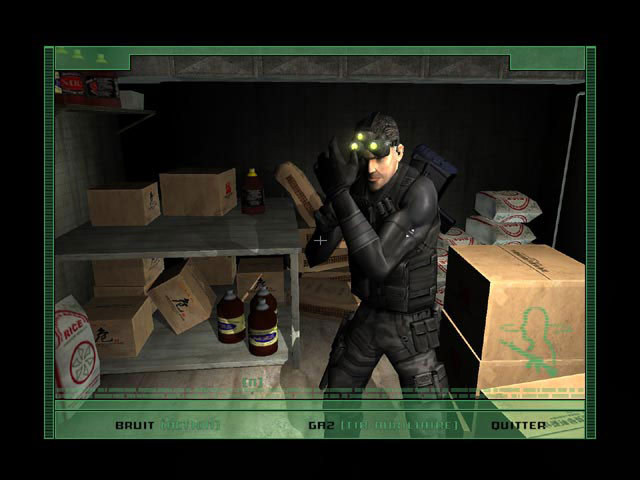
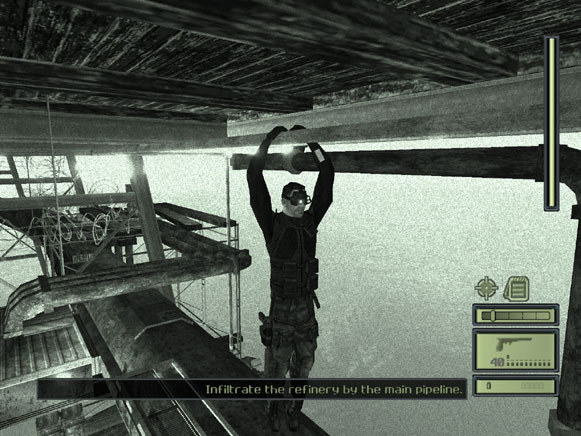
The environments also function as routes with different heights and sight lines. Fisher can climb pipes, ladders and vertical cables, move hand-over-hand along horizontal bars, shimmy across ledges, mantle onto low objects, and use wall jumps or split jumps in narrow passages. Ropes and sloped lines provide further ways to cross or descend, while a quiet landing can reduce the noise of a drop. At doors he can peek before entering, and at corners he can turn with his back to the wall to expose only a narrow angle. These movements let him pass above or around guards and cameras, reach overlooked spaces, or pause in a position that keeps him out of a direct line of sight.
When an enemy is close enough, Fisher can grab and knock the person out, hold them as a human shield, or interrogate selected characters for information. Some objects require an NPC’s access or action, so a captured person can be moved to a console and made to operate it. Bodies can be carried and hidden before a patrol finds them; leaving an unconscious or dead guard in view risks alerting others. The game includes lethal and non-lethal choices, but neither removes the need to manage witnesses, alarms and the security systems around an objective. A close encounter can therefore serve a practical purpose—obtaining a code, clearing a route or learning something—while also creating a new risk if the evidence is discovered.
Fisher’s equipment supports observation and controlled interference. Night-vision goggles amplify low light, while thermal vision reads heat and becomes available after the opening missions. The optic cable lets him inspect the other side of a door, and the laser microphone can pick up conversations through suitable surfaces. A sticky camera sends a steerable, zoomable view to the OPSAT, where it can help assess a room before Fisher enters. A camera jammer interrupts surveillance temporarily and must recharge; lock picks require the player to identify and release pins, while disposable picks open standard cylinder locks more quickly. These tools create small reconnaissance and access tasks within the larger mission, rather than replacing careful movement through the space.
As the operation progresses, Fisher receives a broader set of weapons and field devices. The compact pistol carries a suppressor, and the SC-20K modular rifle is introduced after the early missions when the situation calls for a more overt option. Its launcher can fire different selected devices, including a non-lethal ring airfoil projectile, and its sniper mode supports limited breath-holding to steady a shot. Sticky shockers, diversion cameras and gas devices offer ways to incapacitate or draw enemies away, while grenades and other throwable objects can alter a patrol’s attention. The OPSAT keeps mission goals, notes and collected reconnaissance alongside an equipment record, tying each new tool to the information Fisher is gathering and the specific obstacles between him and the next objective.
- Developer
- Ubisoft
- Genre
- Action; stealth-action espionage