
About Tom Clancy's Splinter Cell Double Agent
Sam Fisher goes undercover inside John Brown’s Army while continuing to answer to the NSA. Across stealth missions and visits to the group’s headquarters, he gathers intelligence, completes conflicting assignments and manages two trust relationships that shape his access to equipment, allies and the campaign’s possible outcomes.
Tom Clancy’s Splinter Cell Double Agent follows Sam Fisher, a field operative of Third Echelon, the NSA’s covert unit. After a personal upheaval, Fisher receives an assignment unlike his earlier infiltrations: enter John Brown’s Army, a terrorist organization, and learn its plans from within. He remains an NSA operative while presenting himself as a JBA recruit, so every operation tests both his cover and his ability to act on orders from the people he is infiltrating. The campaign moves between missions for the two organizations and periods inside the JBA’s headquarters, putting the double identity at the centre of both the story and its play.
The two organizations are represented by separate trust meters that persist from mission to mission. Objectives can support the NSA or the JBA, and conduct that draws suspicion can damage confidence in one side. Trust affects how characters respond to Fisher and what equipment or upgrades become available; allowing either meter to empty ends the campaign. The pressure is therefore broader than choosing a route through a guarded room: optional tasks can help maintain standing with both employers, while some orders pull in opposite directions. The player must weigh the immediate security of a mission against the longer-term consequences of appearing too useful to one side or too unreliable to the other.
Between major field operations, Fisher returns to the JBA base, where he has a limited period to move through a working headquarters and complete several objectives. These interludes emphasize observation and careful movement because Sam cannot attack the people around him without destroying his cover. Restricted rooms, patrols and routine activities create opportunities to search for information while avoiding notice. Some tasks involve familiar stealth actions, while others use the base’s equipment and data systems, including a code-breaking sequence for protected information. The base sections change the rhythm of the campaign: instead of entering a hostile site as an obvious intruder, Fisher must behave like a trusted insider while quietly investigating the organization.
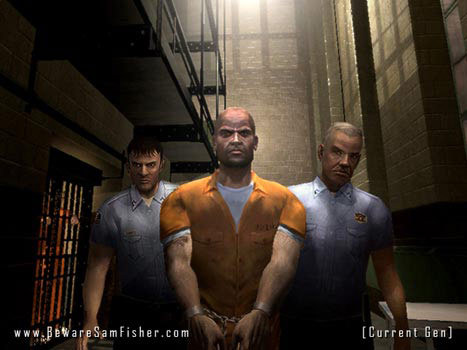
Each assignment is organized around a primary objective with additional tasks that can provide intelligence, equipment access or standing with one of the two agencies. Fisher can review mission objectives and an area map through his OPSAT, while gathered images, emails and sound recordings are filed as separate information. That makes searching rooms useful even when a document is not itself the route to a target: it can add context about the JBA members whose profiles Sam is building, or expose information that helps him understand the next task. Optional goals give the player reasons to revisit a space with a second purpose in mind, but the trust economy means completing every visible task is not automatically neutral. Planning requires knowing who benefits from an action, not simply whether it is possible.
Field missions use the series’ third-person stealth fundamentals. Fisher can crouch to move more quietly and become harder to see, press close to walls, climb pipes and ladders, hang from ledges, cross horizontal pipes, slide along zip lines and enter vents. The visibility indicator reflects both light and sound: shadow can conceal him, bright exposure makes him visible, and a flashing state signals that enemies are searching. When he reaches a guard undetected, he can choose a lethal or nonlethal close attack, interrogate certain captives for information, or carry away an incapacitated body before another patrol finds it. A direct confrontation remains possible, but each noisy or visible action can complicate the infiltration and affect trust.
The PC edition gives Fisher several ways to read and manipulate a location. His OPSAT carries current objectives, area information and recovered material such as images, emails and sound files. Night vision improves visibility in darkness, thermal vision reveals heat sources, and wave vision highlights objects that use electricity. At doors, the player can choose a quiet opening, force the door noisily, pick its lock or slide an optical cable underneath to inspect the next room. Hacking is a timed code puzzle: the device tests possible digits across four columns, while the player can confirm a promising value manually; wrong inputs or a late failure trigger an alarm. Safes use a separate dial-and-tumbler interaction.
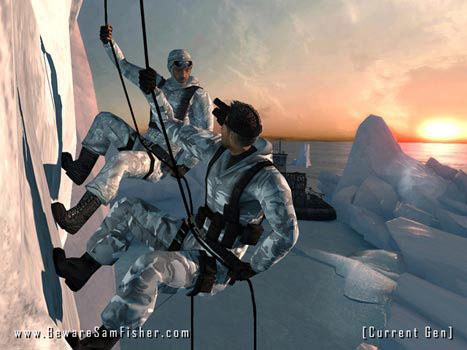
The field assignments take Sam from a tanker in a Russian winter to a war-affected town in Africa. On the ship, narrow passages and patrol routes shape how he moves between objectives; in the town, daylight pushes him toward walls and physical cover instead of relying only on shadows. At select underwater or ice-covered locations, he can pull an unaware guard from the shoreline or strike upward through the ice. The SC-20K rifle, pistol and mission gadgets give him options when stealth breaks down, but the campaign still asks him to track patrols and move carefully toward the next objective. Online features are no longer supported, and multiplayer and co-op modes are no longer functional.
- Developer
- Ubisoft development studios; official page lists Ubisoft Milan, Ubisoft Shanghai and Ubisoft Montreal generally, but does not map studios to PC edition in the page text read
- Genre
- stealth action