
About Tom Clancy's Splinter Cell Chaos Theory
Sam Fisher returns as Third Echelon’s field operative when a captured programmer and a series of international incidents point toward a wider information-war crisis. Across covert missions from a Pacific cargo ship to Tokyo, Fisher gathers intelligence, questions suspects and decides how to pass through guarded spaces using darkness, sound, movement and a flexible equipment loadout.
In Tom Clancy’s Splinter Cell: Chaos Theory, Sam Fisher works for Third Echelon, a covert branch of the NSA that sends a single operative into politically sensitive situations. A crisis begins when American computer programmer Bruce Morgenholt is captured by a Peruvian separatist group, and Fisher is deployed to locate him and recover information. The investigation expands beyond one rescue: communications, records and people encountered on later assignments connect local incidents to a threat involving information warfare and international conflict. Irving Lambert coordinates Fisher’s work from Third Echelon, while analyst Anna ‘Grim’ Grímsdóttir helps interpret technical evidence. Their briefings and updates give the player context for objectives without removing the need to inspect the environments directly.
The campaign moves Fisher through distinct places built around different security problems. The opening operation takes him aboard a cargo ship in the Pacific, where narrow corridors, machinery and decks create intersecting sightlines and patrol routes. Other assignments use spaces such as a bank, a city under blackout conditions and a Tokyo bathhouse, where surveillance, restricted rooms and nearby civilians change the risks of a direct approach. Objectives can include locating a person, securing documents or computer data, planting or altering information, and reaching an extraction point. Primary goals advance the operation, while optional intelligence or evidence can add context and affect the mission result. A briefing introduces the task, then in-mission messages and the OPSAT objective display keep the immediate requirements visible.
Stealth is built around what guards can see and hear. A light meter indicates how exposed Fisher is, while a separate noise meter compares his movement with the sound already present in the area. Crouching slows him and reduces noise; walking, climbing, opening a door or crossing a resonant surface can make different amounts of sound. Machinery, weather and other ambient noise may cover a careful movement, so timing and pace matter as much as simply finding a dark corner. The environment also offers routes above and below eye level: Fisher can climb pipes and ladders, shimmy along ledges, crawl through low passages, rappel from anchor points and move while hanging. Walls, doorways and cover can conceal him while he observes patrols and plans an opening.
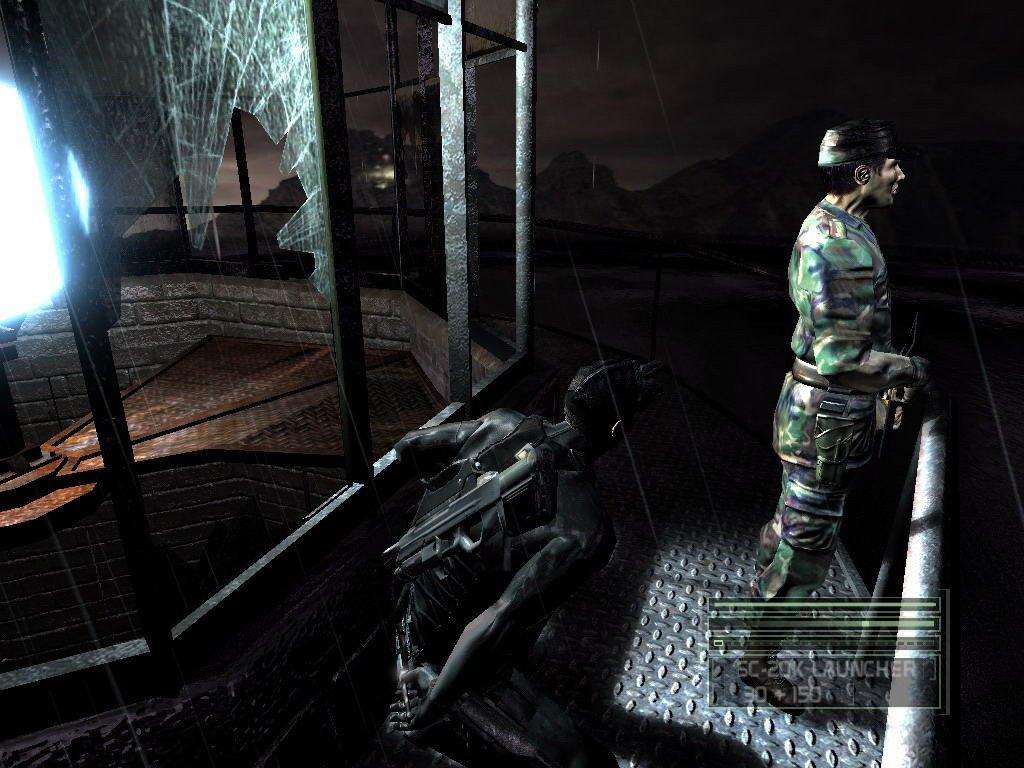
When a route is watched, Fisher can alter the situation instead of immediately engaging. The pistol’s OCP temporarily disrupts lights and electronic devices such as cameras, creating a short window to move or pass a security system. The SC-20K rifle accepts different attachments, including a launcher for tools such as the Sticky Shocker, ring airfoil, gas grenade and sticky camera. A camera can scout from a remote angle, make a sound to draw attention, or release knockout gas at close range; the shocker can disable a target and can also electrify a pool of water. These tools have different effects and limited supplies, so players weigh a quiet distraction or non-lethal takedown against a noisy weapon that may alert nearby guards.
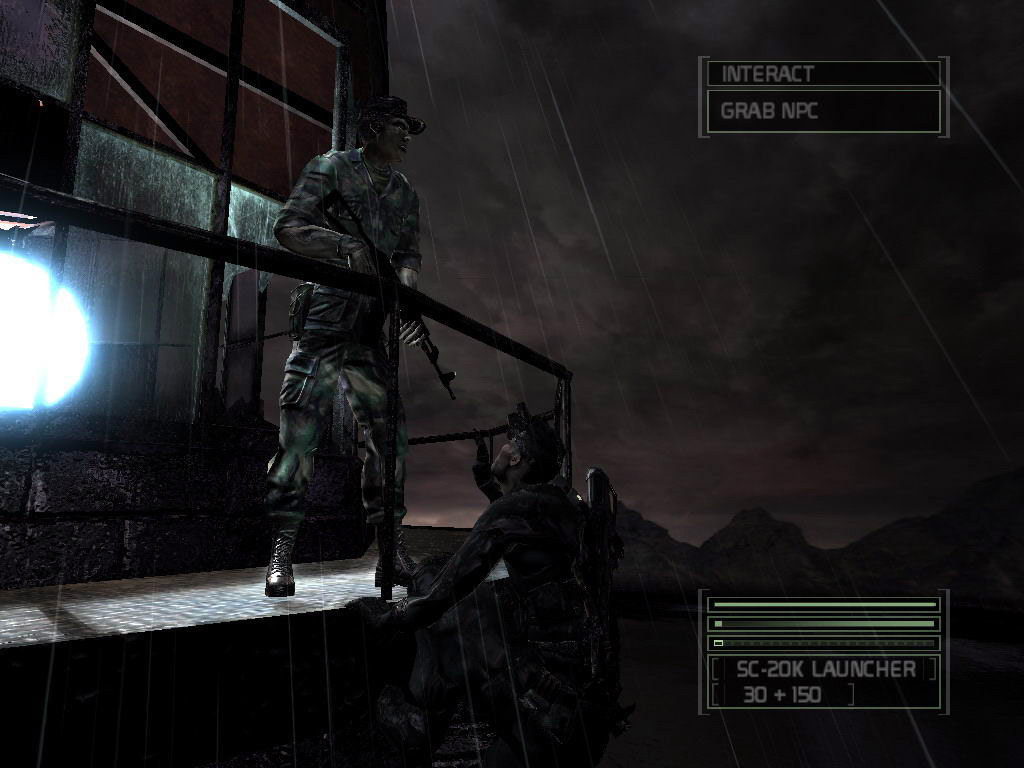
Close encounters offer more than one way to clear a path. Fisher can approach an unaware guard from behind, grab and interrogate him for information, use a lethal or non-lethal close attack, or make a distraction that draws a patrol away from its position. He can hide unconscious or dead bodies because a discovered body can raise suspicion. Some mission objects require a person with access or knowledge; after restraining a suitable character, Fisher may force that person to operate the relevant device. Doorways are interactive choices too: a careful opening can keep noise down, while forcing a door can create a loud entry and may surprise someone on the other side. Computer access, lock picking and physical traversal each ask the player to read the local layout before committing.
Each mission begins with a choice of equipment emphasis: a stealth selection prioritises gadgets, an assault selection carries more ammunition, and William Redding’s recommended arrangement provides a mixed kit. Attachments and available gear expand over campaign progress, giving Fisher options for precision, surveillance or more forceful engagements. The end-of-mission report evaluates objectives and records consequences such as alarms, detection and injuries, so a completed objective is not the only measure of how the operation unfolded. The central rhythm is to observe a route, identify useful cover and ambient noise, then decide whether to bypass, distract, disable or confront whoever blocks the next objective. The original online multiplayer and co-op features are no longer supported, leaving the single-player campaign as the available route through these missions.
The OPSAT keeps mission information close at hand between encounters. Its map helps orient Fisher inside the current area, while collected email and sound files provide material the player can review after finding them. The equipment screen also shows the tools carried into a mission, allowing the player to connect a planned route with the available kit. These records make observation part of the assignment: a terminal may hold more than a progress trigger, and a person or document can clarify what the next objective means. The result is a campaign where movement through a guarded space and the intelligence recovered there work together, rather than treating every level as a sequence of enemies to defeat.
- Developer
- Ubisoft Montreal
- Genre
- Stealth action