
About Tom Clancy's Splinter Cell Blacklist
Sam Fisher leads Fourth Echelon against the Engineers, a group behind a rolling series of attacks called the Blacklist. Across a globe-spanning single-player campaign, scouting, gadgets and movement let players choose Ghost, Panther or Assault tactics, while upgrades between missions expand Sam’s equipment and the Paladin crew’s support.
Tom Clancy’s Splinter Cell Blacklist begins with the Engineers’ ultimatum: a sequence of escalating attacks on United States interests, issued under the name Blacklist. Sam Fisher is tasked with stopping the group and tracing the people and plans behind it. He leads Fourth Echelon, a newly formed covert unit that replaces the disbanded Third Echelon. The team includes Anna “Grim” Grímsdóttir, who handles technical operations; CIA operative Isaac Briggs; and hacker Charlie Cole. Andriy Kobin, an arms dealer known to Sam, is also held aboard the team’s aircraft and becomes a source for black-market weapons. The story moves through operations in Libya, Iraq, Chicago, Paraguay, London, Tehran, Philadelphia, Guantanamo Bay and Colorado. Briefings connect each mission to the wider threat, while the field assignments ask Sam to infiltrate facilities, gather intelligence, locate key people and disrupt attacks.
Fourth Echelon’s headquarters is the Paladin, a repurposed stealth aircraft that serves as a hub between missions. The Strategic Mission Interface presents campaign operations and lets the player follow how the crisis develops across the map. On board, Sam can speak with crew members, choose equipment and improve facilities using money earned through operations. The Paladin is more than a menu screen: its rooms tie named characters to functions in the team. Grim supports technical operations, Charlie works on equipment, Briggs contributes tactical expertise and Kobin can unlock a supply of black-market arms when his holding area is upgraded. Improving facilities can unlock custom loadout slots, change the support available in the field or open additional purchases. This intermission loop links field performance with preparation. A mission’s rewards can therefore feed back into later operations through gadgets, weapon attachments and upgraded support rather than only through a campaign score.
Blacklist lets players approach many encounters through three scored styles. Ghost is built around remaining undetected and slipping through without leaving a trace; Panther rewards quiet lethal precision; Assault covers direct engagements. The player is evaluated for the approach taken, so stealth and combat actions feed different progression tracks rather than one universal ideal. A route may combine styles when conditions change: a distraction can isolate a guard for a silent takedown, while a detected entry can become an open firefight. Sam can move between cover, peek around edges, climb, cross ledges and use overhead positions to avoid patrol sightlines or make an attack. Enemies react to sound, light and missing personnel, which makes pace and positioning part of the plan. The game allows lethal and nonlethal actions, but those choices are not interchangeable: a body left in a patrol route can expose a quiet approach.
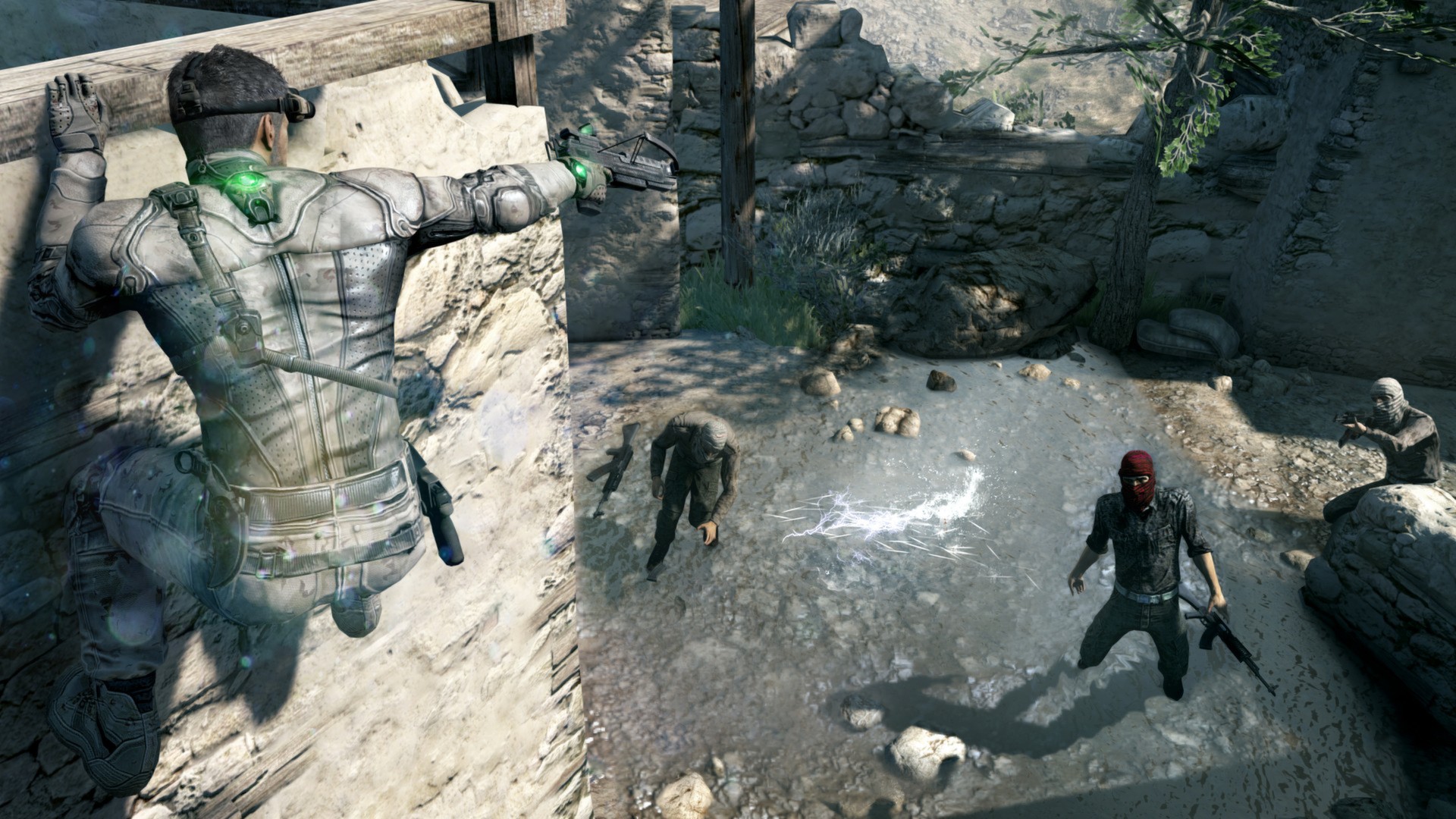
Scouting tools turn enemy positions and electronic obstacles into information the player can act on. Sam’s goggles include night vision, while an unlockable Sonar Pulse can reveal hostiles through walls; later upgrades add tracking for recent footprints and extend the sensor’s capabilities. The Snake Cam can be inserted to inspect the other side of a door, and the remote Micro-Trirotor flies ahead to reconnoitre or fire Sticky Shocker darts. A Sticky Camera gives a remote view, can attract a guard with a sound and can release sleeping gas; Sticky Noisemakers create a separate sound distraction. The Sticky Shocker incapacitates a target with electricity, while an EMP temporarily disrupts nearby lights and electronics. These tools support different decisions: mark a route, draw one guard away, disable a camera or make a passage safer before Sam crosses it. Gadgets and ammunition are limited by the selected loadout, so observation helps conserve the option needed for a later obstacle.
Movement, takedowns and the Killing in Motion system connect stealth to combat without removing the need to plan. From cover, Sam can abduct an opponent, move them out of sight and choose a nonlethal hand-to-hand takedown; lethal close combat uses the curved Karambit. He can also mark multiple hostiles and execute them in a brief sequence when the encounter allows it. That move is powerful, but marking targets does not make the surrounding room safe: other enemies may still see Sam, and loud actions can bring reinforcements. In an infiltrated area, a door can be opened quietly or breached, with the latter risking an alarm and lethal force. Smoke, flashbangs, sleeping gas, tear gas and proximity devices offer different ways to interrupt enemy response. These mechanics encourage players to read patrol spacing, cover, lighting, doorways and escape routes before choosing whether to pass by, incapacitate, eliminate or confront a threat.
After operations, money earned from mission performance can be invested in weapons, gadget upgrades and Paladin improvements. Attachments change practical properties such as suppression, magazine capacity, recoil control and sight magnification; goggles upgrades add functions to the sonar system, while equipment purchases expand the tools Sam can select before deployment. The Crew Quarters can unlock additional custom loadout slots, and the Holding Cell upgrade allows Kobin to offer more black-market weapons. Campaign missions are accompanied by separate 4E missions that provide additional operations for solo play; online co-op and competitive modes were also part of the original product design, but Steam and Ubisoft now state that online features, multiplayer and co-op are no longer supported or functional. These discontinued modes are separate from the single-player campaign and solo operations. Its central loop is clear: choose a mission, prepare a loadout, read the space, carry out the objective, then use the result to shape the next deployment.
- Developer
- Ubisoft Toronto
- Genre
- Stealth-action shooter