
About Sniper Elite 5
In Sniper Elite 5, Karl Fairburne works with the French Resistance in occupied France in 1944, after a covert US Rangers operation brings him behind the Atlantic Wall. Their investigation uncovers Operation Kraken, a Nazi project directed by Abelard Möller. The campaign combines tactical sniping with broad missions, weapon customisation and optional online modes.
The campaign places elite marksman and SOE operative Karl Fairburne in France in 1944, with D-Day approaching. He is attached to a covert US Rangers operation intended to weaken the Atlantikwall fortifications along Brittany's coast. After becoming stranded behind enemy lines, Karl makes contact with the French Resistance. Together they uncover Operation Kraken, a secret Nazi project that could alter the course of the war before the Allied invasion. Its mastermind is Abelard Möller, an Axis officer whom Karl must pursue while gathering intelligence and disrupting the plan. That premise gives the missions a broader purpose than eliminating individual soldiers: objectives, intelligence and high-ranking targets all contribute to uncovering what Kraken is and stopping it. The story keeps Karl operating behind enemy lines among German forces and local resistance networks.
Missions unfold across large locations inspired by real places and recreated with photogrammetry. Rather than funneling Karl along a single firing lane, each area offers several infiltration and extraction points, optional objectives and kill-list targets. The player can survey a position, decide which objective to approach first and choose routes that suit the immediate threat. Improved traversal opens additional paths: Karl can use ziplines, slide down slopes, climb vines and move along ledges to find a new angle or bypass a lookout. These routes feed the central tactical loop of reconnaissance, movement and engagement. A high vantage point can support a distant shot, while a concealed approach may bring Karl close enough to use quieter weapons or perform a takedown. The same objective can be reached through different parts of the environment, so route choice shapes how an encounter begins.
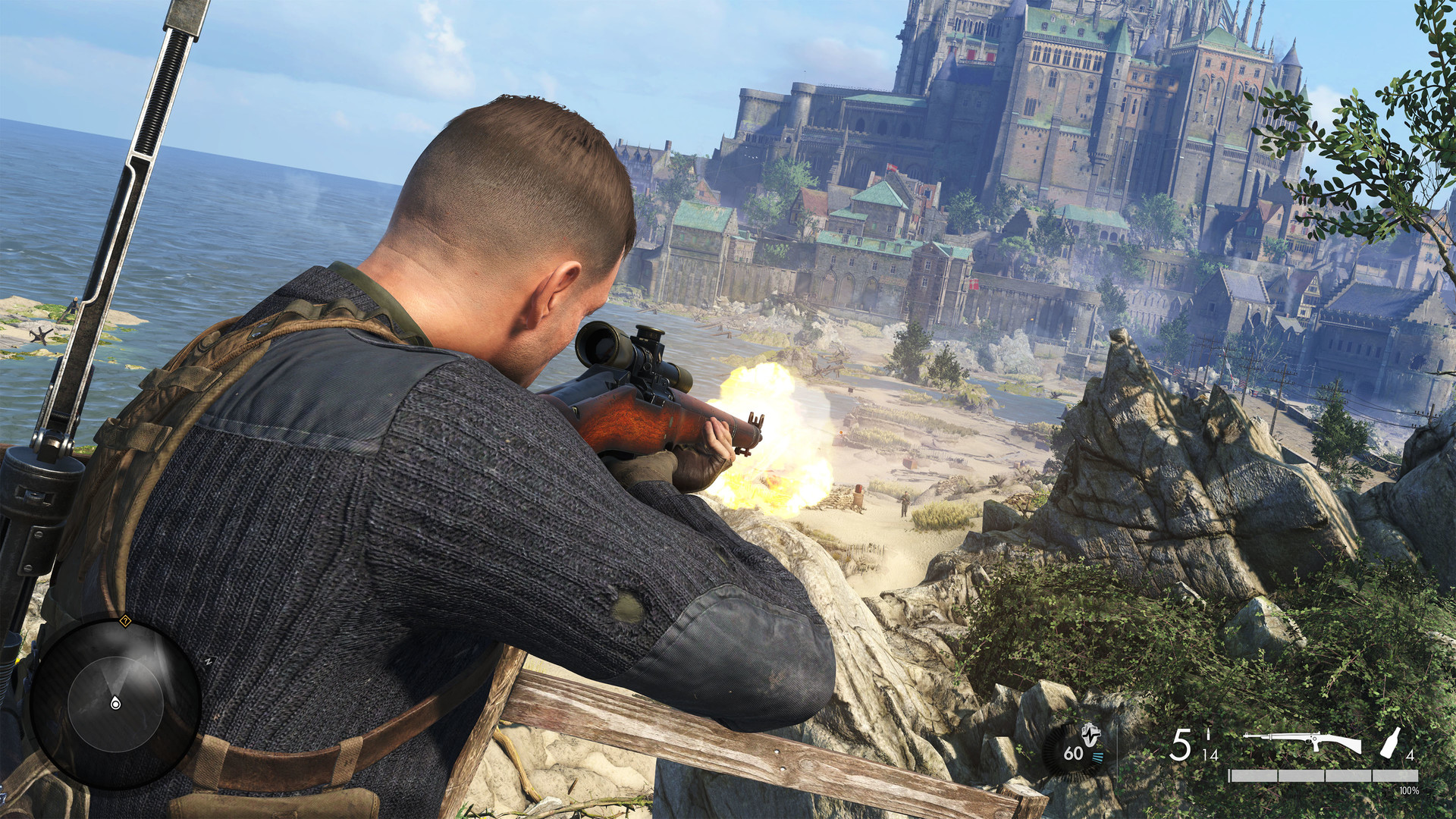
Sniping depends on more than placing a reticle over a target. Gravity, wind and Karl's heart rate affect a shot, and the selected rifle stock and barrel also influence handling. Running, climbing and being hit raise his heart rate, while taking time to settle can make aiming steadier. The player can look for an opening, account for these factors and fire when the target and conditions line up. If the approach collapses, tactical third-person combat supports movement between cover and close-range use of secondary weapons. The enhanced X-ray kill cam follows successful shots; in this entry, pistol and submachine-gun kills can also trigger it. Bone can deflect bullets, and the camera may show multiple impacts in slow motion. The feature links the game's distinctive shot feedback to more than rifle fire while leaving the player responsible for positioning and timing.
Workbenches turn exploration into weapon progression. They are hidden within mission maps, and discovering them unlocks customisation choices for the rifle, secondary weapon and pistol. At a bench, Karl can change components such as the stock, magazine, receiver, barrel, scope and iron sights, as well as the weapon's materials. These choices alter how a weapon is suited to a particular distance or approach, and the player can revise a loadout during a mission rather than restart it. Karl can select ammunition to match a target, from armour-piercing rounds to non-lethal options. Finding a bench therefore has both immediate and lasting value: it provides a place to adapt equipment for the current situation and adds options to later planning. Different weapon builds let a player balance characteristics around the mission and preferred style.
The main campaign can be played alone or with one online partner. Cooperative play adds practical coordination: partners can share ammunition and items, give each other orders and heal one another. Invasion Mode adds an optional opponent to a campaign. An Axis sniper can enter another player's mission and hunt Karl; in return, Karl gains the objective of finding and eliminating the invader. The Axis player can use nearby Axis soldiers to help locate the Allied sniper, while Karl can use phones placed around the level to seek information about the invader. The mode can also operate when Karl already has a co-op partner, changing the hunt into a contest against two Allied players. Players who want the campaign without that interruption can switch Invasion Mode off in the menu.
Outside the campaign, adversarial multiplayer offers sixteen-player matches with customisable characters and loadouts, awarding experience, medals and ribbons. Modes include Free-for-All, Team Match and No-Cross, plus Squad Match's four teams of four; players can adjust a match's score type, score cap and time limit, with cross-play across systems. Multiplayer also has its own progression: weapon challenges unlock attachments, skins and weapons, and each level adds perk points for class perk trees. Sniper is the default class; Scout, Medic, Engineer and Assault can be chosen as secondary classes. Tagging an opponent broadcasts their position to the team, and a teammate's kill earns a tag-assist bonus; reviving an ally can protect the team's score. Decoys generate scope glint to lure shots and can expose an opponent's position if destroyed, while supply drops offer heavy weapons but tag opponents within 50 metres. Survival instead teams up to four players against waves of enemies. Kraken Awakes is a separate DLC mission pack that requires the base game.
- Developer
- Rebellion
- Genre
- Third-person tactical shooter with stealth, sniping and online modes