
About Sniper Elite 4
Sniper Elite 4 sends Allied marksman Karl Fairburne to Italy in 1943, where he investigates a German weapons threat and works alongside the Italian Resistance. Large mission areas combine long-range ballistics, stealth, traversal, sabotage and optional tasks, letting the player choose how to reach and complete each objective.
Set in Italy in 1943, Sniper Elite 4 follows Karl Fairburne as the Allies prepare to invade the country and investigate a German weapons project that could threaten their advance. The campaign places him among the Italian Resistance, Allied intelligence operatives, Italian troops, Fascist Black Brigade fighters, Mafia figures and Nazi forces. Its story unfolds across the peninsula, from coastal settlements and wooded valleys to forests and military installations. Karl is a marksman working ahead of the Allied advance, so his assignments revolve around identifying threats, neutralising key targets and disrupting enemy operations. Documents, conversations and information gathered with binoculars add context to the people and factions he encounters, while the central objective in each mission keeps the operation moving without requiring every optional story detail to be found.
Campaign missions take place in broad environments with multiple routes, vantage points and entrances. The player can survey a site with binoculars, tag soldiers and vehicles, and note how patrols move before choosing a path. High ground may provide a long firing line; climbing, shimmying along ledges or crossing rooftops can open another angle; a tunnel or concealed approach can lead behind a guarded position. Main objectives can be pursued alongside side missions, kill-list targets and hidden documents or collectibles. Some optional tasks reveal more about the local situation or weaken enemy control, but the player can also head directly toward the principal target. The map therefore functions as an operational space to study, not a linear chain of rooms, and changing the approach changes which threats have to be handled first.
A rifle shot depends on range, gravity, wind and Karl’s physical state. Running, climbing or taking damage raises his heart rate and increases scope sway; settling into a lower stance and pausing lets it fall. Empty Lung can temporarily steady the aim, while scope zeroing helps compensate for bullet drop after binoculars reveal a target’s distance. At higher difficulties, wind also affects the bullet’s path and tactical assistance is reduced or removed, changing how much the player must judge from the environment. The X-ray kill camera follows selected shots through their impact, and the game also frames some melee kills and explosive traps. These features sit within a broader combat loop: scout, choose a firing position, make the shot, then decide whether to hold the area, move or use a different tool.
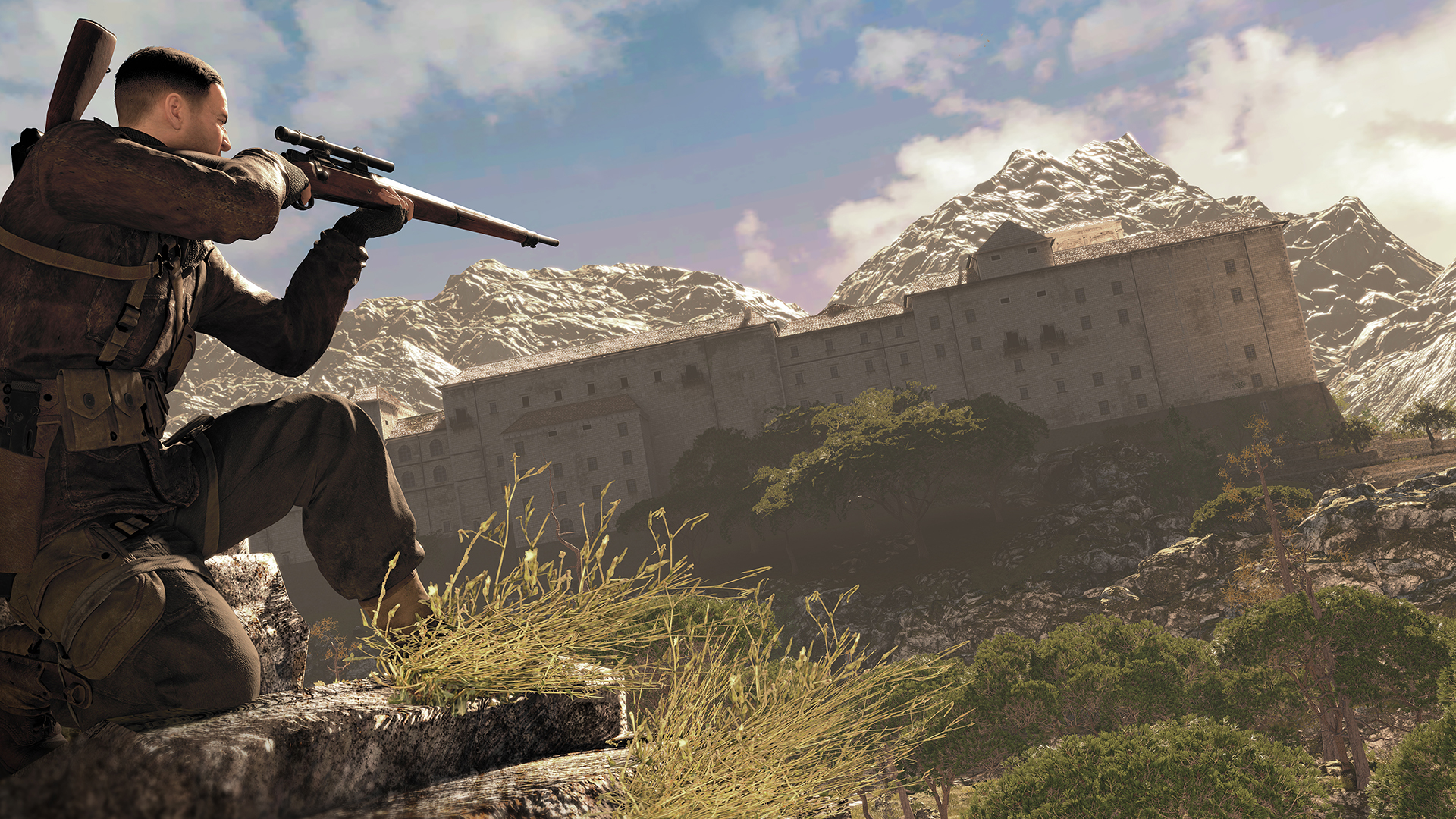
Stealth depends on controlling what enemies can see and hear. Tagged opponents have alert states that shift from passive to cautious or combat, and the nearby awareness display helps show when they are searching or have found a threat. Rocks and whistles can draw patrols away from companions, while suppressed ammunition makes a compatible weapon quieter but is a limited resource that must be found and selected. Environmental sound masks offer another chance to fire without drawing the same attention. If an enemy investigates a fallen soldier, an explosive trap on the body can turn that search into an ambush; mines, grenades and explosives can also be used against vehicles. A discovered player can retreat through the level’s traversal routes, hide, or reposition to break the immediate line of pursuit rather than treating detection as an automatic mission failure.
The weapon and skill systems let Karl prepare for different encounters. Loadouts can be saved with distinct weapons, equipment and skills, and as XP accumulates, Karl also gains Sharpshooter Tokens used to unlock additional items and weapons. Weapon traits include damage, muzzle velocity, recoil dampening, stability, zoom and rate of fire, so choosing a rifle or adjusting its setup involves trade-offs between precision, handling and the time needed for follow-up shots. Skills can be selected at rank milestones and reconfigured between missions. The arsenal extends beyond rifles to pistols, submachine guns, heavy weapons, traps, grenades and explosives. Work in close quarters can use takedowns and traversal attacks, while a distant approach may rely on careful ballistic shots; loadout choices determine which options are ready when a plan changes.
The base game includes the main Italy campaign, solo play, online two-player campaign co-op, dedicated cooperative modes and competitive multiplayer. In Overwatch, partners divide the work between a sniper who covers from a distance and an operative who moves on the ground with an SMG and binoculars for marking targets. Survival supports two to four players defending command posts against successive waves, with positions and supplies becoming part of the team’s problem. Competitive modes use custom maps and objective or sharpshooting rules. Separately sold campaign expansions add missions beyond the base campaign, while other DLC packs add weapons or character and cosmetic content. This distinction matters because the story’s Italy operation belongs to the base game, while later purchased mission packs are additional campaign chapters rather than required scenes within that core sequence.
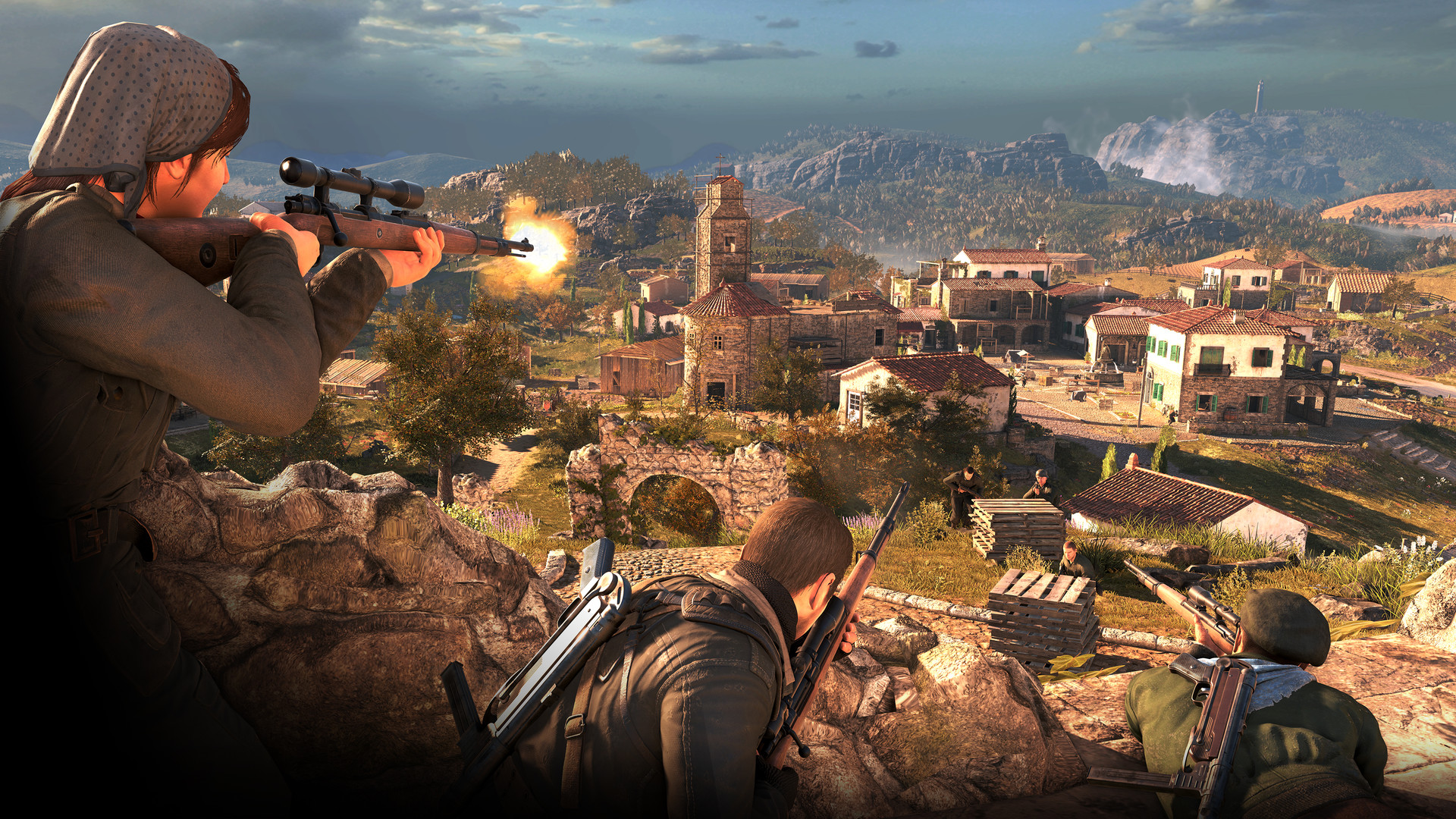
Between operations, mission select lets the player return to completed campaign levels, while a service record tracks statistics, collected items, documents, ribbons and medals. Solo Survival offers a separate way to face increasingly difficult waves, and the shooting range provides a place to try weapons and practice aiming. These systems give progression a rhythm beyond the main objective: XP and tokens contribute to equipment choices, documents preserve pieces of the setting, and replaying a mission makes it possible to pursue missed side objectives with another loadout. The result is a campaign structure in which preparation, observation, movement and shooting remain linked, whether Karl is operating alone or coordinating with a partner.
- Developer
- Rebellion
- Genre
- Action-adventure and tactical third-person shooter with stealth and sniping