
About Sniper Elite 3
In Sniper Elite 3, Allied marksman Karl Fairburne crosses North Africa in 1942 during the Second World War to disrupt a German weapons programme. Across desert canyons, oases and occupied settlements, he studies patrols, chooses routes, and combines long-range shooting with stealth, close combat, distractions and sabotage.
Sniper Elite 3 follows Karl Fairburne, an Allied marksman operating behind enemy lines in the North African theatre in 1942. His assignment grows around a German weapons programme whose success could threaten the Allied position. The campaign moves through the Western Desert’s canyons, oases, settlements and military installations, with the Afrika Korps as the main opposing force. Rather than treating each mission as a corridor from one firefight to the next, the game places objectives inside broad areas that can be approached from more than one direction. The surrounding terrain matters because it offers ridges for observation, cover for movement and routes around guarded approaches. Fairburne’s work is a sequence of reconnaissance, infiltration, sabotage and escape, with the immediate task in each location shaping how much of the surrounding enemy force he must confront.
A mission begins with a primary goal and can include secondary objectives that help weaken the opposition or alter the conditions of the operation. These tasks need not be completed in a single prescribed order, so a player can first remove a lookout, investigate a nearby position or move toward a key installation. Binoculars let Fairburne survey soldiers and vehicles, mark targets and follow their positions through the environment. That information helps map a route before he moves into range. Crouching and crawling reduce exposure, while climbing or crossing higher ground can open a view over a guarded space. The levels reward reading the layout: a direct path may offer a clear firing lane but leave the shooter exposed, whereas a longer approach can bring him behind patrols or close enough for a quiet takedown.
Rifle shooting is governed by more than the direction of the crosshair. Distance changes the amount of bullet drop, and higher difficulty settings add wind to the calculation. Fairburne’s heart rate rises after exertion or injury, making the scope less steady; slowing down and lowering his stance helps it settle. Emptying his lungs can steady a shot temporarily, and at a sufficiently low heart rate the game can slow the action while the player lines up a difficult target. Difficulty settings determine which of these aids are available, as well as how much information the interface provides. A shot can trigger the X-ray camera, which follows the bullet into the target, while vehicle shots can show damage spreading through vulnerable parts. These effects accompany the ballistic system rather than replacing the decisions about range, position and timing.
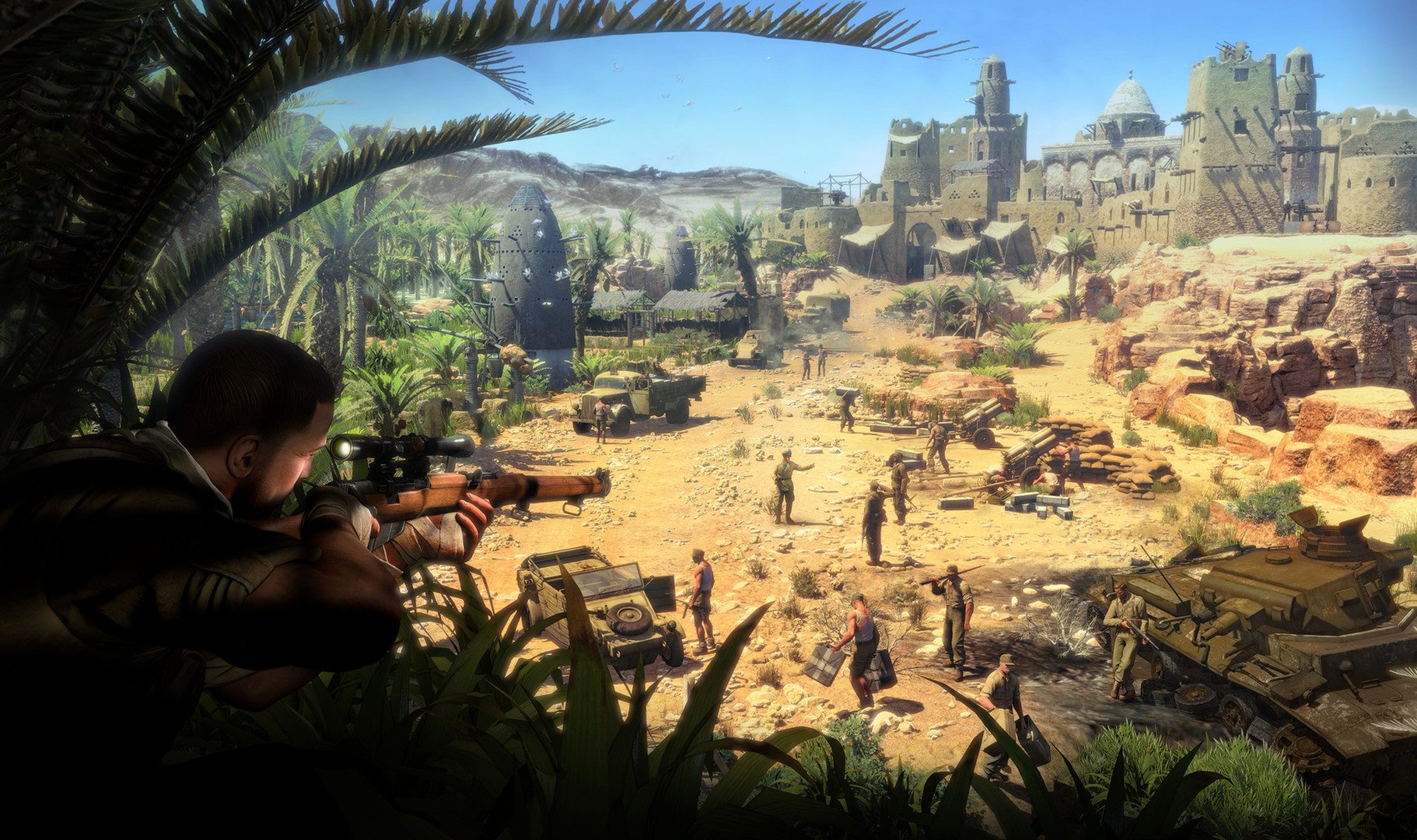
Firing also changes the enemy’s behaviour. Soldiers who hear a shot may take cover, search toward its likely source and eventually attack if they become confident about Fairburne’s position. A relocation indicator tracks how much the opposing force has narrowed down that location; moving far enough away before a full search begins can clear the trail and let the hunt continue from another position. Environmental noise creates another option: firing beside a loud generator or similar sound source can mask a shot and delay detection. Rocks and whistles can draw a patrol away from its companions, and traps can turn a body or a narrow approach into a hazard. These tools make stealth an active process of shaping what enemies hear and where they look, rather than simply remaining out of sight.
The available responses extend beyond the scoped rifle. A loadout includes a primary rifle, secondary weapon and sidearm alongside ammunition and equipment, with different weapons supporting different distances and levels of noise. Fairburne can use melee takedowns when he reaches a guard unseen, place explosives, exploit grenades carried by soldiers, or target machinery and weak points on vehicles. A vehicle may require several components to be disabled rather than one ordinary hit, so the player can use binoculars to identify vulnerable parts and decide whether to spend ammunition or approach with a trap. If stealth breaks, the mission can become a direct fight, but the limited supplies and the risk of attracting reinforcements make staying mobile valuable. Returning to cover and changing position can reopen options that a fixed firefight would close.
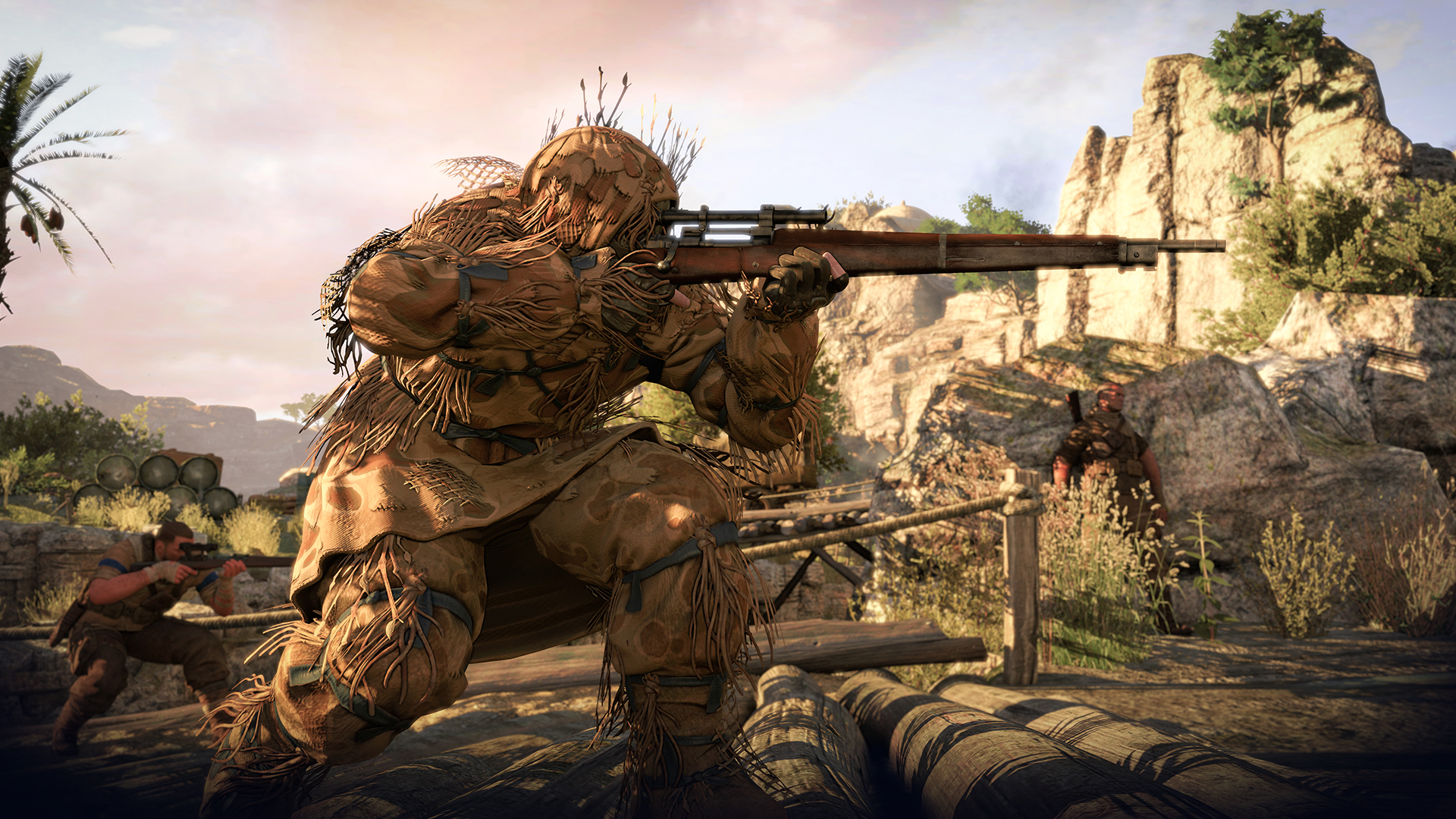
The base campaign is built around its North African operation; the separately sold Save Churchill missions and Target Hitler mission add campaign content outside that core story, while weapon and outfit packs are equipment or cosmetic additions. The main game also supports two-player online campaign co-op and separate Overwatch and Survival modes. In Overwatch, one player operates as the distant sniper while the other takes the operative role on the ground, combining binocular spotting with close-range movement. Survival instead asks a team to hold against waves of Axis troops, while competitive modes focus on opposing marksmen. These modes give the same tools different purposes: scouting and cover can coordinate a paired advance, or a defensive position can become the centre of a wave-based fight. The story missions remain structured around Fairburne’s covert work in North Africa and the German programme he is sent to disrupt.
- Developer
- Rebellion
- Genre
- Tactical third-person shooter with stealth and sniping