
About Smushi Come Home
After a bird carries Smushi away from home and leaves the tiny mushroom in an unfamiliar forest, the journey back unfolds through woodland exploration, conversations, small favors, platforming and puzzles. Run, swim, climb and glide between areas, use new tools to open routes, and record real mushroom species in a field journal.
Smushi Come Home begins with a separation: Smushi, a small mushroom, is taken from home by a bird and dropped into a forest far from familiar surroundings. The goal is to find a way back, but the forest is not treated as a hostile wilderness to defeat. Instead, its different areas form a connected journey in which the route home becomes clearer through encounters, errands and newly available ways to move. The developer describes the setting as an overgrown forest long after humans have left; the scale of the plants and ordinary objects makes Smushi’s small size central to how the world is seen. Forest creatures are part of the journey rather than enemies to fight. Some offer help, while others need Smushi to solve a problem or complete a task. That exchange gives the return trip a social shape: progress comes from learning what is happening around each place and assisting the inhabitants, as well as from reaching the next path. The premise stays focused on getting home, while the optional conversations and favors make the forest feel like a community with its own daily concerns.
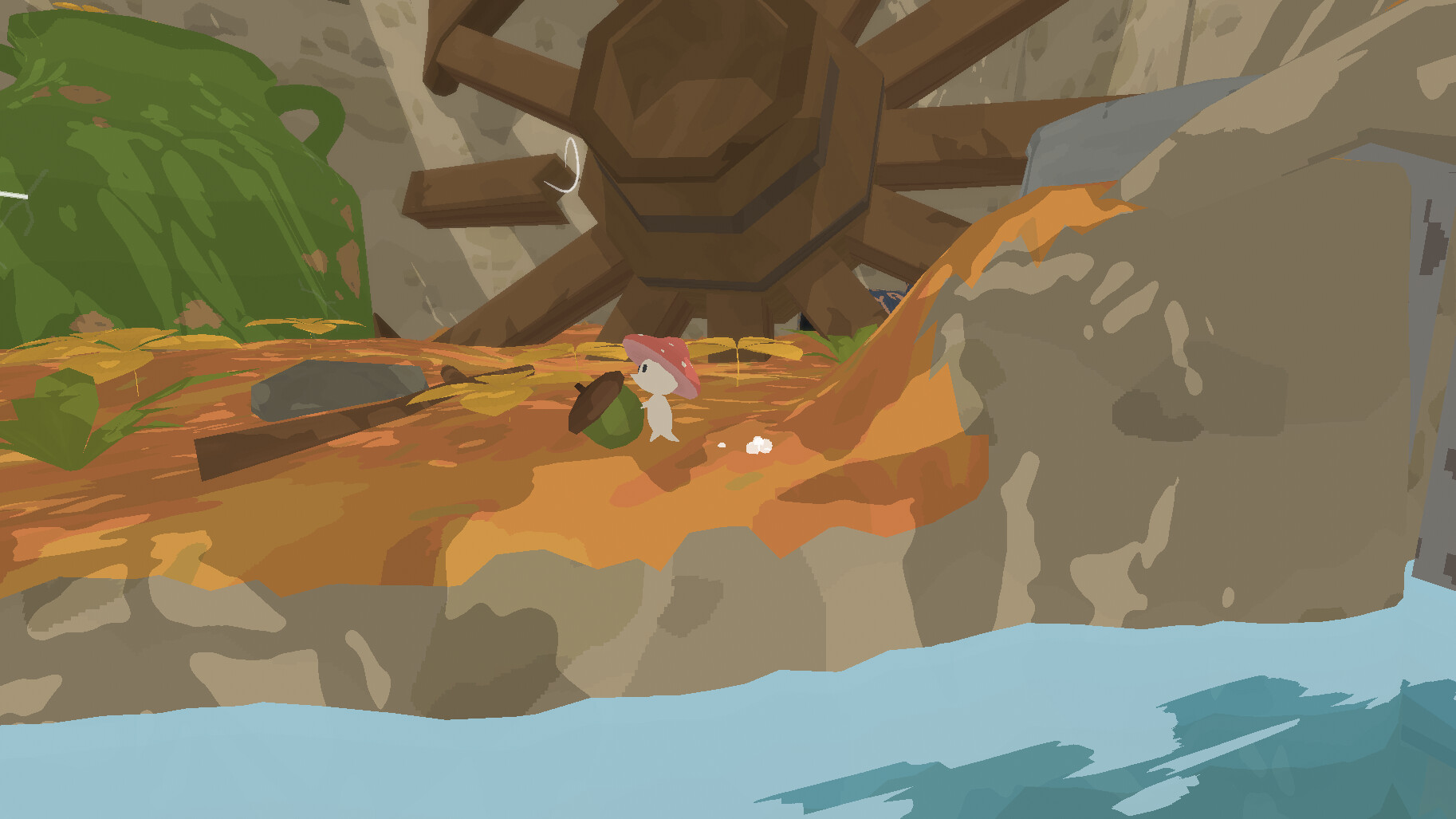
Movement ties the areas together. Smushi can run, jump, swim and climb, while a leaf glider carries the character across open gaps. The climbing hooks let Smushi catch a wall and push off for an additional jump, turning a vertical surface into a route rather than a dead end. The glider serves a different purpose: it converts height into horizontal distance, so a ledge, slope or launch point can help reach platforms across the forest. These tools are introduced as practical equipment for traversal, and later improvements extend how high Smushi can climb and how far the glide can travel. That makes movement progression easy to read in the environment: a previously unreachable ledge or broad gap can become manageable after an upgrade. Swimming adds another way through the landscape, while light platforming asks the player to combine these abilities with timing and positioning. The game describes exploration as open and paced by the player, with no time limits or game overs. Its challenges therefore center on finding a workable route and handling small movement sequences, not on surviving combat or racing a countdown.
Exploration is organized around distinct forest areas that invite detours while keeping the homeward goal in view. The official descriptions emphasize that players can explore freely and take on adventures at their own pace. In practice, that structure connects traversal with observation: a creature’s request, an obstacle in the landscape or an unfamiliar route can give a reason to look around before moving on. The tasks are local in scale, such as helping a resident, locating something they need or taking part in a light platforming challenge. Puzzles are also part of the journey, but the published descriptions characterize them as light rather than as a separate complex puzzle system. The forest’s layout supports these different activities by mixing walkable ground with climbable surfaces, water and gaps suited to gliding. Because the tools have distinct uses, exploration can mean checking a wall for a climb, looking for a launch point, or following a water route, as well as speaking with inhabitants. The game does not frame discovery as a race for territory or a combat loop. It gives space to move between these small objectives, and progress comes from making connections between what the environment permits and what the people Smushi meets ask for.
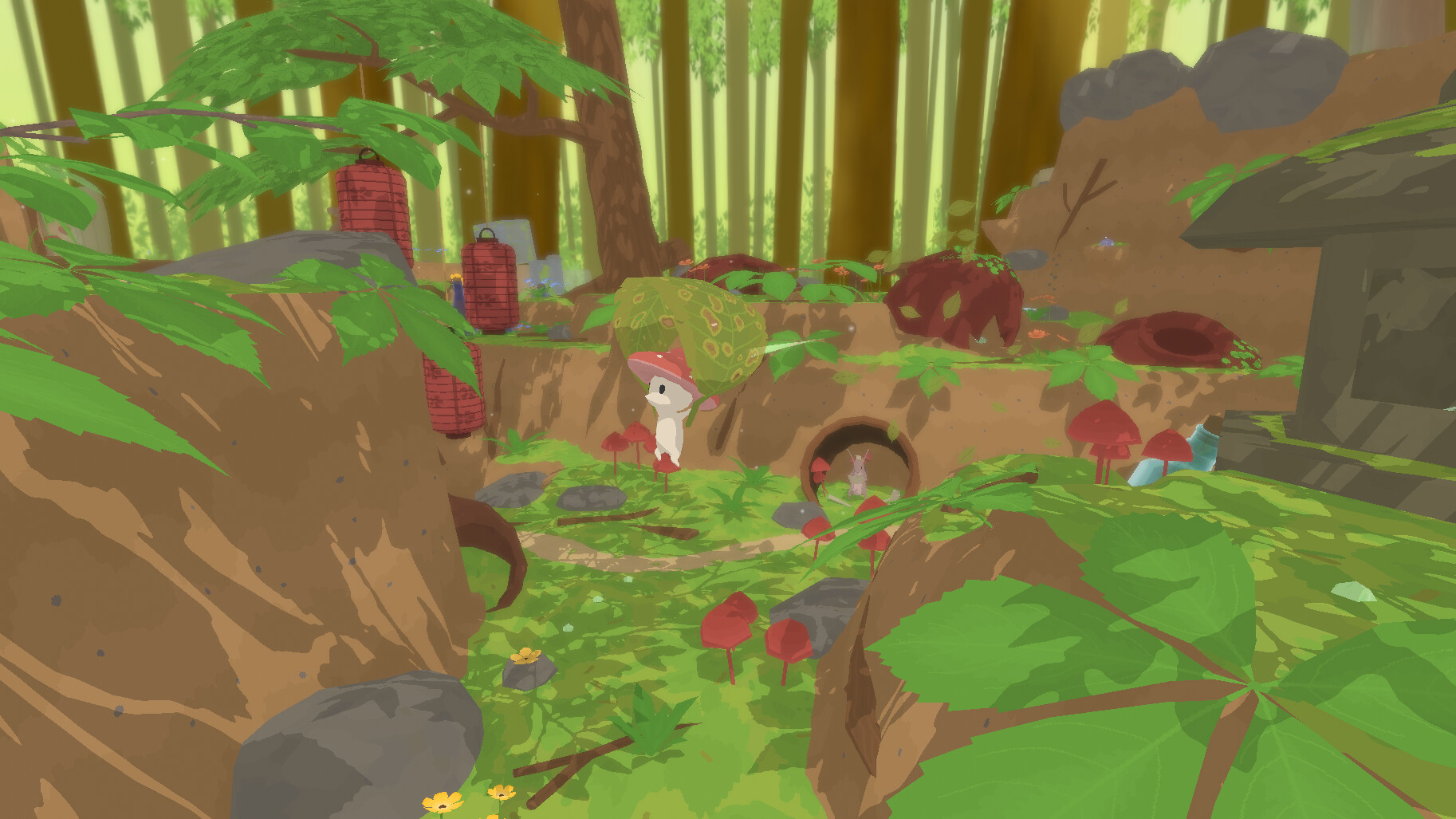
Quests and small problems provide the main structure for moving forward. The forest creatures Smushi meets can give assistance or ask for it, and their requests lead into short adventures that use the movement and puzzle elements. Some barriers require specific tools: a mining tool breaks rocks, while the Blade of Power cuts vines. Other obstacles can call for a nearby item, and some encounters are resolved by helping someone with a simple need. This makes favors more than dialogue stops: they send Smushi into the surrounding area, where routes and objects become part of completing the request. The developer’s overview describes puzzles scattered through the forest alongside light platforming, and the publisher’s description likewise presents both as parts of the journey home. There is no combat system to master; the creator’s account explicitly describes the game as having no combat or game overs. Instead, the activity shifts between talking, navigating, collecting or using an object, and completing a small challenge. The tone of those exchanges is conveyed through quirky forest residents and short conversations. The result is a progression rhythm built around clearing a local concern and continuing through the forest, rather than defeating a chain of stronger opponents or following a branching battle campaign.
Progress also includes discoveries and optional rewards. A Mycology Journal records real-life mushroom information, giving collected species an informational place beyond their appearance in the forest. Mushroom cap skins provide a cosmetic reward that changes Smushi’s look. The traversal tools can be improved, with the climbing hooks and leaf glider gaining greater reach according to the contemporary account of their functions. These different rewards serve separate purposes: journal entries record what has been found, skins personalize the character, and equipment upgrades expand movement possibilities. The free post-game update adds another layer after the main return-home story. A 2024 update added new areas and an effort to restore the Heart of the Forest, with additional characters, items, mushrooms, skins, mechanics and music. The same update added a secret upgrade and two speedrunner modes. Its notes say the new content can be started by speaking with a capybara in the Lake of Bloom area. This places the update after the original journey and ties its entry point to an existing character and location, rather than presenting it as a separate unrelated campaign. The full current game therefore includes both the trip home and this additional post-game forest adventure.
The presentation reinforces the difference between Smushi and the oversized woodland around them. The developer describes a low-poly 3D world with an optional pixelated look: players can switch that pixel effect on or off. The small protagonist is set against larger plants and objects, while the forest remains readable through simple shapes and restrained textures. The creator’s art discussion identifies details such as veins in leaves, color on flower petals and worn marks on objects, balanced against the pixel treatment so that scenery does not become visually noisy. A depth-of-field effect softens near and distant objects, supporting the miniature scale and keeping attention on the space around Smushi. Light filtering through foliage and a detailed forest backdrop establish a calm outdoor setting even when the character is lost and unsure of the route. These choices matter to play as well as mood: visible ledges, plants, gaps and water help distinguish possible routes through the environment. The result is a stylized forest adventure where movement and local discovery remain easy to follow, while the optional pixel effect lets the same low-poly scenes take on a more overtly retro appearance.
Some of Smushi’s side encounters turn on how forest residents treat one another. One task involves a capybara family working through disagreements; helping them means reminding them to respect their differences. Another character expresses a cynical view of the world, and Smushi responds by speaking about the value of kindness. These moments make conversation part of the game’s small-scale problem solving: the task is not always to locate an object or cross an obstacle, but to understand what is troubling a resident and respond. The characters’ concerns also give the woodland a social dimension alongside its physical routes. A glider can carry Smushi across a gap and climbing hooks can open a way up a wall, but these tools do not settle the disagreements encountered along the path. Instead, the game lets requests and conversations sit beside traversal and light puzzles as different kinds of progress. The capybara family episode is a concrete example of how helping other creatures can shape the journey, while keeping the stakes within the gentle, non-combat structure of the adventure.
- Developer
- SomeHumbleOnion (Noah Lone)
- Genre
- Adventure / exploration platform game; publisher press kit labels it Adventure, RPG.