
About Slime Rancher
As Beatrix LeBeau, a rancher on the distant Far, Far Range, you collect and raise the planet’s gelatinous slimes. Use a Vacpack to gather creatures, food, plorts and resources, then build corrals and farms, sell plorts for Newbucks, improve your equipment and explore new regions. Each outing feeds a growing ranching operation.
Slime Rancher places Beatrix LeBeau on the Far, Far Range, where she inherits the ranch once owned by Hobson Twillgers. The first-person view makes the Vacpack both a tool and the game’s main way of handling the world: it can draw in nearby slimes, food, plorts and loose resources, then fire selected items back out. The ranch sits beside open wilderness populated by different slime species and harvestable food. The broad goal is to turn this remote homestead into a working operation while learning what the surrounding regions contain. The game leaves room for a player to focus on collection, building, discovery or a mix of all three, but each activity connects through the ranch economy: slimes need suitable food, feeding produces plorts, and selling plorts funds further expansion.
The daily loop alternates between excursions and ranch work. In the wild, Beatrix searches for slimes and the fruits, vegetables or Chickadoos that match their diets, while the Vacpack’s separate storage slots make each trip a matter of choosing what to bring back. Back at the ranch, vacant plots can become corrals for most slimes, gardens for crops, coops for chickens, ponds for aquatic slimes, or storage and utility structures. A garden grows one plant type, while a coop supports a supply of hens and roostros. Corrals can be improved with features such as higher walls, an overhead net, an auto-feeder and a plort collector. These choices turn captured creatures and foraged food into repeatable production, but the player still decides how many slimes to keep and how much care each pen requires.
Every ordinary slime produces a plort after eating food, and a slime’s preferred food yields more than an ordinary meal. Plorts are collected with the Vacpack or gathered by a corral collector, then sold through the Plort Market for Newbucks. Market prices shift, so plorts can be sold as soon as they are collected or stored before a later sale. The income buys ranch plots, Vacpack upgrades and new equipment; some upgrades expand carrying capacity or movement, making longer supply runs possible. Daily requests from other ranchers offer a separate way to earn rewards by delivering specified items. These systems make the player juggle immediate needs against future capacity: a crop plot uses space that could hold slimes, while a new corral creates more output but also requires food and containment.
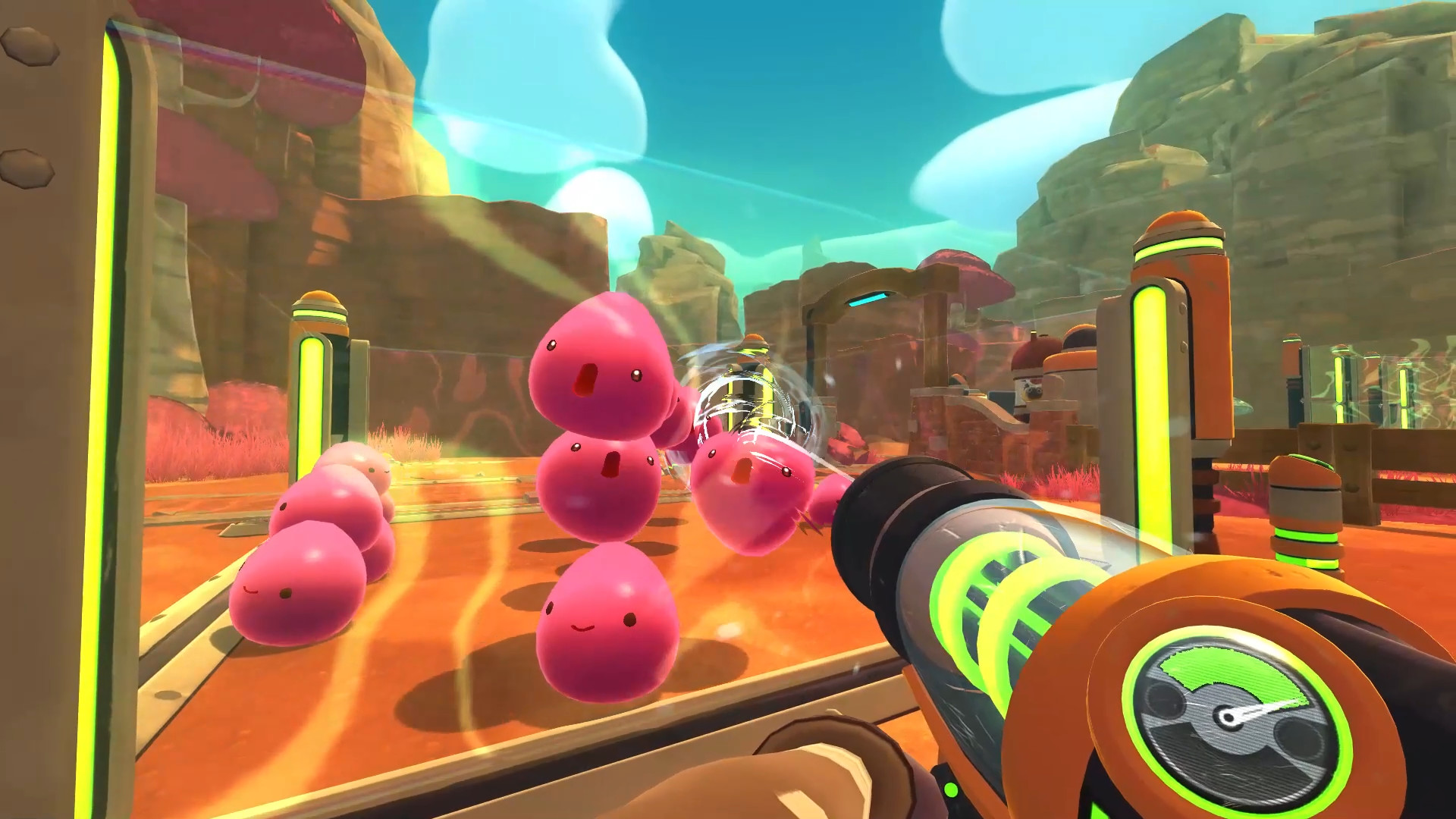
Combining species creates Largos, larger slimes that inherit the traits and diets of both source types and produce both kinds of plort when fed. The combination can make a ranch more space-efficient, but it also changes what a slime eats and how it behaves. A Largo formed with a flying species may need protection from escaping, while one with a more energetic species can require extra containment. There is a hazard behind the production logic: if a Largo eats a third kind of plort, it becomes a Tarr, a hostile slime that attacks other slimes and can spread through a ranch. Separation, collecting stray plorts, and choosing where to place corrals therefore matter as part of ordinary ranch management. The system encourages experimentation with useful combinations while giving loose plorts and careless mixing meaningful consequences.
Exploration gradually opens more of the Far, Far Range, whose named areas introduce new slime varieties, food, scenery and resources. Large Gordo slimes cannot be carried in the Vacpack; feeding one enough of its preferred food makes it burst and can reveal items or access onward. Slime Keys from some Gordos open sealed doors, while teleporters connect distant points and can shorten return trips. The map therefore advances through a mix of discovery and preparation: the player may leave with an empty inventory to collect supplies, then return with new species or resources that support another ranch expansion. The Moss Blanket and Indigo Quarry, for example, introduce additional slime varieties and resources that broaden what the ranch can support.
The ranch’s later development adds Slime Science through the Lab, an expansion containing Hobson’s former workshop. Plorts and gathered materials can be used there to fabricate gadgets, decorations and useful devices, giving the player a reason to reserve resources rather than sell everything. Crafted devices such as teleporters, warp depots and hydro turrets offer a distinct use for production beyond money, changing how the player travels or responds to hazards. The Range Exchange gives requests from other ranchers, including specific item deliveries in return for rewards and upgrades. Adventure is the standard mode for open-ended ranch development; Casual follows its structure without Tarr and with less aggressive feral slimes; Rush challenges the player to earn Newbucks within a limited time. In Rush, Range Exchange requests can extend the run, while prepared gadgets and ranch planning shape its faster pace. The three modes frame the same collection, feeding and ranch-building systems around sustained exploration, a gentler environment or a short, score-focused run.
- Developer
- Monomi Park
- Genre
- First-person sandbox ranching and exploration simulation