
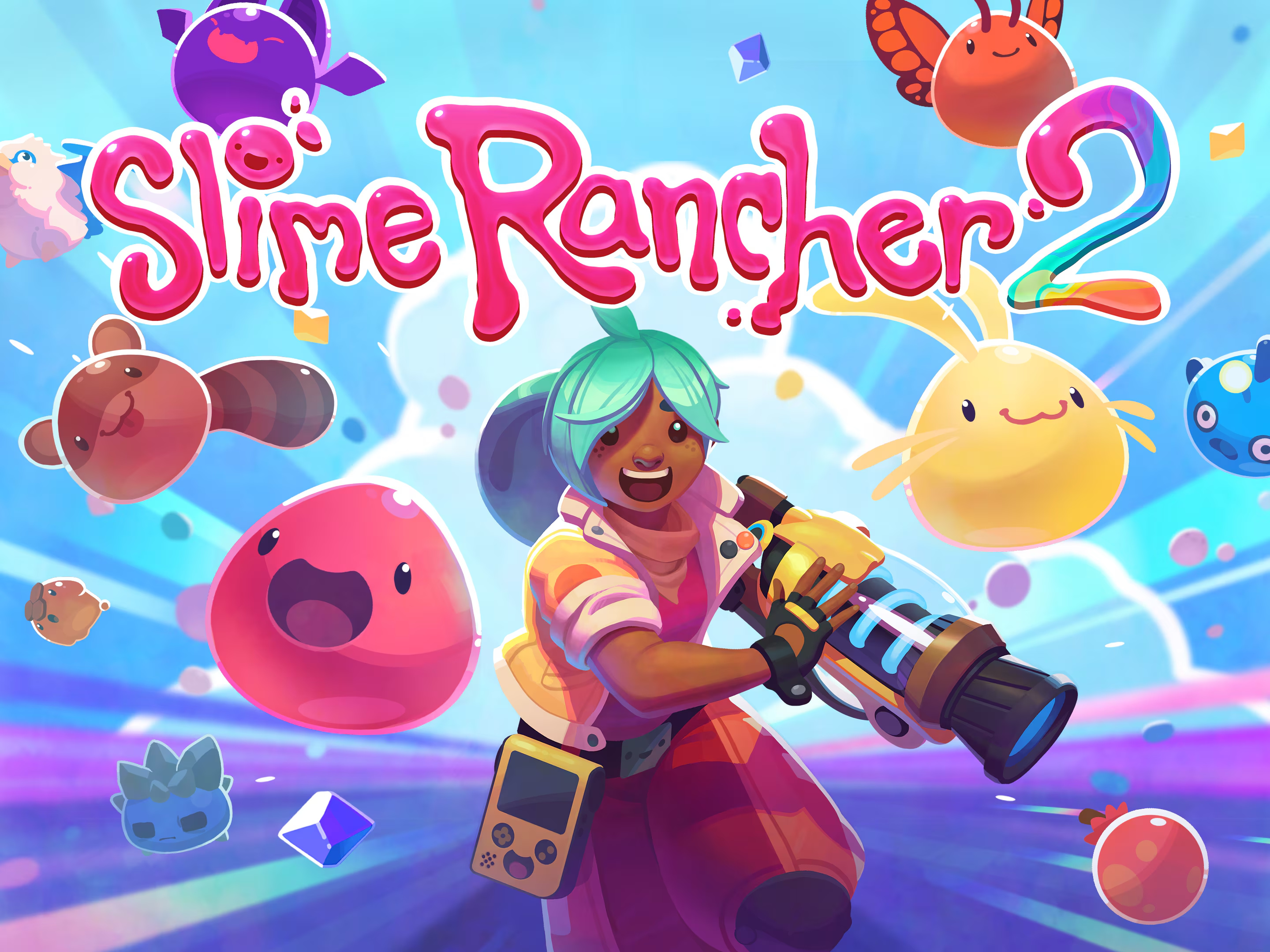
About Slime Rancher 2
Beatrix LeBeau follows a mysterious invitation to Rainbow Island, where she builds a ranch in a glass Conservatory and studies a landscape shaped by ancient technology. Vacpack exploration, slime care, plort trading and crafted upgrades feed one another as she searches the Grey Labyrinth for the source of a danger threatening the island.
Slime Rancher 2 continues Beatrix LeBeau’s story on Rainbow Island, a remote, vividly coloured place reached after a mysterious invitation draws her across the Slime Sea. Her base is the Conservatory, a glass-walled ranch overlooking the island’s shifting terrain, but the arrival is also the beginning of an investigation. Beatrix discovers unfamiliar slimes, remnants of ancient technology and messages from people who know more about the island than they initially reveal. The CommStation lets her keep in contact with returning characters such as Ogden, Mochi and Viktor, while Gigi becomes an important new presence as the mystery develops. The story’s central question is why Rainbow Island exists in its current form and what lies behind the force gathering at its heart. In the full release, the Grey Labyrinth leads into that mystery’s endgame: Beatrix searches its deeper passages for the Prismacore and the power threatening both Rainbow Island and the wider Far, Far Range. The narrative gives a longer direction to the open-ended ranching routine, but much of the journey remains in the player’s hands: travel, gather, build and learn about the island at a self-directed pace.
Exploration uses a first-person Vacpack as Beatrix’s universal field tool. It can draw nearby slimes, food and loose materials into its storage slots, then fire selected contents back into the world. That makes collecting an active part of movement through each landscape: a patch of food can be harvested for the Conservatory, a slime can be brought home, or a crafting material can be carried back to the Fabricator. The starting capacity is limited, so each trip involves choosing what to take and when to return. Crafted Vacpack modules expand that capacity, and the Jetpack opens routes that are difficult to reach on foot. Its extra lift changes how Beatrix crosses gaps and climbs terrain, while additional tanks let her bring home a more varied haul. These upgrades make scouting and resource runs more productive rather than turning the game into a combat-focused shooter. The Vacpack also has an upgrade path of its own, and later equipment helps Beatrix negotiate the more involved spaces of the Grey Labyrinth. A map and Slimepedia help orient her and record discoveries, but the world is designed to reward looking around rather than following a single corridor from objective to objective.
Rainbow Island is arranged as a connected open world with distinct environments, routes and visual identities. The colourful fields around the Conservatory provide an approachable place to meet common slimes and gather food, while farther regions such as Ember Valley and the Grey Labyrinth introduce their own terrain, creatures and useful materials. Cliffs, water, caves and ancient structures make travel a matter of reading the landscape and deciding whether Beatrix has enough equipment to continue. The Jetpack is especially useful for reaching ledges and crossing broken ground, and the Vacpack’s finite slots give detours a practical cost: a trip for one rare material may mean leaving other discoveries behind. Large Gordo slimes can occupy a route or landmark; feeding them enough of their preferred food causes them to burst apart and may expose a passage or reward. Treasure pods and other tucked-away finds provide another reason to revisit familiar spaces after crafting a new upgrade. Exploration therefore overlaps with ranching: discoveries in the field expand what Beatrix can grow, build and care for at home, while new equipment gives her access to more of the island.
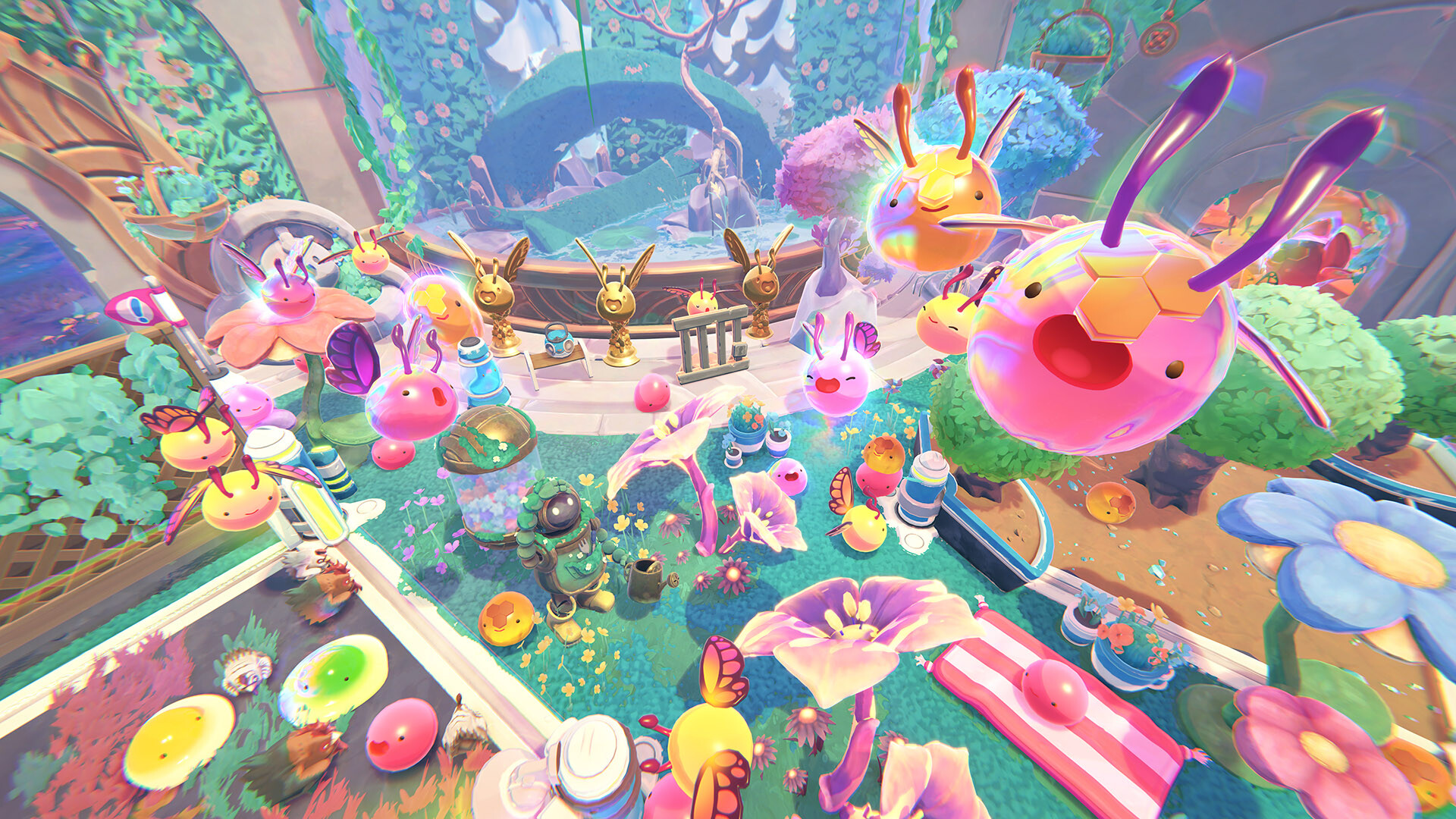
The Conservatory turns collected slimes and food into a small, configurable production system. Corrals keep slimes contained, garden plots grow produce, and coops provide a source of poultry. Feeding a slime produces its plort, the valuable by-product that can be sold or saved for crafting. Diet matters: a slime produces twice as many plorts when fed its favourite food, so matching a garden or coop to the residents of a corral creates a more reliable supply. A Largo combines two slime types after one eats the other type’s plort; it grows larger and produces both kinds of plort when fed. That offers a way to combine ranching lines, but it also means the keeper must understand the needs and behaviour of both varieties. Corrals, food production and collection each occupy space in the Conservatory, so expansion involves deciding which slimes and resources deserve a dedicated plot. The ranch is not a separate menu exercise: its output supports purchases and fabrication, while its layout determines how much ongoing work the player wants to take on. As the network grows, the daily cycle of collecting food, feeding slimes and gathering plorts becomes a foundation for broader exploration.
Plorts connect that care routine to the game’s economy and crafting. Depositing them at the Plort Market earns Newbucks, which can fund Conservatory expansions and other purchases. They can also be placed in the Refinery, where they are held as ingredients for upgrades and gadgets rather than converted into spending money. Choosing between the two destinations creates a steady trade-off: a productive slime may support immediate ranch development by selling its plorts, or contribute toward a module that will make the next exploration trip easier. This is where the two halves of the game reinforce each other. Money improves the base and helps establish food supply, while stored plorts and collected natural resources unlock tools that increase Beatrix’s reach. The market is easy to understand at a glance, but its role is broader than a score counter; it marks the point where living creatures, feeding decisions and work in the field become usable progress. The player can keep the ranch modest and travel often, or invest in more corrals and crops to support a larger operation. In either case, selling and saving are competing uses for the same output.
Crafting gives Rainbow Island’s loose materials a purpose beyond filling Vacpack slots. The Fabricator, located in the Conservatory, turns collected resources and stored plorts into Vacpack modules and gadgets. A Resource Harvester is an early tool for gathering materials in the wild; further discoveries include substances such as Silky Sand and Radiant Ore, which are used in recipes. Unlike a routine built around placing extractors and waiting for them to produce, resource collection here sends Beatrix out to find materials in the environment and bring them back. Blueprints broaden what the Fabricator can make, from player upgrades to devices and decorations, and the Conservatory can be expanded as the ranch develops. At the endgame, Quantum Drones can take over some repeated ranch work: a drone assigned to the Conservatory can help with ranch tasks, while one sent into the wild can collect resources. They need plorts as fuel, and stations let the player charge and program them. Their Rancher and Explorer modes tie the two main settings of the game together, turning a productive slime operation into support for longer trips. The available tools thus grow from simple collection toward a network of upgrades, gadgets and helpers.
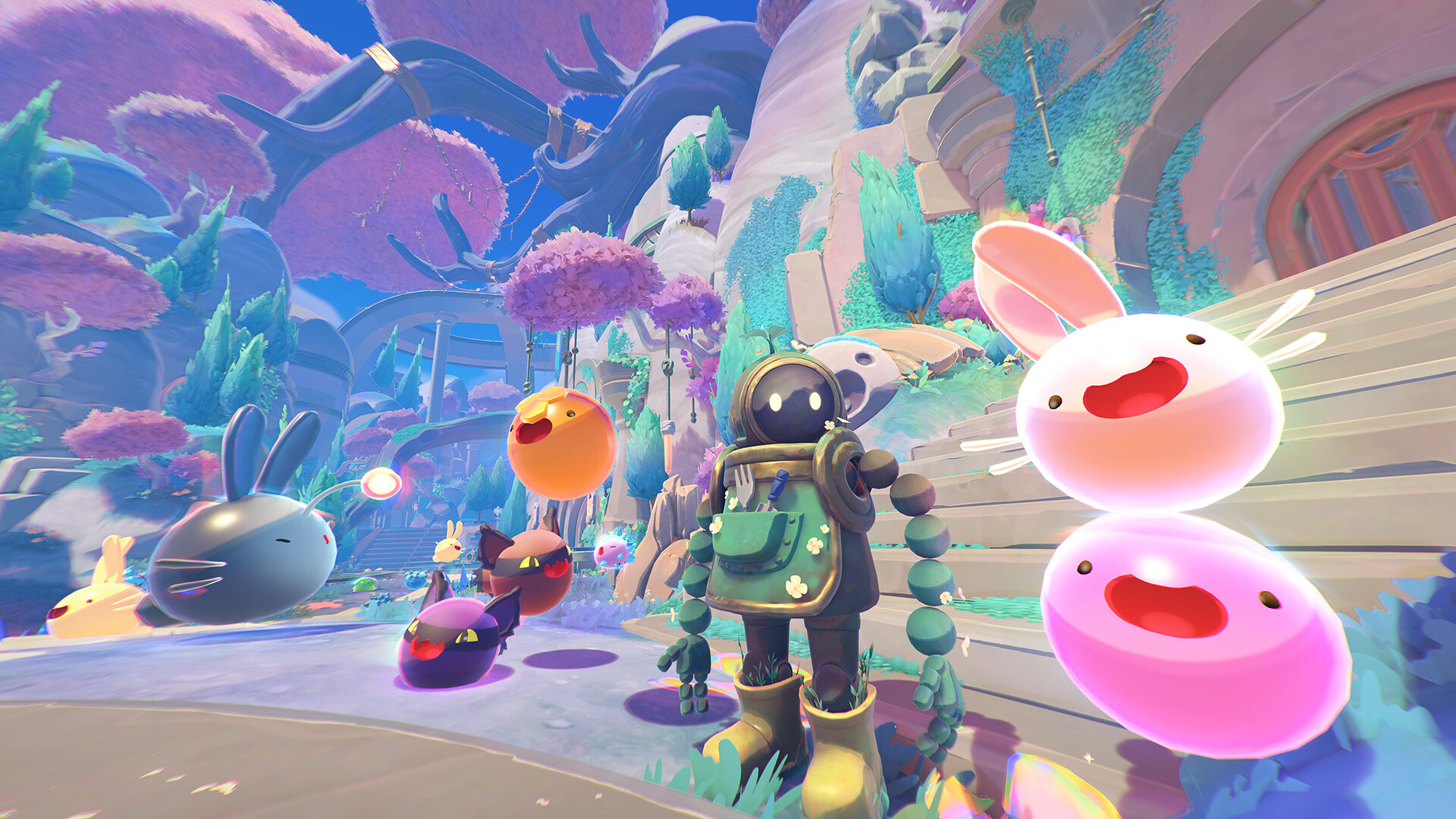
Rainbow Island remains inviting, but it is not entirely safe. Feral Slimes behave aggressively, and Tarr can threaten both the ranching routine and travel through the world; options let players reduce or disable those hazards, with the final challenge retaining a related threat at reduced damage when regular Tarr are disabled. The game’s tension comes from managing proximity, supplies and route choices rather than from a conventional arsenal: Beatrix must account for where she is, what she is carrying and whether an encounter is worth pressing through. That contrast suits the presentation. Soft lighting, glass, vegetation and colourful slimes frame environments that also contain ruins, environmental puzzles and deeper labyrinthine spaces. The Vacpack and slime physics make the creatures feel lively as they bounce around corrals and open ground, while the island’s ancient architecture supplies a quieter sense of age and purpose. Slime Rancher 2 first entered Early Access in 2022; the complete version arrived with its 1.0 update, adding the Grey Labyrinth finale and the events that resolve Beatrix’s Rainbow Island journey. The profile here describes that full release, whose story and systems bring together the ranch, the wilderness and the island’s underlying mystery.
- Developer
- Monomi Park
- Genre
- First-person exploration and ranching simulation adventure