
About Shadows of Doubt
Investigate murders as a private detective in an alternate-reality, industrial 1980s city. Explore apartments, offices and public spaces, collect forensic and documentary evidence, and connect leads on a caseboard. Follow records, interviews and surveillance toward suspects while navigating locked rooms, security and the risks of working discreetly.
Shadows of Doubt is a first-person detective stealth game set in an alternate, hyper-industrialised 1980s, where rain-darkened streets, apartment blocks, shops and offices form a compact science-fiction noir city. You work as a private investigator pursuing a serial killer while keeping a low profile. ColePowered Games describes the city as fully simulated: rooms are individually explorable, and citizens continue their routines independently of the investigator. Procedural generation combines with handcrafted design to produce buildings and cases, giving each new city its own layout and people rather than placing the player inside one fixed neighbourhood. The setting supplies a broad network of places to inspect, from a victim’s home to workplaces and public businesses.
The central activity is taking a case from an initial crime scene toward an identified suspect. A murder report gives you a reason to visit the location and begin assembling facts; the scene may contain fingerprints, physical traces, documents or other leads. You examine what is present, decide which details could narrow the search, and pursue those leads elsewhere in the city. An address book can point toward a victim’s acquaintances, a workplace can suggest colleagues to investigate, and a found name can be checked against public records. The game does not prescribe one route through this evidence. The investigation is a process of linking identifying details to people, places and times until the available information supports an accusation.
Your caseboard is the working record for that reasoning. Evidence, names and other discoveries can be pinned and connected, so a fingerprint or note can sit alongside a person’s address, a witness account or a location to revisit. This lets you keep a trail visible while moving between the scene and the rest of the city, and compare new details with leads already collected. The board helps you distinguish a confirmed link from a promising lead that still needs checking. A receipt, for example, may point to a shop and a time; surveillance footage or a person’s routine can then give that small piece of paper a wider meaning.

Forensic tools turn a hunch into something that can be tested. A fingerprint scanner can read prints left on objects and surfaces; comparing an unknown print with identified prints can connect an item to a person. Lockpicks and security sabotage help you reach restricted spaces when a lead takes you inside a private building. Documents, address books and computer messages may identify contacts or provide another route to a name. Surveillance recordings and conversations can also help establish who was present or what someone observed. Each tool serves a different kind of access or evidence, so a blocked entrance or an inconclusive print can send the investigation toward another source.
Reaching those sources means moving through buildings as well as reading records. Apartments, offices and commercial premises can be entered and searched, and rooms contain both ordinary objects and possible evidence. A locked door may call for lockpicking; a password found elsewhere can help with a secured computer. Security cameras and people nearby make entry a stealth problem, especially when the investigator is somewhere they are not permitted to be. Vents provide another way through connected interiors, while a police scanner can direct attention to cases. The city’s layout encourages a practical loop: follow a paper lead to an address, find a way inside, gather evidence, and leave before attention turns into confrontation.
Interviews and observation add context to physical clues. People can be asked for information, and witnesses may provide details about a person or an event; conversations are one possible lead among records, prints and surveillance. Deduction comes from cross-checking details rather than treating a single statement as a complete solution. If a victim’s address book yields several names, the investigator can compare those contacts with fingerprints or other evidence and then locate their homes through records. A clue found in one building can therefore make another location worth searching. These systems support improvised routes through a case, while citizens are presented through discoverable identity details and routines.
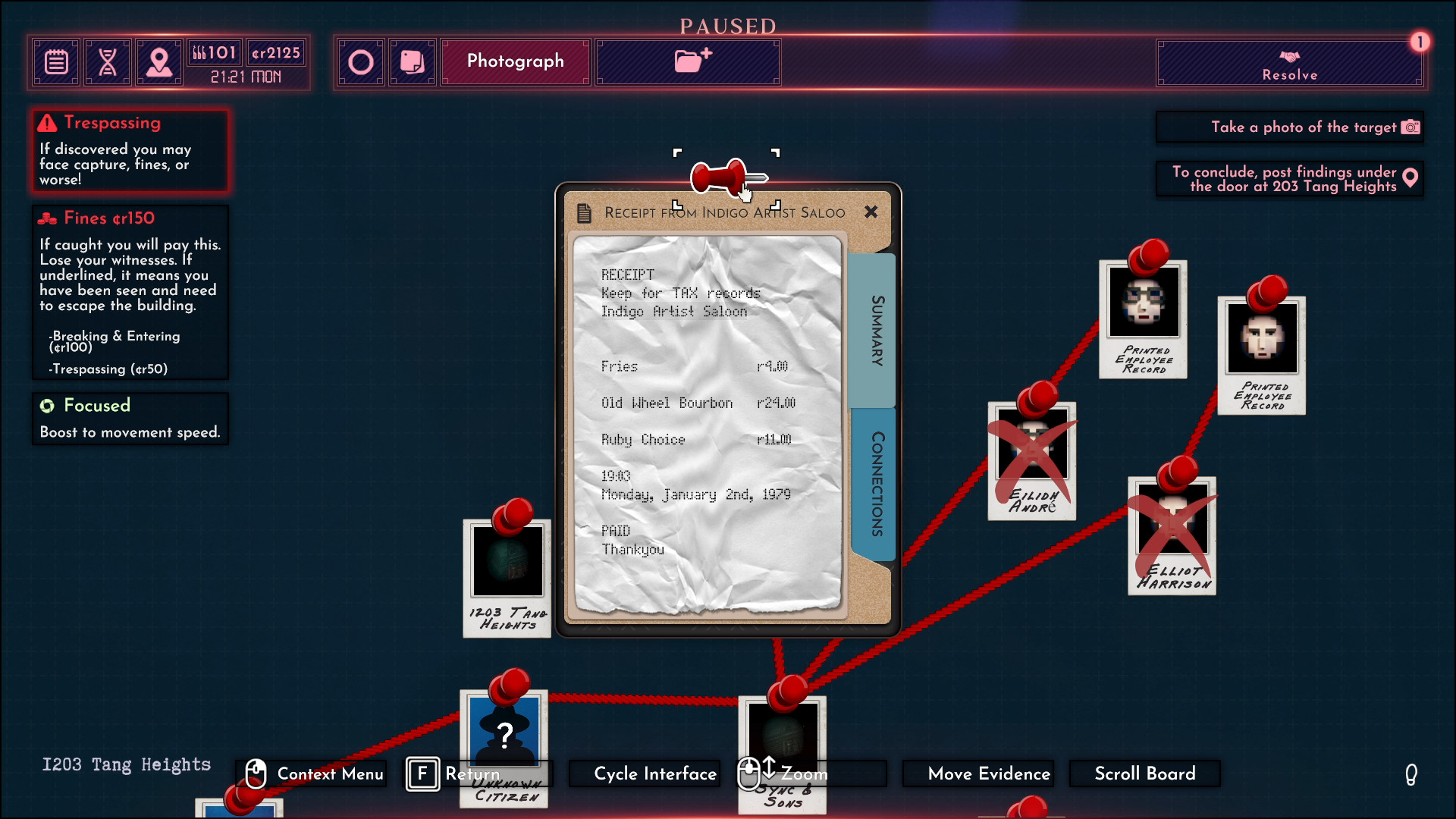
Solving cases and taking smaller investigative jobs provides a way to earn money and build social credit. Money supports the practical costs of detective work, including new gadgets and equipment, and can be spent on customizing an apartment; social credit represents standing in the city and opens progression toward better status. The game frames that climb against the possibility of reaching the Fields, a promised destination beyond the industrial city. Between leads, the investigator must also manage basic needs and physical risk: searching takes time, trespassing can draw a response, and an encounter can become a fight or an escape. There is no requirement to approach every lead in the same order; success comes from choosing which evidence to pursue, using the city’s records and spaces, and deciding when a case has enough support to close.
- Developer
- ColePowered Games
- Genre
- First-person detective stealth / investigative immersive sim