
About Shadow Warrior
Shadow Warrior reimagines Flying Wild Hog’s first-person shooter as the story of Lo Wang, a sword-wielding mercenary sent by his employer to acquire the Nobitsura Kage. A deal gone wrong draws him into a conflict involving the Shadow Realm, ancient gods and a demonic invasion, fought with katana, firearms and mystical powers.
Lo Wang begins as a corporate shogun working for Zilla Enterprise, sent to obtain a legendary blade whose power has made it valuable to forces beyond his employer. The transaction collapses into a fight for survival, and Wang is left to understand why the sword matters as demons cross into the human world. The Nobitsura Kage is tied to ancient gods and the Shadow Realm, so the job grows from a mercenary assignment into a struggle against a threat that could overwhelm the world. Wang’s journey is accompanied by Hoji, a demon with knowledge of the blade and its history. Their exchanges supply much of the game’s dry, deliberately irreverent dialogue, while the larger story follows the consequences of Wang’s bargain and betrayal. The setup gives the campaign a clear through-line: pursue the sword’s power, discover the forces gathering around it, and use it to oppose the invasion.
The adventure is a single-player, first-person campaign built around connected stages, enclosed combat encounters and spaces that invite a closer look between fights. Wang searches buildings and outdoor routes for ammunition, money and hidden Ki Crystals, then moves through doors and newly accessible paths as the level’s objectives advance. Some locations contain optional secret rooms, while backtracking can bring him through areas already visited when a switch, key or opened route changes how he can proceed. This structure keeps the focus on combat but gives exploration practical value: money pays for firearm modifications, and crystals expand the supernatural techniques available to Wang. Encounters interrupt that searching with waves of humans and demons, including larger or more specialised opponents that make weapon selection and movement matter. The story moves between those battles through scenes and conversations with Hoji, balancing the danger of the invasion with Wang’s jokes and the demon’s commentary.
The katana is always available and makes close-range fighting a deliberate part of the shooter’s rhythm. Wang can direct slashes to cut through enemies, use heavier attacks to commit to a stronger strike, and perform directional sword flourishes that reach several foes or create space when he is surrounded. Those attacks are more than a cosmetic alternative to bullets: a well-placed cut can remove a limb or head, changing the shape of a fight and making groups easier to manage. Sword techniques are expanded through progression, so the blade gains moves beyond its basic swing as the campaign continues. The player can close distance with the katana, then shift to a firearm when an enemy is farther away or the encounter calls for sustained ranged damage. The result is a combat loop that asks Wang to move through enemy groups, switch the angle and reach of his attacks, and choose whether a crowded moment calls for a sweeping cut, a thrust or a gun.
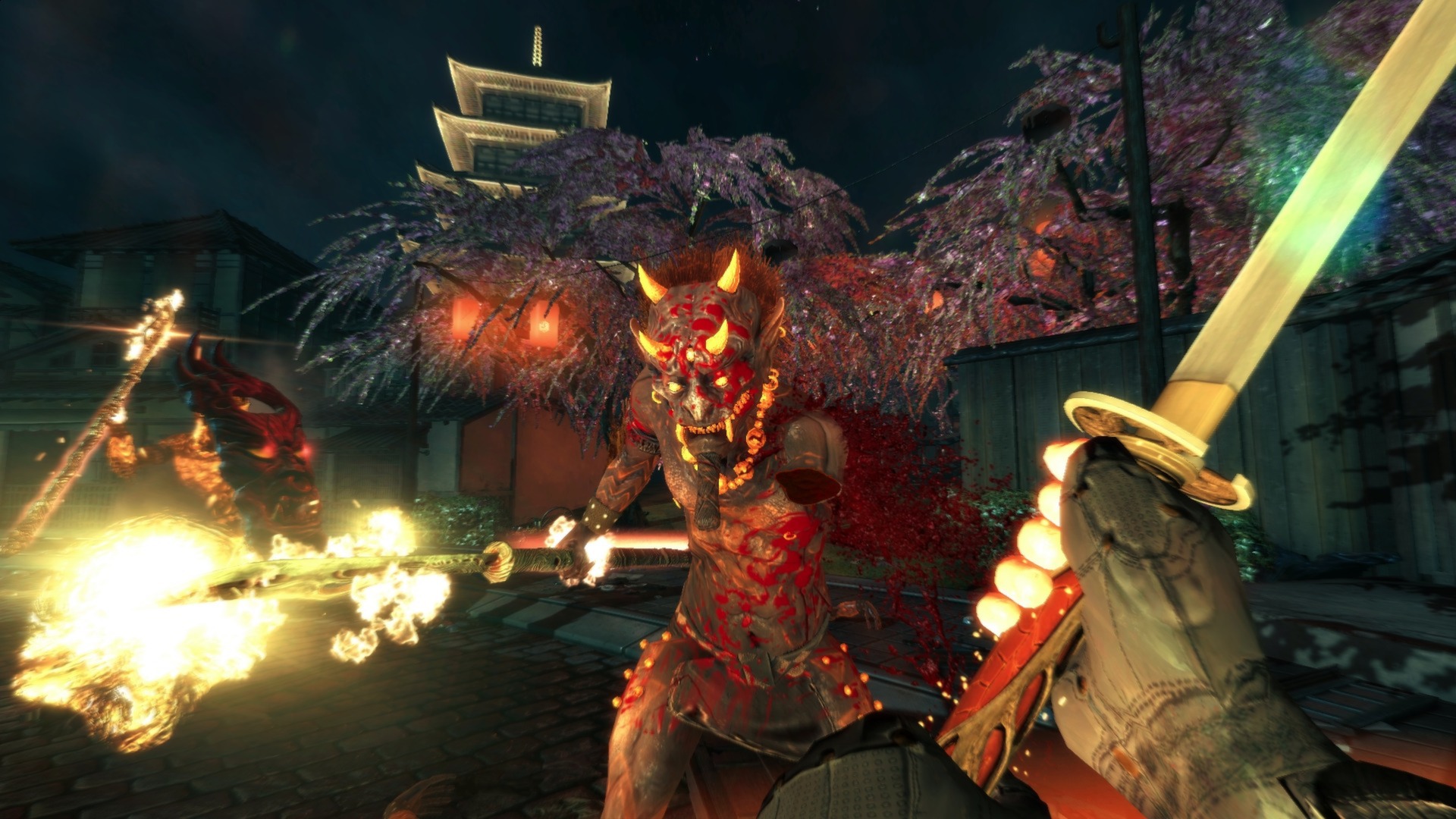
Firearms give Wang a broad answer to threats that are awkward to reach with the blade. The arsenal includes handguns, automatic weapons, shotguns, a crossbow and heavy explosive weapons, with particular guns gaining alternative functions through paid upgrades. These changes can affect how a weapon fires rather than simply increasing its damage: a shotgun can gain additional barrels, the crossbow can use explosive bolts, and a launcher can receive guided rockets. Cash found during the campaign funds these improvements, giving exploration a direct connection to combat preparation. Ammunition and weapon choice still shape the immediate decision in an arena. A gun can cover a distant or airborne target, while a shotgun or explosive round can punish a dense group; the katana remains ready when enemies press into close range. Wang can carry his expanding arsenal from one encounter to the next, so a new weapon adds another tool to the rotation rather than replacing the blade.
Progression separates permanent character improvements, sword and magical techniques, and firearm modifications across distinct resources. Karma earned through combat contributes to skills and stat bonuses, while Ki Crystals found along the route unlock or improve powers. These powers include defensive and control effects such as a shield, knockback or lifting enemies, as well as a healing ability. Wang can use a power while holding a weapon, which allows the player to interrupt an attack pattern with magic and then continue firing or cutting without switching into a separate spell-only mode. The currency distinction matters: money is collected and spent on guns, Karma reflects combat performance and supports personal skills, and Ki Crystals are the limited finds used for mystical abilities. Each system advances a different part of the same loop, turning successful fights and careful searches into new options for surviving the next group.
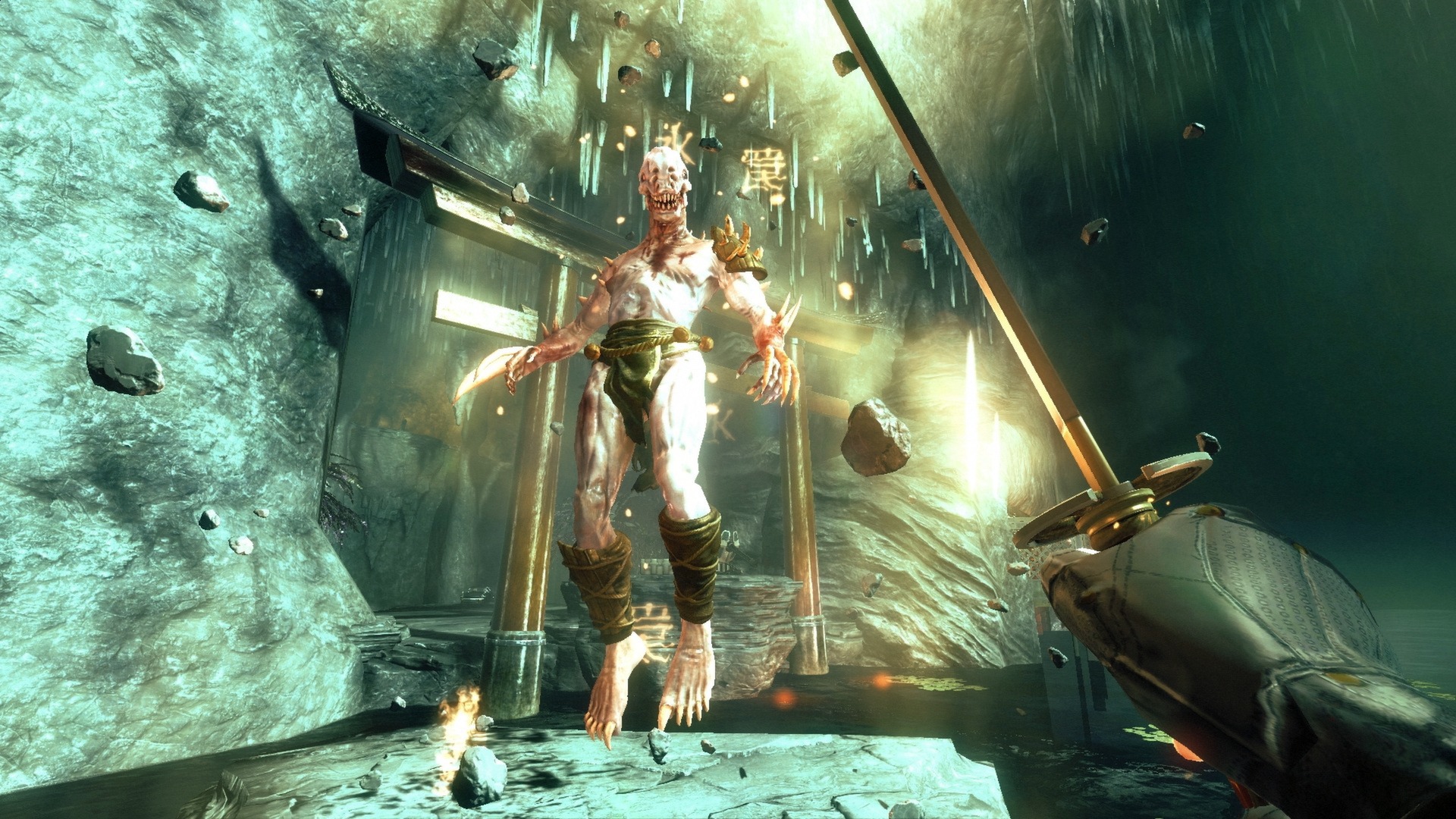
Enemy encounters vary the pressure through demons with different sizes, defences and attack patterns, alongside human opponents and larger boss-scale threats. Some foes can shelter behind shields or demand a more careful approach, while tougher enemies may withstand several attacks and force Wang to alternate between damage types. The campaign’s recurring combat spaces make those differences legible: a crowd can be thinned with a weapon that reaches several targets, a resistant opponent can be met with a better suited firearm, and the katana can finish enemies at close range. Between arenas, the level routes hold secrets and resources that feed the upgrade systems, giving a reason to check side passages rather than only following the next exit. The game’s distinctive loop is therefore broader than shooting through a corridor: Wang searches for resources, chooses how to improve his kit, and combines blade, guns and Ki techniques against each fresh arrangement of enemies.
- Developer
- Flying Wild Hog
- Genre
- Single-player first-person action shooter