
About Severed Steel
Steel, a one-armed sharpshooter, fights through the superstructure of megacorporation EdenSys in a single-player first-person shooter. Wall runs, dives, slides, bullet time, weapon scavenging and destructible voxel environments combine across a six-chapter campaign, a randomly generated Rogue mode and score-focused Firefight challenges.
Severed Steel is a single-player first-person shooter built around Steel, a nimble, one-armed sharpshooter on a mission inside a superstructure controlled by the megacorporation EdenSys. The campaign follows her battle against the corporation’s forces across six compact story chapters. Its premise keeps the focus on the immediate conflict: one fighter pushes into hostile facilities, facing squads of armed opponents in spaces that can be crossed, climbed through and damaged. Steel’s missing arm is part of the game’s combat identity, shaping the way she handles weapons and reloads. The science-fiction setting is conveyed through the corporate stronghold, its security forces and the futuristic tools available to its lone intruder, rather than through long exposition between firefights.
Movement is the defining feature of Steel’s approach. She can run along walls, dive, flip, slide and leap into combat, chaining these actions together to cross a room while keeping enemies under pressure. These stunts are useful for more than style: they let the player change elevation and direction, avoid incoming shots and approach targets from unexpected angles. A fight can begin with a sprint across open ground, continue as a wall run above the opposition and end with a slide kick or close-range shot. The player has to read the room while moving, because a route that looks clear may lead into another firing lane. The system rewards active movement and improvisation, making navigation through each encounter as important as aiming at the next opponent.
Steel’s firearm has no conventional reload action. When its ammunition is spent, the player must find another loaded gun, often by taking one from an enemy. This rule makes each weapon a temporary resource and turns the battlefield into a changing inventory. A player can choose shots carefully, use up a gun at a useful moment and then decide how to reach the next weapon. The limitation ties shooting directly to movement: advancing toward an armed opponent may be necessary to replenish firepower, while a stunt can create the brief opening needed to grab a weapon safely. Kicks and thrown guns provide further ways to disrupt foes when firing is inconvenient. The result is a combat rhythm of shooting, repositioning, disarming and adapting, rather than remaining behind cover with one weapon for an entire encounter.
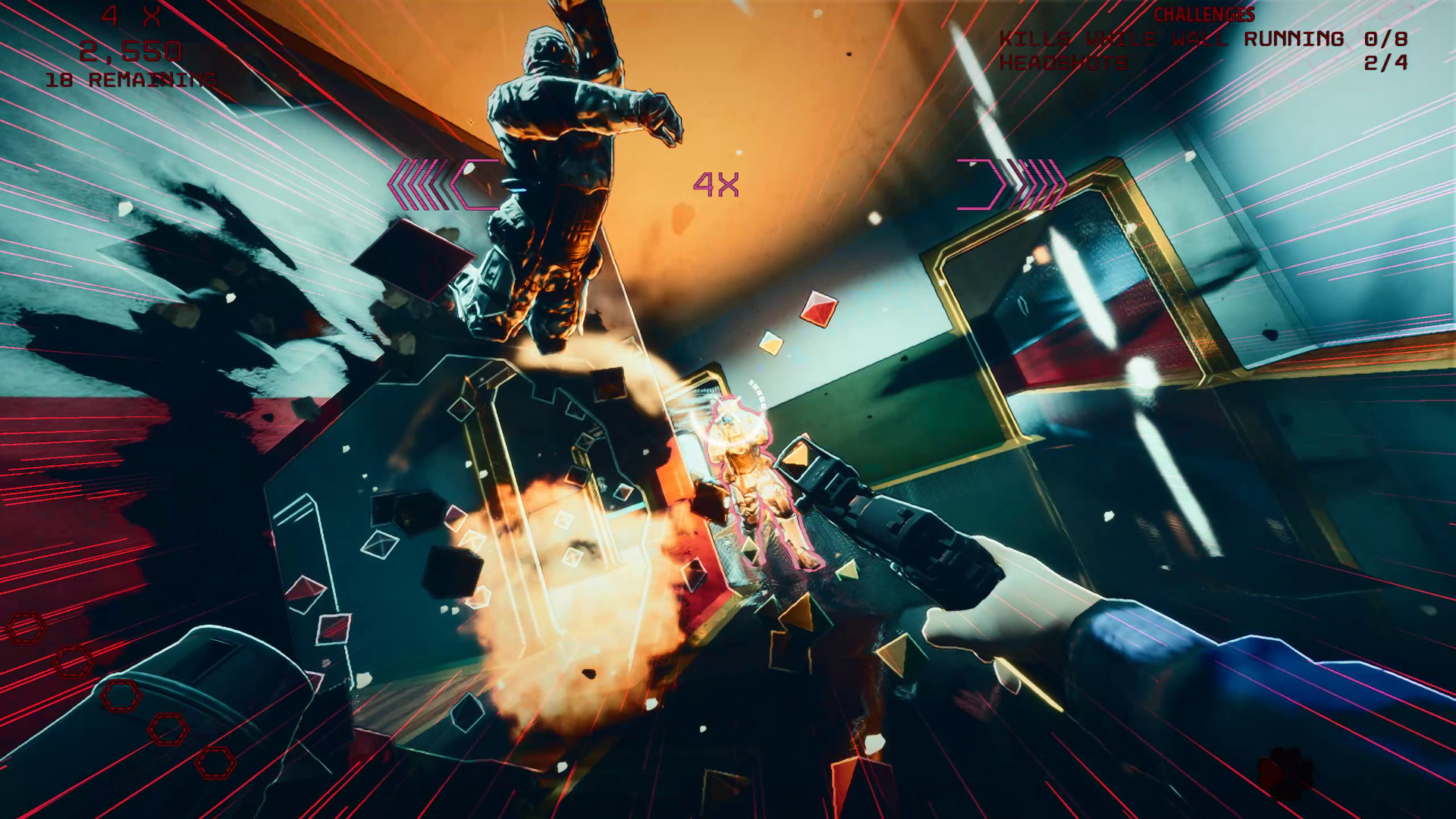
Bullet time gives the player another way to manage the speed of a firefight. Slowing the action can make a difficult sequence easier to read and give Steel a chance to line up a shot or move past incoming fire. It sits beside the stunt system as a tool for controlling momentum: the player can choose a fast route through a room, then use a slower moment to refine an attack when several threats overlap. This does not remove the need to track enemies or choose a path. Opponents still occupy angles and respond to the player’s position, while the limited time spent in slow motion makes its use a tactical decision. Combining movement, aim and bullet time lets players create their own sequence of attacks within the same objective.
The environments are made from destructible voxels, so gunfire can alter the geometry of a level. Powerful rounds can punch through concrete, and Steel’s arm cannon can make larger openings. Destruction changes how the player thinks about cover and routes: a wall can offer temporary protection, become an obstacle to remove or turn into a new passage when damaged. The environment is therefore part of the combat toolkit, not a static arena around it. A player can exploit the layout as it stands or reshape parts of it to open another line of attack. Enemies use dynamic, squad-based behaviour, making their response less fixed and encouraging attention to how the group is reacting. Different battles can develop differently as opponents and damaged surroundings change the available options.
Firefight mode shifts the emphasis from the six-chapter story to performance. Its 42 levels ask players to pursue high scores and fast completion times, with sub-challenges and more than twenty unlockable Mutators that modify gameplay. These stages provide compact settings for practising the movement and weapon systems under a scoring objective. Mutators offer rule changes that can make a run feel different, giving the mode room for experimentation beyond simply repeating the same route. Leaderboards connect those attempts to time and score comparisons. The focus stays on the player’s execution: moving through a level efficiently, dealing with its enemies and meeting the selected challenge conditions. This mode makes the game’s action loop available in a more arcade-like structure than the narrative campaign.
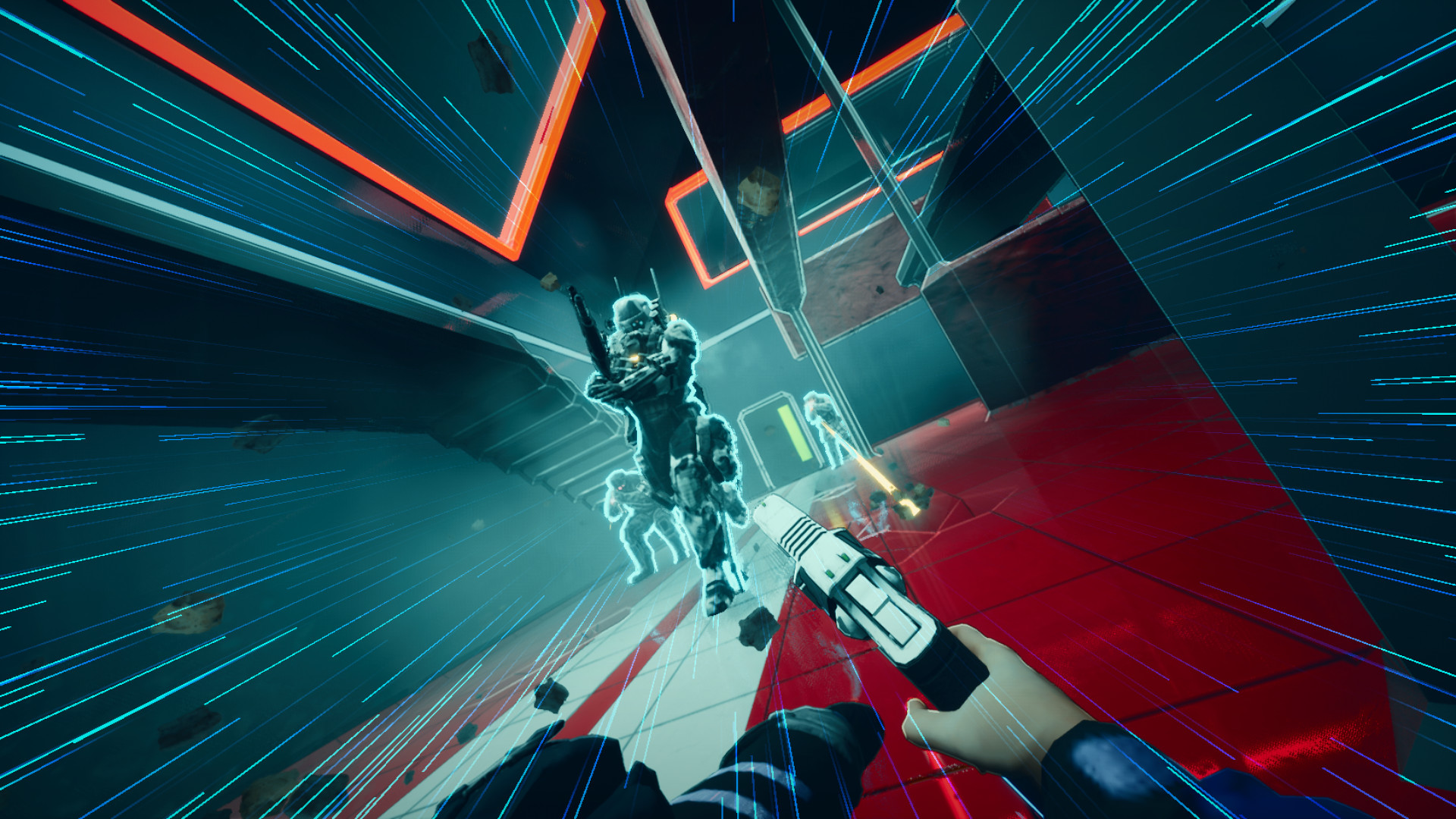
Rogue mode provides a separate roguelite route: a short, randomly generated ten-level campaign with unlockable perks, skins and other rewards. Its changing sequence distinguishes it from the six fixed story chapters, while preserving the same first-person movement and combat foundations. A run asks players to make progress through consecutive fights using the tools and opportunities presented along the way. The campaign also has New Game+, which remixes the story for another playthrough after completion. Outside these modes, the Steam release includes a level editor with Workshop support, allowing players to build and share stages. Together, the campaign, Firefight, Rogue mode and editor show several ways to engage with Steel’s core abilities: follow the EdenSys conflict, chase a score, tackle a varied run or create a level for others.
- Developer
- Greylock Studio
- Genre
- Single-player first-person action shooter