
About Seasons after Fall
A wild fox crosses the Forest of the Ancestors on a quest involving four spirits who guard the seasons. By meeting each Guardian, the fox gains another season-changing power, then uses Spring rain, Summer growth, Autumn mushrooms and Winter ice to alter the woodland, its inhabitants and the paths through its puzzles.
A young nature spirit awakens as an unseen voice guides it into a fox whose body can travel through the Forest of the Ancestors. The woodland is in peril, and the spirit is sent to find four Guardians and recover the fragments associated with them. The fox carries those fragments back to the Sanctuary, where the journey’s purpose becomes tied to a mysterious seasonal ritual. This gives the story two linked points of view: the spirit has a task and receives instructions, while the fox physically explores the forest and encounters its strange plants and animals. The Guardians are gigantic totemic spirits who protect the ritual, and the game leaves their intentions as a question while the fox works toward them. Rather than presenting the forest as a series of battlefields, the premise directs attention toward its natural systems and the power to alter them. The central mystery develops through places visited and the changing world around the fox.
The game is a two-dimensional platform puzzler. The fox moves through hand-painted woodland spaces, jumping between ledges and negotiating water, gaps and living obstacles while looking for a route forward. Its central action is to call a season and transform the local environment. Water, vegetation and animals respond to that choice, so navigating a space involves noticing which conditions currently exist and how they affect movement. The fox’s platforming gives each puzzle a physical shape: a ledge sets a height to reach, a stream interrupts the ground, or a plant occupies a space that could become a passage. Seasonal change then alters those conditions. The player observes a barrier, considers which environmental state could affect it, and moves through the resulting route. This approach makes the forest itself the game’s main puzzle surface, with jumping and traversal connecting the places where seasonal effects matter.
The four seasonal powers become available one after another as the fox meets the Guardians. After a guardian grants its power, the fox can summon that season wherever it is needed. This creates a progression from discovering a new ability to applying it in the forest. Later puzzles can ask the player to combine environmental effects rather than rely on a single transformation. The seasons alter both the physical setting and the behaviour of inhabitants, so a solution may depend on what a creature or plant does under particular conditions. Progress comes from gaining the powers and learning how their effects interact with the forest’s systems. The player can choose a season on demand after it has been unlocked, making the same set of abilities available across different parts of the world.
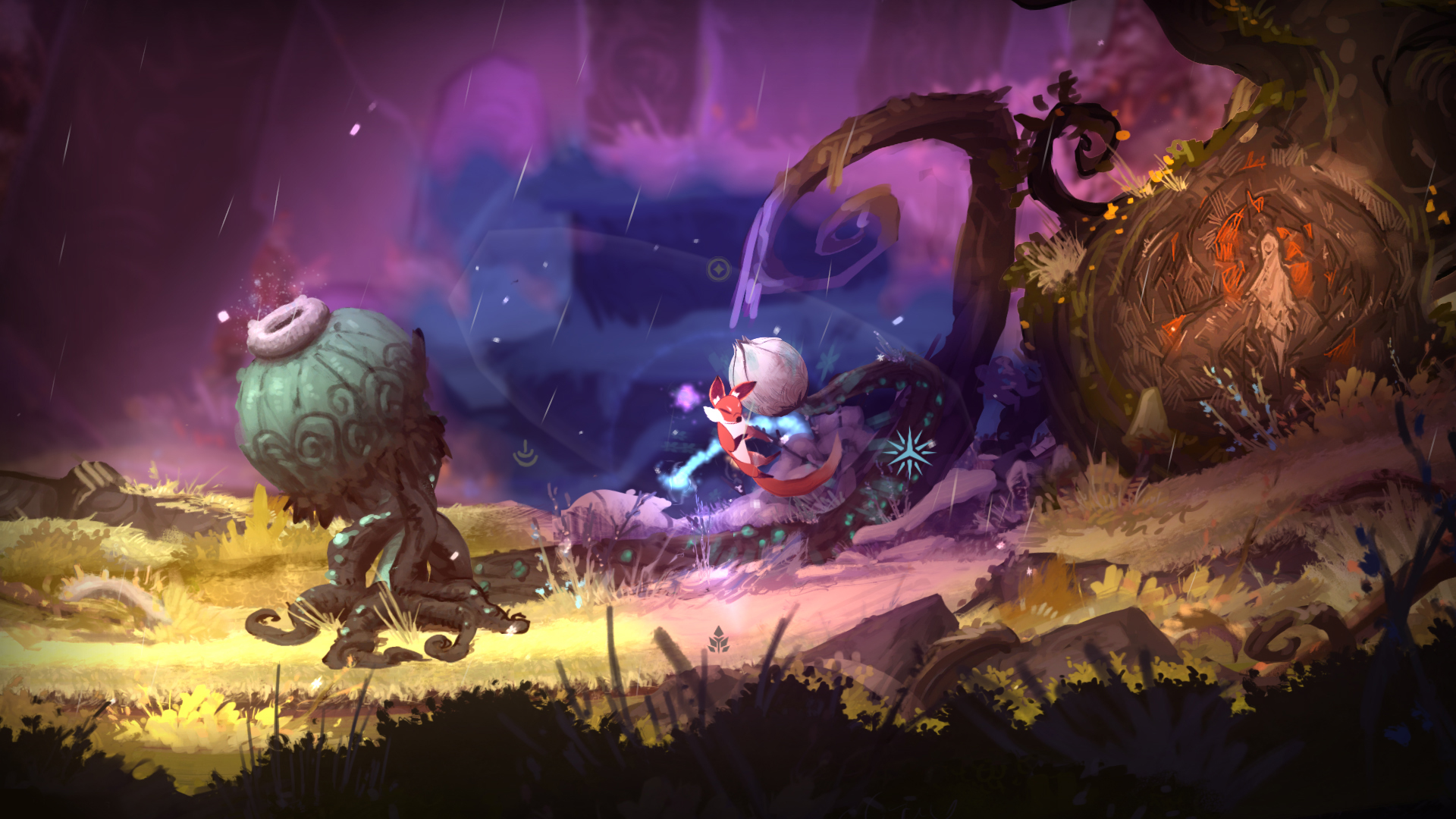
Spring and Summer produce different kinds of access. Spring rain raises water levels, which can lift the fox toward a higher ledge or change how it crosses a low part of the forest. Summer encourages certain plants to grow and extend, turning vegetation into a route through a space that could not previously be crossed. Those effects ask the player to read a scene as a small system. A change in water height may open a path while submerging another; a growing vine or plant can bridge a gap or reach a platform. Since the season can be changed on demand once its guardian has granted the ability, the puzzle is about choosing the useful state for the current place and then moving through it. Some obstacles require a sequence of seasonal choices, so recognizing the right first effect is only part of the task. The fox’s movement and the environment’s response work together: platforming provides the route, and seasonal transformation changes which routes exist.
Autumn and Winter provide another pair of transformations. In Autumn, mushrooms bloom, adding new forms to the forest and changing what the fox can use as it navigates a scene. Winter freezes water, including waterfalls; the fox cannot jump while swimming, but can walk across water once it has frozen into ice. This changes the route from a swimming obstacle into solid footing. Each transformation shifts the relationships among solid ground, water and living growth. The player can compare the same location under different seasons and look for a surface, opening or creature response that was previously absent. Autumn’s mushrooms and Winter’s ice provide different environmental affordances, while the Fox’s core platforming controls remain the means of crossing the new route. Puzzles use those changed conditions to connect exploration with the forest’s seasonal logic.
Some plants and water features react in several ways, making the order of seasonal changes matter. A large plant can send a snowball outward in Winter, helping the fox reach a high ledge; in Spring, the same plant releases water that can grow a seedling into a tree or break a weakened log. Water gushers also vary by season: their flow rises in Spring, falls in Autumn and freezes in Winter. Combining Spring’s flow with Winter’s freeze can create a tall ice pillar for reaching an elevated route. These interactions give the player concrete cause-and-effect clues to test. A single object can offer different outputs, and a sequence can turn a temporary environmental response into a platform. The fox gains no attack from these changes; the reward is a new way through the terrain.
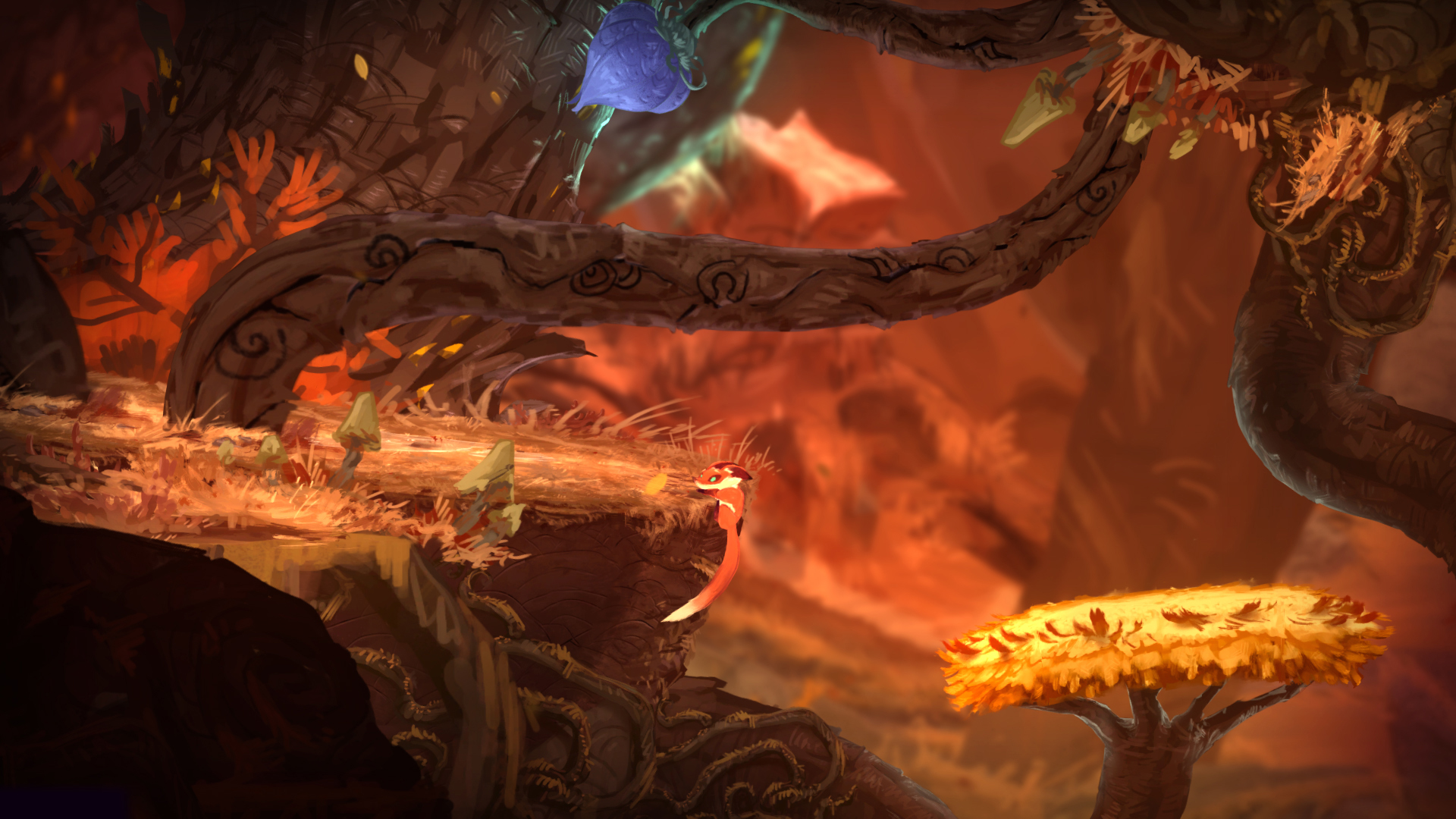
Composer Yann van der Cruyssen wrote the original score with the studio’s natural and narrative aims in mind. The team chose an acoustic string quartet because its small ensemble could convey the fox’s solitude and the mystery of the forest. Some pieces were composed before the story had fully taken shape, so music helped establish the game’s atmosphere early in development. The hand-painted environments also receive separate seasonal treatments, with color and scenery changing as the fox alters the forest. This presentation keeps attention on pools, plants, mushrooms and waterfalls as parts of a living setting rather than static decoration. The four seasonal states are visible in the artwork, while the quartet gives the woodland a distinct musical identity.
The journey changes its guidance once the four fragments have been returned to the Sanctuary. The opening section leads the fox along routes toward the Guardians and introduces a seasonal power during each leg; a later chapter adds new objectives and becomes more free-roaming. The Guardians give the powers distinct identities: the Bear is associated with Winter, the Crane with Autumn, the Eel with Spring and the Cicada with Summer. Those meetings connect each new tool to a character and a part of the forest’s seasonal order. At first the fox’s basic actions are jumping and barking, while season-changing powers arrive through Guardian encounters. With all four available, the player can decide where to investigate and how to combine the conditions needed for an objective. This progression gives earlier locations another role: their paths can be reconsidered with a fuller set of transformations, while the next goal is less tightly prescribed. The added complexity comes from reading familiar terrain under four possible environmental states, including how water, vegetation and creatures respond to a sequence of changes. The later objectives therefore draw on the player’s knowledge of the forest as well as the full set of powers. The control scheme remains centered on platforming and environmental change, but the later chapter asks the player to choose which area to approach and which seasonal interactions to test.
- Developer
- Swing Swing Submarine
- Genre
- 2D platform-puzzler