
About Sea of Thieves: 2026 Edition
Set sail alone or with a crew in a shared pirate world where voyages lead to buried treasure, bounty targets and trade deliveries. Steer and maintain your ship, explore islands and dangerous waters, and decide how to deal with rival crews. The 2026 Edition listing includes the full game and bonus digital media.
Sea of Thieves is a first-person pirate adventure built around a shared world rather than a fixed class or prescribed route. Players can sail solo or crew a ship together, choosing whether to pursue company voyages, explore the sea, fight its threats or meet other crews as friends or rivals. The ship carries the crew, its supplies and any treasure recovered along the way, so a session connects the work of setting out with the decision to return and sell what has been gathered. Islands, underwater locations, shipwrecks and open water provide different destinations, while storms, hostile creatures and other players can disrupt a planned journey. The game’s Steam listing calls this identity the “2026 Edition”; its base edition includes the full game, while the listing separately identifies bonus digital media such as the soundtrack, an audiobook and an e-book.
A voyage begins aboard a ship, where crew members can agree on a quest and plot a route using the map table. Sailing is a set of physical tasks: raise the anchor at the capstan, lower the sails, angle them to catch the wind, and steer with the wheel and compass. The crew can divide these jobs or one player can move between them, while the map below deck helps check the ship’s position against the intended destination. Sail length changes speed, and sail angle affects how the vessel uses the wind. The anchor stops the ship, but lowering it takes time to raise again, so approaching a shore or turning in a hurry involves a choice about control and momentum. Players can also use a cannon to launch themselves toward a nearby island, leaving the ship to continue its course while they search.
Trading Companies give voyages different purposes and turn discoveries into reputation. Gold Hoarders seek treasure, with quests that can lead to map-marked caches or riddles; the Order of Souls sends crews after skeleton captains and their bounty skulls; and the Merchant Alliance focuses on cargo and deliveries. Once a crew has recovered the relevant loot or completed an order, it must carry the result back to a buyer to receive gold and company reputation. A voyage is a starting assignment, not a protected route: crews can encounter environmental dangers and other players while sailing between islands. This makes navigation part of the objective, since the crew must decide what to load aboard, how long to remain at a site and when to head back. The game also includes longer narrative Tall Tales for crews seeking story-led adventures alongside the company quest loop.
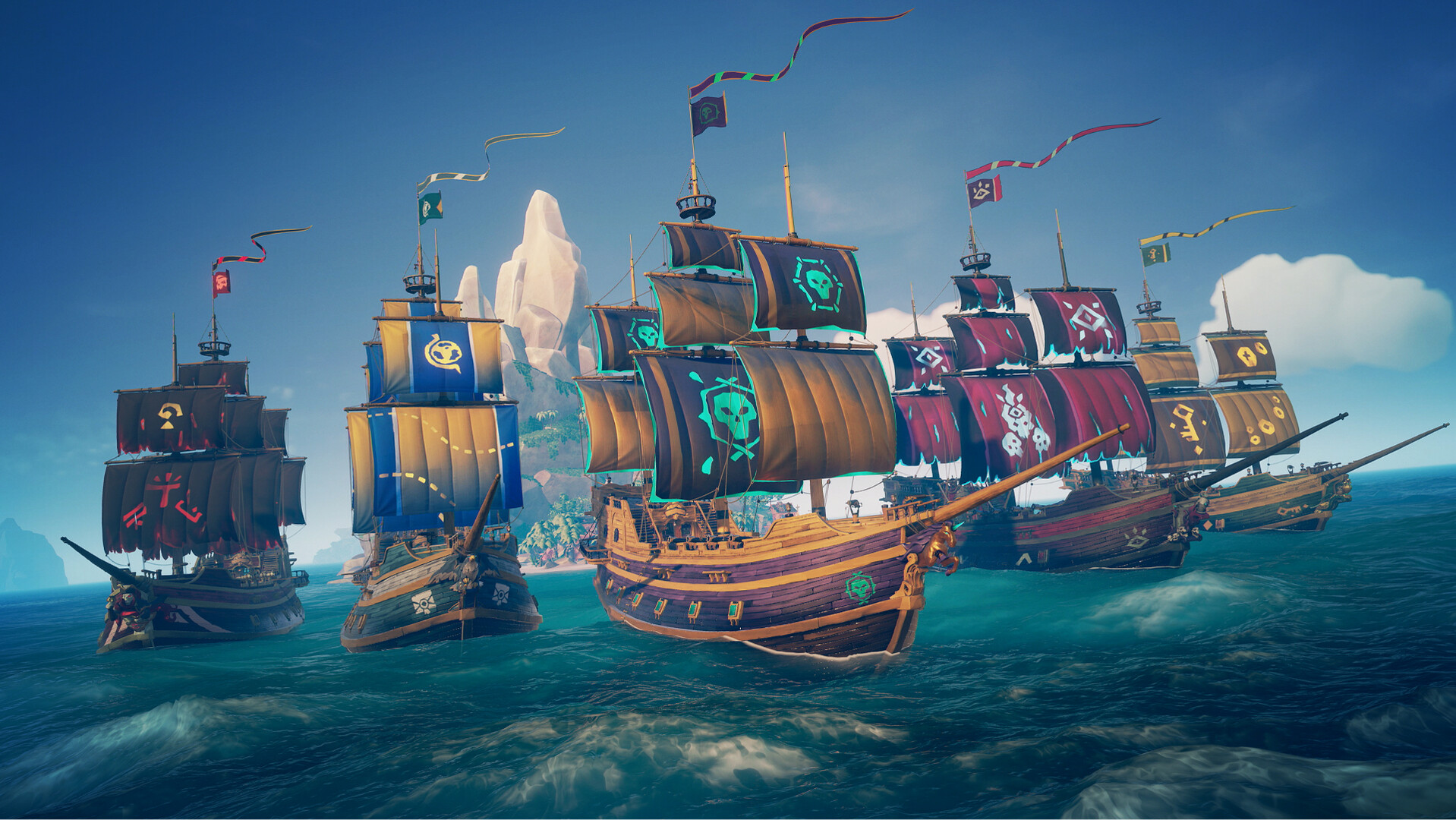
The ship is both transport and a shared resource that the crew must maintain. Cannon fire, collisions and storms can open holes in the hull; water then accumulates below deck. A sailor uses wooden planks to patch each breach and a bucket to bail water overboard, because repairs alone do not remove water that has already entered. Other ship components can also be damaged, interrupting movement or steering. During a sea battle, crew members may handle the helm, sails, cannons and repairs at the same time: cannonballs pressure the opposing hull, while a crew under fire must keep afloat and preserve a way to manoeuvre. Treasure stays aboard during this risk. If the ship sinks, the crew loses its gathered supplies and the treasure floats in the sea for a limited opportunity to recover it, turning a fight into a contest over both cargo and the route home.
The Trading Companies track reputation, commendations and promotions as crews sell loot and complete related activities. Their distinct interests give familiar objects a destination: a chest, skull or delivery cargo can support different lines of company progress. Players may also raise an Emissary flag to represent a company at sea. Company work and successful deliveries build Emissary Grade, which can increase the gold and reputation received for that company’s loot; the flag also signals the crew’s allegiance to others sailing nearby. Progress is expressed through ranks, titles, commendations and cosmetic rewards that change a pirate’s or ship’s appearance. These systems let crews choose what work to pursue, what treasure to risk carrying, and which company or personal goals should shape the next voyage.
Not every trip needs to follow a company map. Crews can fish, explore for shipwrecks, encounter sea creatures, search underwater kingdoms, or create their own treasure maps by burying loot. Optional activities can bring supplies, discoveries or new encounters into a route that began as a straightforward delivery. The sea also makes communication useful: one player can watch the horizon while another reads a map, steers or handles a sail, and crews decide whether to hail another ship, avoid it or engage. These overlapping tasks produce a flexible loop of preparation, navigation, discovery, conflict and return. The 2026 Edition’s listed audio and book bonuses sit outside that loop; the listing identifies the complete game as the base edition, while the adventure itself remains the shared-world sailing and piracy experience.
- Developer
- Rare Ltd
- Genre
- Online action-adventure, first-person sailing and piracy