
About Sea of Stars
Valere and Zale, two Children of the Solstice, train to wield lunar and solar magic against the monstrous creations of the alchemist known as the Fleshmancer. This turn-based role-playing adventure combines timed combat actions, freeform traversal, puzzles and quieter activities such as cooking, fishing and sailing.
Sea of Stars follows Valere and Zale, born on the Winter and Summer Solstices and trained as Solstice Warriors. Their lunar and solar powers combine into Eclipse Magic, the force needed to oppose the creations of the Fleshmancer, an evil alchemist threatening the world. Their friend Garl travels with them despite having no special magic: a capable cook and defensive fighter, he supports the pair through the journey. The story moves between everyday friendships, strange discoveries and a conflict whose reach grows beyond the heroes’ early training, introducing a wide cast of allies and communities along the way.
The early journey is rooted in Mooncradle, a village on Evermist Island where the Children of the Solstice are raised before entering Zenith Academy for training. Valere and Zale leave that familiar community to learn the duties attached to their lunar and solar powers, giving the opening a clear movement from childhood into a larger world. The village’s solstice traditions and the academy’s instruction establish how these warriors are prepared: as a complementary pair whose different celestial abilities can answer threats that ordinary fighters cannot. From this starting point, the party travels between islands, settlements and ancient places, meeting people whose lives intersect with the Solstice Warriors’ mission while the scale of the Fleshmancer’s danger comes into focus.
Battles begin directly when the party encounters enemies in the world, rather than cutting away to a separate arena. Each combatant acts in turn, and pressing the action button in time with an attack animation strengthens the hit; timed defensive inputs can also reduce incoming damage. These active inputs make ordinary attacks and blocks depend on attention as well as character statistics. Enemies signal powerful attacks or spells by channeling them, giving the party a limited window to respond. With no random encounters or required grinding, exploration and combat feed into one another instead of being split into separate modes of play.
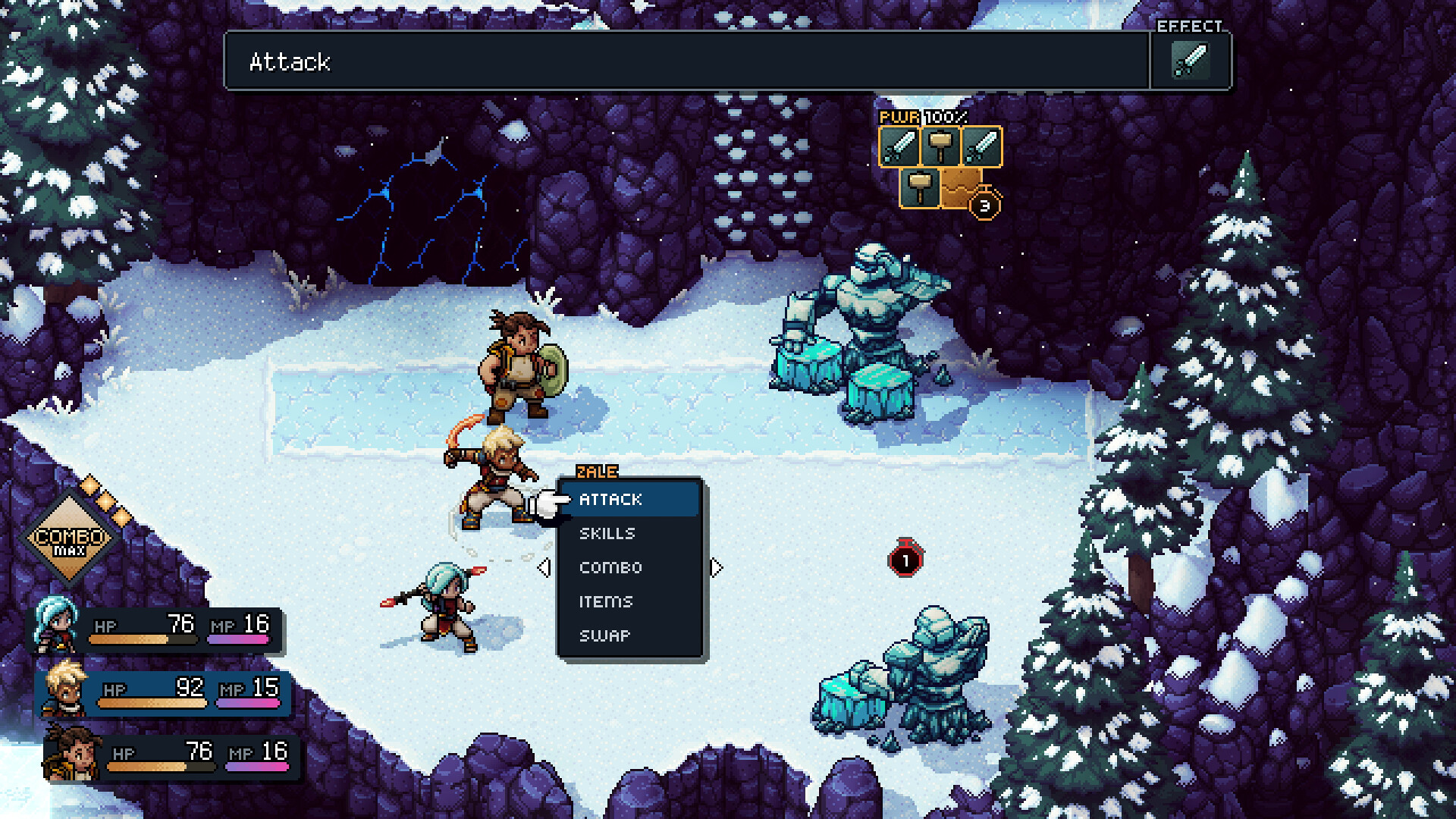
The lock system gives those enemy windups a tactical response. A spell in preparation can display locks that call for particular damage types; landing the right kinds of attacks can break them and hinder the enemy before the move resolves. Solstice magic supplies sun and moon damage, while other characters and abilities bring further options. The free Dawn of Equinox update added Mystery Locks for newly encountered enemy spells, so their needed types must first be tested or revealed; some character skills can expose them, and revealed patterns are then recorded for that enemy and spell. The update also made Combo Points persist between battles, giving players more ways to open a later encounter.
Attacks can produce Live Mana, which party members absorb to boost an action with magical force. Normal attacks also restore MP, so using one can rebuild the capacity to cast skills rather than leaving magic unavailable after a few turns. Boosting spends gathered Live Mana and can be stacked up to three times, adding a portion of the character’s magic attack to the next action; it can also supply a character’s damage type when that character has run out of MP. The player therefore chooses between recovering MP with a basic attack, using current MP for a skill, or absorbing orbs to strengthen an action and supply needed elemental damage. Combo attacks remain another option, joining two characters’ patterns and damage types when the party has built enough Combo Points.
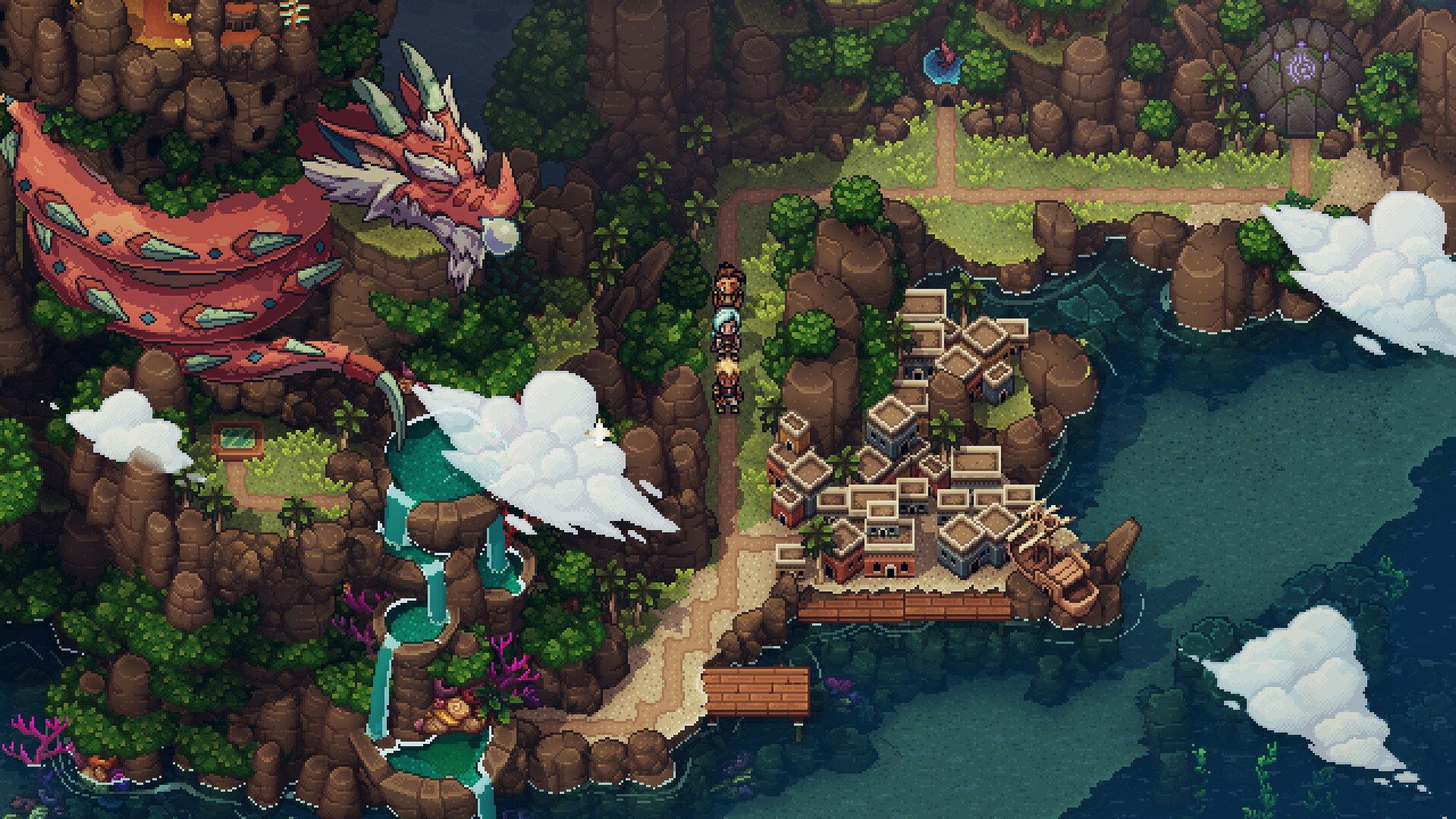
Outside battle, movement is not restricted to a square grid. The party can swim, climb, vault, jump down and hoist itself onto ledges while crossing connected environments, so routes are shaped by platforms and landmarks as well as doors and corridors. Exploration also includes puzzles that use the heroes’ changing command of sun and moonlight. As their Solstice abilities develop, they gain control over the time of day, letting the player alter lighting in real time to interact with mechanisms or reach places that depend on a particular celestial condition. Sailing extends travel across the wider world, while fishing spots and environmental finds provide short activities between story destinations. This movement system makes the party’s route part of the moment-to-moment play: a cliff edge, climbable surface or body of water can lead to a new path, while environmental puzzles ask players to connect visible scenery with the powers learned through the story.
Cooking gives ingredients gathered during the journey a practical use: at camp, the party can prepare food for recovery and carry it into later encounters. A tavern offers a quieter break, where players can listen to a song or play the tabletop game Wheels. For players who want company, Dawn of Equinox added local couch co-op for up to three participants across the full story, with shared traversal and cooperative timed hits in combat. The free Throes of the Watchmaker DLC adds a separate clockwork adventure for Valere and Zale, with new classes and Arty as a playable character; it extends the world without replacing the main campaign’s identity.
- Developer
- Sabotage Studio
- Genre
- Turn-based role-playing game