

About Sayonara Wild Hearts
After a young woman’s heart breaks and disturbs the balance of the universe, a diamond butterfly leads her through a dreamlike skyway to her masked other self, The Fool. Across a sequence of pop songs, The Fool rides, fights and chases scores while confronting Little Death and a cast of tarot-inspired rivals.
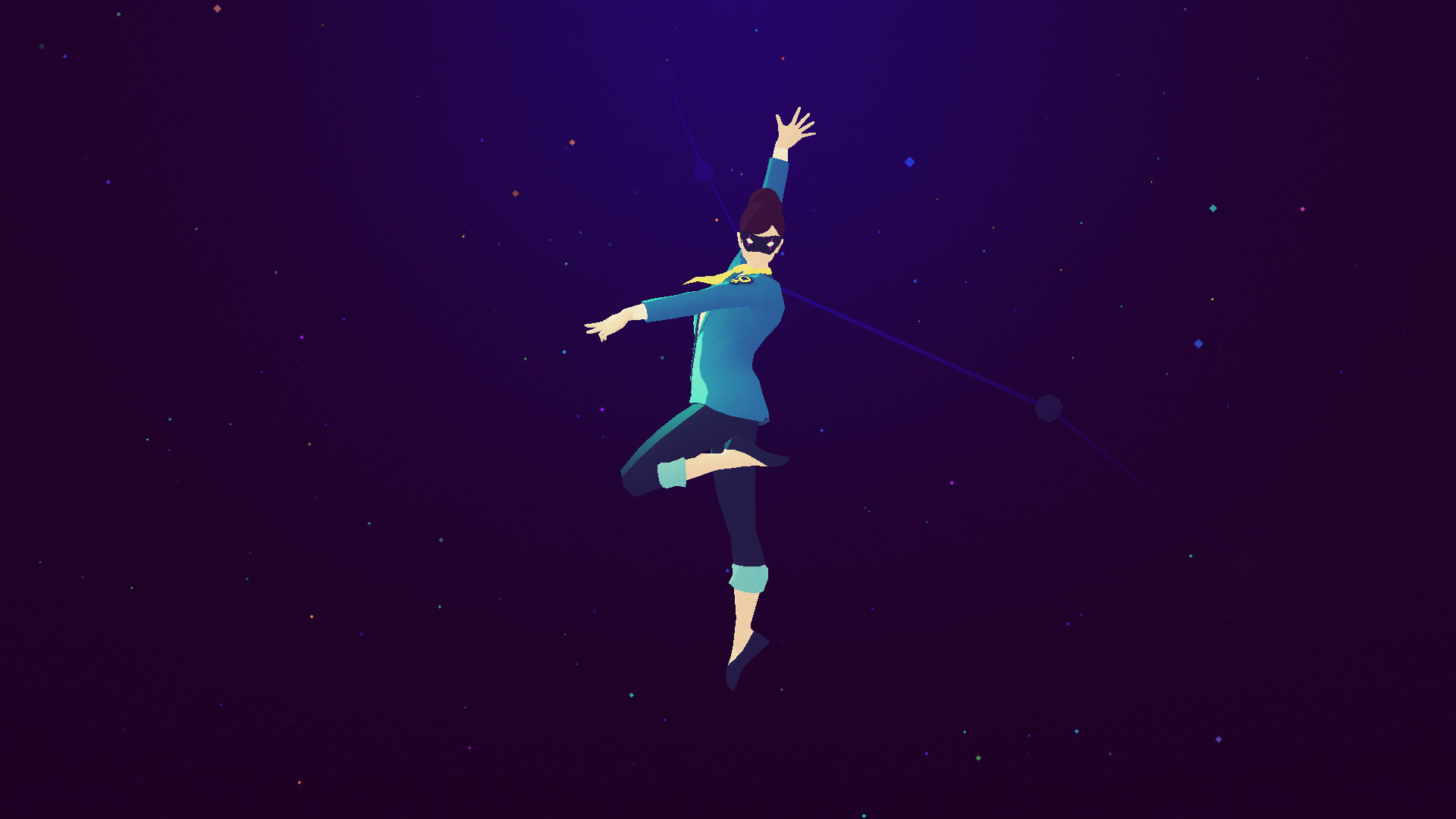
Sayonara Wild Hearts frames heartbreak as a disturbance that reaches beyond one person. A young woman’s heart breaks, the balance of the universe is upset, and a diamond butterfly appears in her dreams to guide her along a highway in the sky. There she meets The Fool, her masked biker identity, and begins a journey through a surreal world whose characters and rival groups draw on tarot imagery. The journey centers on recovering harmony from Little Death and the allies around her: the Dancing Devils, Howling Moons, Stereo Lovers and Hermit 64. The story is conveyed through movement, imagery and music more than explanatory dialogue. Its central transformation gives the player a clear role: guide The Fool through the dreamlike landscape and meet the figures who hold pieces of the universe’s lost harmony. The tarot influence supplies a shared symbolic vocabulary for this cast, but the game uses it to stage an action journey rather than a card-reading or turn-based system. The Fool is the playable identity through which the woman encounters that world, and the changing road gives the journey its sense of travel from one rival and song to another.
The game is structured like a pop album divided into levels, with each stage set to a custom-written song. Simogo describes it as an arcade game rather than a rhythm game: the action follows the rises and falls of each track, but the player is not asked to match every movement to a beat. Directional input steers The Fool through the route, while a single action button handles prompted moves. That small control set carries across motorcycles, skateboards, cars and even a flying sword, so new scenes can change the action without asking the player to learn a new control scheme for every vehicle. The camera follows automatically and dynamically, keeping attention on the route and on the transitions between one visual and mechanical idea and the next. This structure lets the songs do more than accompany the action. Their changing intensity shapes when a stage accelerates, when a new movement idea appears and when a brief pause in the action can make the next surge feel distinct. The level is both a playable challenge and one track in a larger musical sequence.
Movement is about reading the lane ahead and adjusting The Fool’s position as the road changes. The game shifts between forward-rushing rides, airborne passages and other arcade sequences, with obstacles and opportunities arranged along the path. Hearts placed through these spaces contribute to the scoring chase, while hazards make route choice and timing matter. A level can ask for lateral steering one moment and a prompted action the next, such as jumping or striking with a sword. Those changes are introduced within the same basic inputs, allowing a stage to move quickly from riding to a brief action cue and onward without pausing for a menu or tutorial-like break. The automatic camera and animated road work together to make these changes part of the stage’s flow. This format means the player reacts to a route that has already been composed, rather than choosing where to travel in an open map. Attention stays on the next obstacle, collectible or prompt, while the camera and surrounding scenery reveal the stage’s direction. A new vehicle or surface changes the look and feel of a sequence while the familiar input scheme remains in place.
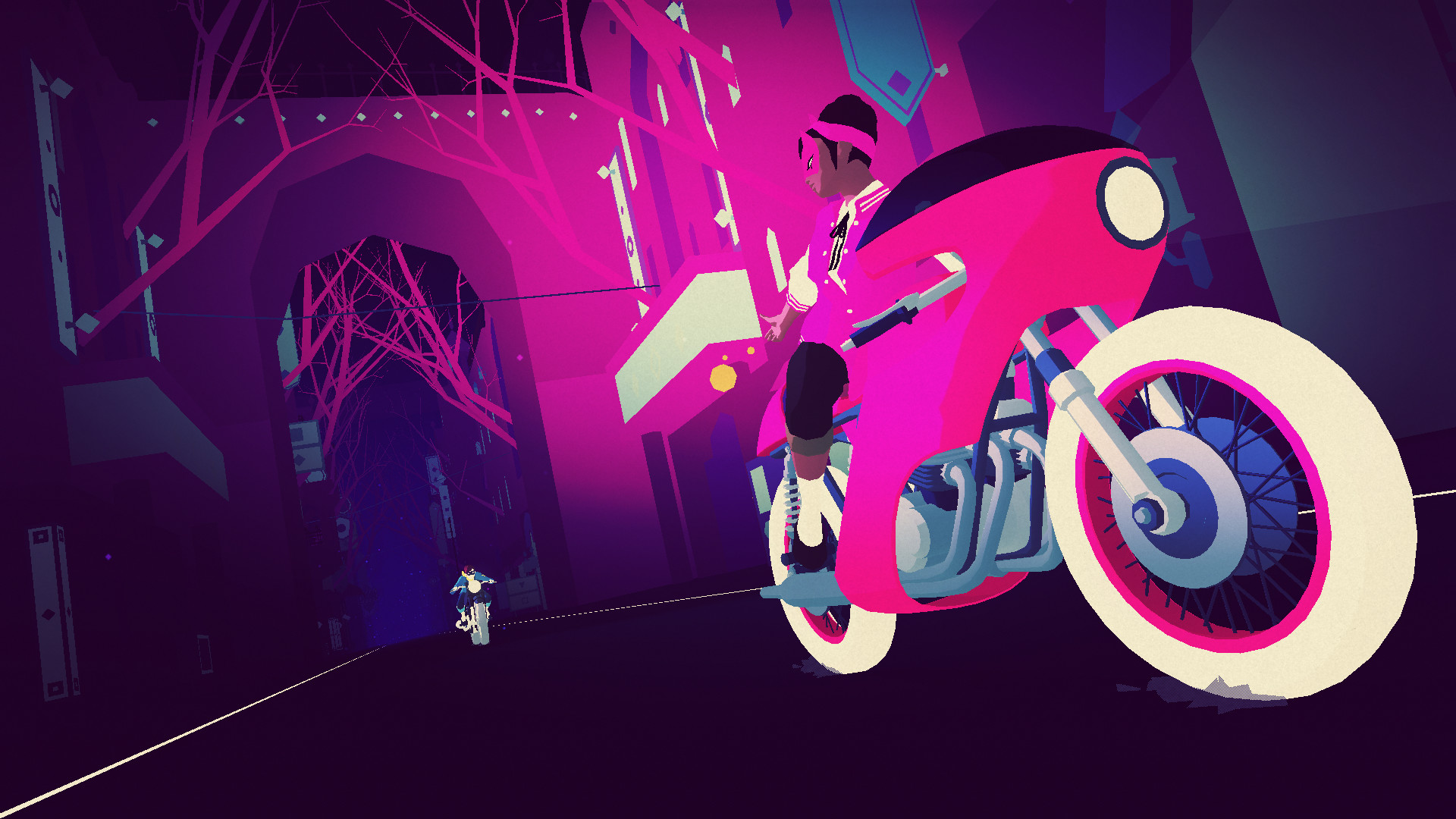
Encounters with the rival figures turn that movement into confrontations. The Fool pursues and faces characters associated with the tarot-inspired groups, and the action can call for a timed punch, sword strike, jump or other button prompt. Rather than using a conventional combat interface with a large set of attacks and equipment, the game folds each interaction into its directional movement and one-button action language. The result is a sequence of short arcade challenges built around staying on course, avoiding obstacles and responding when the scene presents an opening. The stages vary their visual setting and activity while retaining this readable foundation. Because attacks and jumps are brief events in an ongoing ride, the confrontation feels integrated with the music-led journey instead of separated into a different mode with its own progression tree. Simogo has said that it removed more complicated interaction ideas during development when they interfered with the core controls. The finished approach keeps a new action legible through the same directional and button inputs, even when the scene changes from dodging to a strike. The design’s simplicity is therefore a system choice that supports the rapid shifts between songs and set pieces.
Score chasing provides the clearest ongoing challenge. Simogo’s own description emphasizes chasing scores, and the Steam release presents the game as a single-player experience with achievements. Collecting hearts and making it through sequences cleanly supports the arcade focus: each song becomes a discrete course whose route can be revisited as the player tries to improve a result. The game does not rely on a long chain of combat upgrades or equipment statistics to create forward momentum. Instead, its repeated play comes from learning the timing and layout of a level, responding more consistently to its prompts, and pursuing a stronger score. That structure suits the album format, where a stage can be brief but still invite another run to refine how its events are handled. The distinction between completing the song and mastering it keeps the progression compact: the player advances through a sequence of stages, while score goals give already-seen tracks another purpose. Steam achievements add platform-specific milestones, but the core arcade motivation remains the score chase built into the songs themselves.
The presentation binds the songs, characters and control cues into a single audiovisual sequence. Simogo says a prototype was being played with energetic electronic pop in the background when the music and screen action seemed to fit together; that experiment led to the decision to create songs specifically for the game. The completed levels respond to the tracks’ ebbs and flows, with shifting camera angles, scenes and action moments coordinated across each song. The visual world moves through saturated colors, dramatic silhouettes and surreal roads, while the tarot references provide a recurring set of figures and symbols. Rather than pausing to explain every connection, the game lets the songs and staged encounters carry the emotional progression from heartbreak through confrontation and toward restored balance. The soundtrack is custom written and tightly linked to the level format, so the player experiences the music as the organizing structure of the adventure rather than as a separate playlist. The transitions between visual motifs and activities follow the album’s changing sound, supporting the impression that each level is a song made playable.
Each level is also built as a tightly controlled piece of animation. Simogo describes a master level animation that defines the events, camera, visual changes and where characters appear along the road at a given time. This approach lets the stage transform around the player while preserving the simple directional and action inputs. The path can bend into a new setting, change the kind of movement underfoot, or frame a rival encounter without a conventional loading-screen transition breaking the song. Presentation is therefore part of how the gameplay communicates: the player reads an upcoming turn, obstacle or button prompt as part of an authored sequence whose visual rhythm is tied to the soundtrack. The format makes the whole adventure feel like a connected album of playable scenes, rather than a single environment explored at free-roaming pace.
Later editions add a different way to use the album’s short stages. The PlayStation 5 release includes Remix Arcade, a mode built from small portions of existing levels that follow one another at an increasingly fast pace. Its changing sequence asks the player to recognize a familiar hazard or action cue without the full song leading up to it, and some segments can appear visually mirrored. Scoring and a rising difficulty curve give this mode a distinct structure from replaying one chosen track for a better result. Simogo first explored this idea during the original game’s development but set it aside because the transitions between fragments could not load quickly enough; the faster PlayStation 5 storage made the later implementation possible. The Nintendo Switch 2 Edition also includes Remix Arcade. Those versions expand the ways a player can revisit the music and courses, while the original song-by-song journey remains the foundation of the game.
- Developer
- Simogo
- Genre
- Pop arcade