

About Saltsea Chronicles
Captain Maja has vanished, and her crew steals back its impounded ship to search the islands of Saltsea. Each chapter asks where to sail and who should go ashore, opening different communities and strains within the crew. The investigation unfolds through conversations, an evolving log, collectable records and choices that can send later chapters down different routes.
Captain Maja is missing, the crew’s ship has been impounded, and the people left behind must act before they can even begin asking what happened. Saltsea Chronicles opens with a theft of that ship and a rescue mission that soon becomes more complicated than its first explanation. The crew crosses a world remade by a great Flood, where islands are settled on the remains of structures and societies that existed before the water rose. Its people tell stories about the Hoarders, but the past has not survived intact. Each new community has its own account of what was lost and what was built in its place. Guiding the search means more than following a single captain’s trail: the crew has to decide which island deserves attention, whose local knowledge matters and which of its members is best placed to approach a particular conversation. Maja’s disappearance raises an uncomfortable possibility that remains open at the outset. Was she taken, or did she choose to go? The voyage gives the crew reasons to doubt its first assumptions, while the distances between the islands make every new explanation arrive through someone with their own interests and memories. Beneath the immediate rescue lie questions about who owns the surviving fragments of the old world and how a community tells its children what the Flood meant. A ruin can be shelter to one island and a warning to another, making history part of each stop rather than a fixed introductory legend.
The islands are places to meet rather than areas to conquer. A chapter lets the player choose a destination and decide which crew members will go ashore. That pairing changes which exchanges can occur: one person may have the patience, connection or curiosity to draw out a story that another would never hear. Once on an island, the crew can move quickly among its locations and take in a short observation or stay for a fuller conversation with residents. Some scenes belong to different times of day, so a place can reveal another aspect of itself after the first visit. The communities are not interchangeable quest stops. Each has adapted pre-Flood material to a particular climate and way of living, and each has practices for dealing with conflict and change. Even a brief encounter can show how local history has shaped what people use, value and remember. The route through these places is deliberately selective. Choosing one island or companion can unlock details that another path does not, so a journey is defined partly by what the crew decided was most urgent at the time.
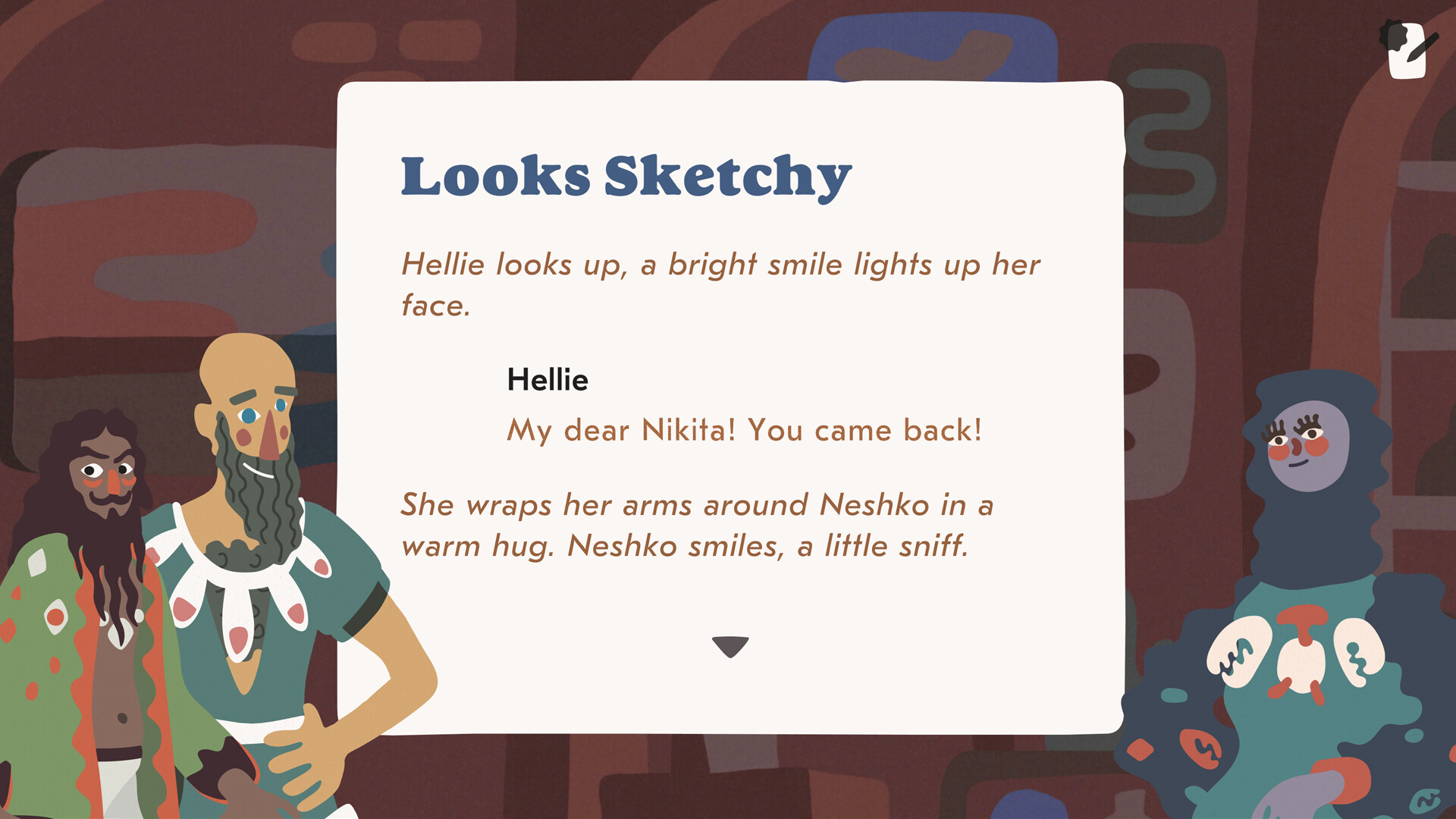
Managing the people aboard is as important as selecting a point on the map. The player guides an ensemble rather than occupying one permanent hero, and the crew’s relationships continue to develop while the investigation advances. Disagreement appears as an Issue: a trackable tension between characters that can become a small relationship story in its own right. Some Issues can be resolved through what the crew sees and says; others persist because a voyage cannot force every person into agreement. New people may ask to join, changing the group that makes later decisions and the conversations available when it reaches another shore. This gives practical weight to the choice of whom to send out. A crewmate is not simply a key that opens a dialogue; that person returns with a memory of what happened and a relationship to the others who stayed aboard. The search for Maja thus has two pressures at once. The crew needs information about its captain, yet its ability to keep searching depends on whether it can live with its own differences long enough to reach the next island.
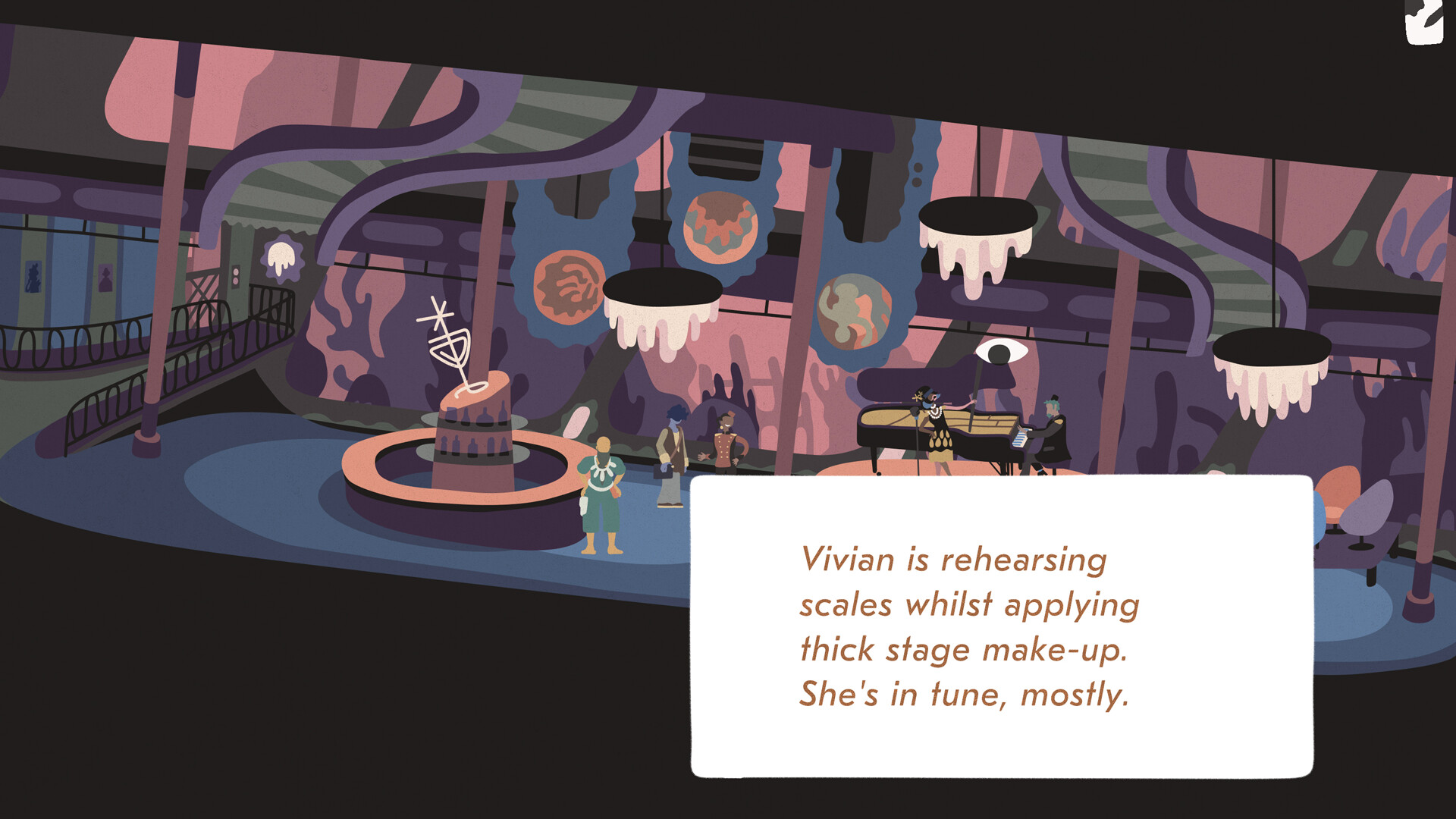
The mystery has records that help a branching journey remain legible. Murl’s Log gathers the questions around Maja’s disappearance, while the Almanac collects encounters as stickers. These are different ways of holding onto information: one keeps the investigation’s threads visible, and the other preserves people and places the crew has actually met. A sticker can be a small reminder that the voyage took a particular route, not proof that every possible path has been exhausted. From any chapter, a save can be replayed and branched, allowing a different landing party or destination to expose an alternative line of events. That structure makes replaying a choice a way to learn about a community rather than simply hunting for a numerical completion marker. It also protects the coherence of a first journey. Decisions can carry dramatic consequences for the crew, and the game does not require the player to see every island before its story can move forward. A missed conversation remains a real absence within one version of the voyage, while another version may reveal why it mattered. The Log and Almanac also give the crew different reasons to revisit an island: a question may still lack an answer even after its people have become familiar, while a chance encounter might enrich the record without solving the central case. They keep discovery personal to the route chosen.
There is a quieter game within the voyage called Spoils. It is a trick-taking card game played with people in the communities the crew visits, and some islands use their own house rules. Sitting down to play offers a different way to learn how a place thinks: the same shared game changes slightly when its hosts explain their custom. It sits alongside small observations and long conversations, giving social life space beyond the urgent question of where Maja went. Saltsea Chronicles does not turn its post-Flood setting into a combat campaign or a simulation of steering a ship through dangerous water. Its mechanics are closer to choosing an itinerary, bringing the right company ashore, noticing the character of a place and living with what a conversation leaves unresolved. The card table makes this approach concrete. The crew can learn something about an island without immediately extracting a clue from it, and a local can be a person with leisure, habits and preferences rather than another witness waiting to deliver exposition.
A print-like visual language helps every community feel part of the same world without flattening their differences. Shapes and colours draw on risograph techniques, with animation bringing the illustrated crew and inhabited ruins into motion. Places can be read quickly at a glance, then filled in through the shorter observations and deeper conversations the player chooses to pursue. Eli Rainsberry’s score shifts with those spaces and the people in them, while the dialogue itself is presented as text rather than a fully voiced performance. That balance suits an adventure in which the player often decides how deeply to listen. Die Gute Fabrik released the single-player base game in 2023 on PC, PlayStation 5 and Switch; store extras such as the soundtrack and wallpapers do not add a second campaign. Within the game, the most consequential resource is attention. Each chapter offers a chance to spend it on another island, a strained friendship, an unfamiliar custom or a fresh lead in Maja’s disappearance. The world keeps moving through all of those choices, and the crew that reaches the next shore carries more than a growing list of clues. Its members may be newly close or newly divided, and the next landing can ask whether either change affects whom they trust. That continuity gives the search a social cost even when no physical obstacle blocks the journey.
- Developer
- Die Gute Fabrik
- Genre
- Branching narrative adventure