
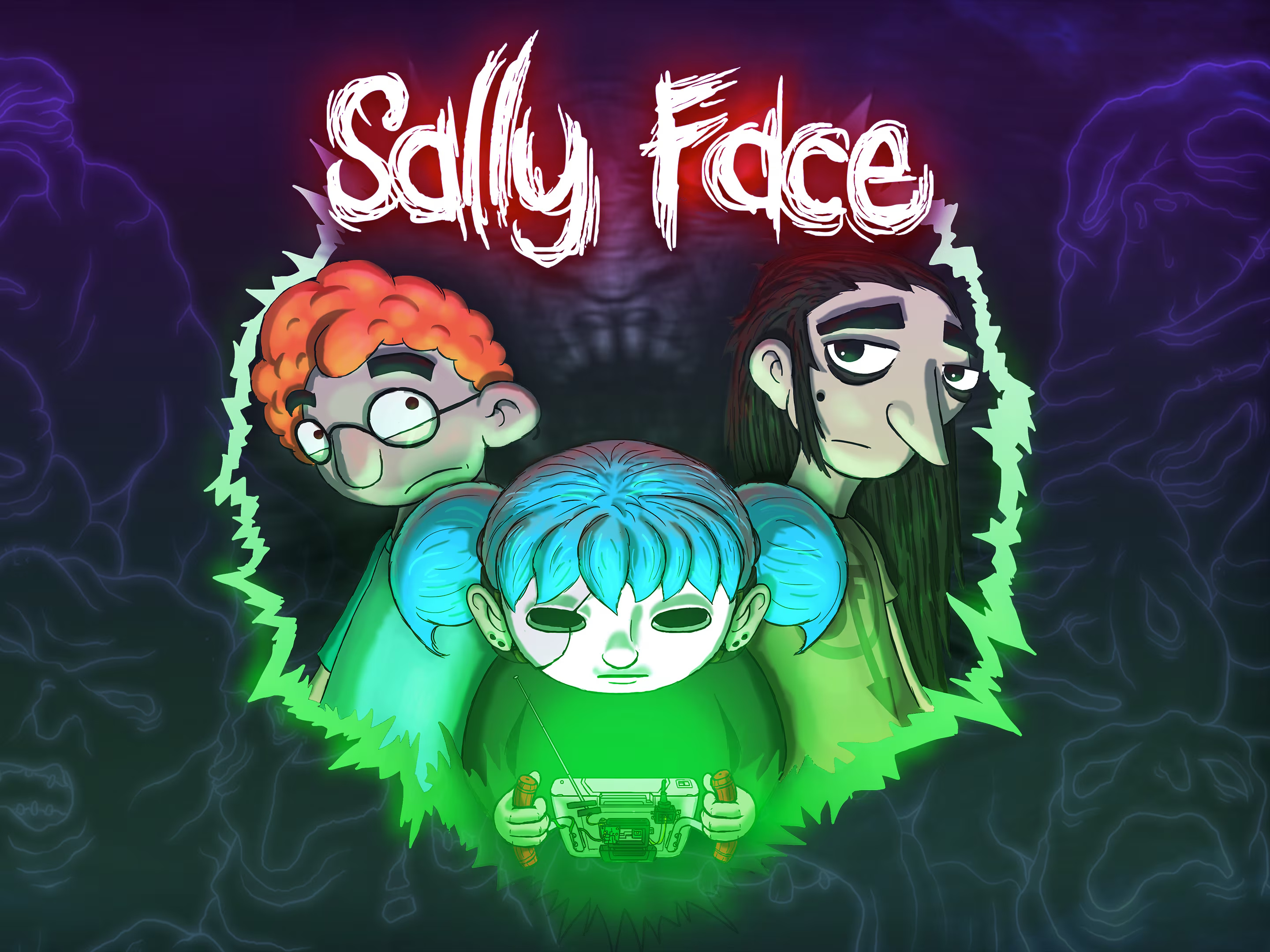
About Sally Face
Sal Fisher and his father move into an apartment building shadowed by a crime scene. Behind Sal's blue hair and prosthetic face, Sally Face follows a five-episode murder mystery that grows from awkward encounters with new neighbours into an investigation of ghosts and a wider supernatural threat. Exploration, conversations and optional puzzles carry the story.
Sal Fisher arrives at a new apartment building with his father and an ordinary problem: they must make a home among people they do not know. The building refuses to stay ordinary for long. A crime scene is part of its recent history, the neighbours have their own unsettling stories, and Sal becomes drawn into questions that cannot be settled by the first explanation he hears. This is the opening of Strange Neighbors, the first of Sally Face's five episodes. Sal's blue hair and facial prosthesis make him immediately recognizable, but they are not a substitute for his role in the story: he is the person who goes out into these rooms, speaks with their occupants, notices what does not fit and decides which lead to follow. The apartment setting gives the mystery a human scale before the threat widens. A hallway connects people who can hide something from one another, while a door that seemed like a harmless part of daily life can lead to another fragment of the case. The game asks players to stay curious about those small discoveries, because its larger supernatural story grows out of the relationships and evidence found close to home.
Sal does not investigate alone. Three friends stand beside him as the murders and supernatural events become harder to ignore. That friendship changes the shape of the mystery: conversations are not merely a way to collect a password or receive the next instruction, but part of how Sal and the people around him make sense of events that resist a neat answer. A player is asked to pay attention to what someone says, where they live, what they may have seen and what the surroundings suggest. The story moves beyond the first building into a small town whose familiar spaces can acquire a threatening second meaning. It keeps the perspective close to the young people following the case rather than opening with a distant account of its entire mythology. That choice lets a disturbing detail register first as something found by a person, not as an encyclopedia entry. It also leaves room for uncertainty. A neighbour may seem strange without being an enemy; a frightening occurrence may be real even when the available explanation is incomplete. The friendships give Sal a reason to keep returning to the people affected as the investigation grows.
The Gear Boy is the clearest sign that this is more than a conventional crime story. The handheld device lets Sal communicate with ghosts, so the search for answers can cross the boundary between the living residents of a place and presences that ordinary questioning cannot reach. It gives the player a specific investigative action to consider alongside examining an area and talking to someone. A room can matter for its visible objects, its connection to a witness and what might be disclosed through the device. Sally Face also contains optional puzzles that reveal further pieces of its narrative. Those additions reward attention without making every extra thread a prerequisite for understanding the central premise. The developer describes the game as an adventure with point-and-click and side-scrolling elements, a useful description of its rhythm: move through a scene, look carefully, interact and return to what an earlier detail now makes meaningful. Investigation and puzzle discovery carry the story rather than a combat system or character build. Expect progress to come from the order in which information is uncovered and the connections drawn between people, places and incidents.

The five-part structure is more than a label placed on a single uninterrupted trip. Strange Neighbors establishes the move, the apartment building and the first murder mystery; the following chapters are The Wretched, The Bologna Incident, The Trial, and Memories and Dreams. Their names hint at changes in setting and stakes without requiring an account of their revelations before a player reaches them. The first episode serves as an introduction, while the remaining four enlarge the story and bring its running questions toward an ending. That matters when choosing a version to buy or a point from which to begin. On Steam, app 541570 is specifically the Episode One listing; a separate Season Pass covers the later chapters, and the storefront presents a complete-game bundle. The PlayStation listing describes Sally Face as the game rather than using the Episode One product name. A reader seeking the entire story should therefore check the contents of the edition in front of them, not assume that every store page bearing Sal's face contains all five episodes. The episodic publication history explains those different labels, but the complete narrative is designed to be followed in order.
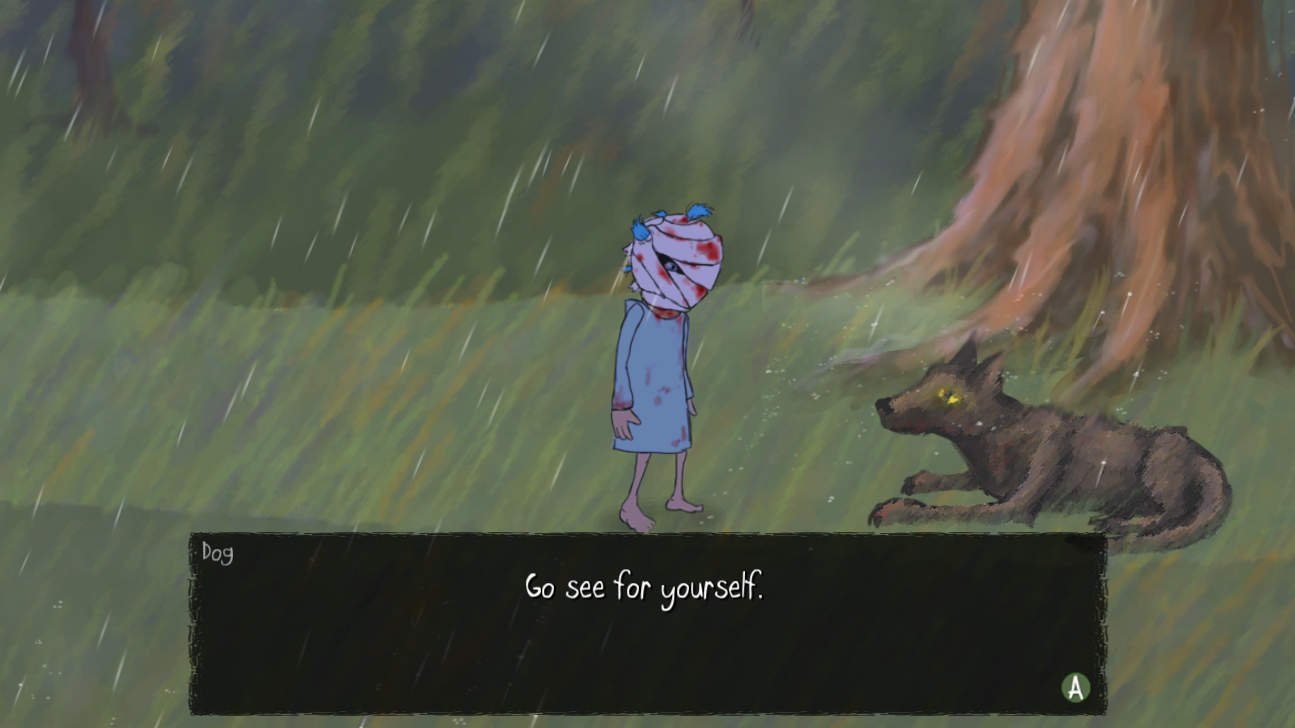
Sally Face uses a drawn world whose cartoon features sit beside a persistently uncomfortable subject. Sal's silhouette, bright hair and stark prosthesis stand out against rooms that can appear quiet, cluttered or wrong in ways that are not immediately explained. The original idea, according to creator Steve Gabry, grew from an animation concept influenced by 1990s cartoons and by a nightmare. That combination helps explain why a character can look at home in an animated series while the story deals with murder and disturbing supernatural imagery. Gabry identifies himself as the person behind the story, art, design and music, so those parts of the presentation were built around one creative vision. The result depends on more than a monster appearing on screen: a background detail, a pause during a conversation or a change in the sound of a place can sharpen what the player thinks is happening. Official content notices make the intended audience clear. Strong language, violence and gore are among the listed elements, with the PlayStation notice also naming nudity and drug references. The visual style should never be taken as a promise that the material is aimed at children.
The mystery's appeal lies partly in its ability to revisit a place or an event after the player has learned something that changes its meaning. A crime scene gives Sal an immediate reason to ask questions, but the story's direction is not limited to finding one straightforward culprit. Ghostly communication, a string of murders and the growing threat described by the developer put the evidence of everyday life beside things that cannot be explained through routine police work alone. Optional puzzles extend that inquiry by offering further narrative threads to someone willing to inspect beyond the most direct route. The player is not asked to fill in Sal's personality from a blank slate; his situation, his relationships and the people he encounters are authored parts of the tale. The work is in observing, connecting and staying with a question through successive episodes as the town's spaces and their residents acquire more history. That makes the contrast between an inviting cartoon surface and harsher events more than an aesthetic trick. It supports the story's movement from an unfamiliar apartment and its odd neighbours toward a wider investigation whose implications Sal and his friends must confront together.
Sally Face's distribution history also explains some of its practical differences between editions. The first episode was originally sold as its own PC entry, and the developer's Season Pass added the four later episodes as they became available; a dated developer announcement confirms that Memories and Dreams was available in 2019. The current itch.io listing offers Windows, macOS and Linux builds and identifies keyboard and Xbox-controller inputs, while PlayStation's storefront presents a PS4 edition of the complete game. Its soundtrack is listed with the Season Pass on the developer's page. These product details matter because a search for the title can bring up the Episode One listing, a Season Pass, a complete-game bundle or a later console release, each describing a different purchase path into the same five-chapter story. The chapters themselves remain sequential, so a player beginning with the first crime scene is not expected to choose among independent cases. The older release labels are evidence of how the work grew over time; they should be checked against the actual contents of a storefront listing before assuming that a single purchase includes the ending.
- Developer
- Portable Moose
- Genre
- Episodic supernatural adventure