
About Saints Row: Gat out of Hell
When Satan takes the Saints’ leader to Hell to marry his daughter Jezebel, Johnny Gat and Kinzie Kensington go after them. This standalone open-world expansion trades simulated Steelport for New Hades, where flight, supernatural powers and destructive activities help the pair draw Satan’s attention.
Saints Row: Gat out of Hell follows the events of Saints Row IV with a new rescue mission and a different playable lead. Satan abducts the Saints’ leader, the Boss, intending to force a marriage to his daughter Jezebel. Johnny Gat and Kinzie Kensington enter Hell to bring the Boss back, and the player can take control of either character. The premise makes the two Saints the centre of this standalone expansion rather than continuing to play as the President from the previous game. Their search takes place in New Hades, a city built around a towering central landmark and divided into five distinct districts. It is an open-world playground designed for flight, combat and activities that attract the attention of Hell’s ruler.
New Hades is arranged vertically as well as across its districts. Floating platforms, steep structures, gaps between buildings and dark chasms create routes that invite the player to look above the road grid. Johnny and Kinzie can run quickly, leap across rooftops and use fallen angel wings to cross the skyline. Flapping gives a burst of speed, while dives and course corrections carry the character through openings and around raised structures. Flight changes how the map is read: a checkpoint may lead through a narrow passage between buildings, and an objective below can be approached from the air rather than by following streets. Movement still has limits, so a long trip may require touching down while the flight resource recovers before taking off again.
The combat powers retain the broad idea of Saints Row IV’s abilities but have Hell-specific forms. Stomp sends a shockwave across the ground, Summon calls a small demon to harass an enemy, and Aura lets the character set themselves on fire and spread that effect to nearby foes. Blast has elemental effects: one can turn a foe into stone ready to shatter, while another drains life instead of setting targets on fire. Each power has its own cooldown, which lets the player rotate between effects instead of waiting on one attack. Weapons cover the remaining distance, from conventional gunfire to themed arms built around the deadly sins. Some weapons fire explosive frogs or locusts, and another uses a lethal chair as its firing platform. Together, powers and guns support a combat rhythm of crowd control, movement and direct damage against demons and other enemies.
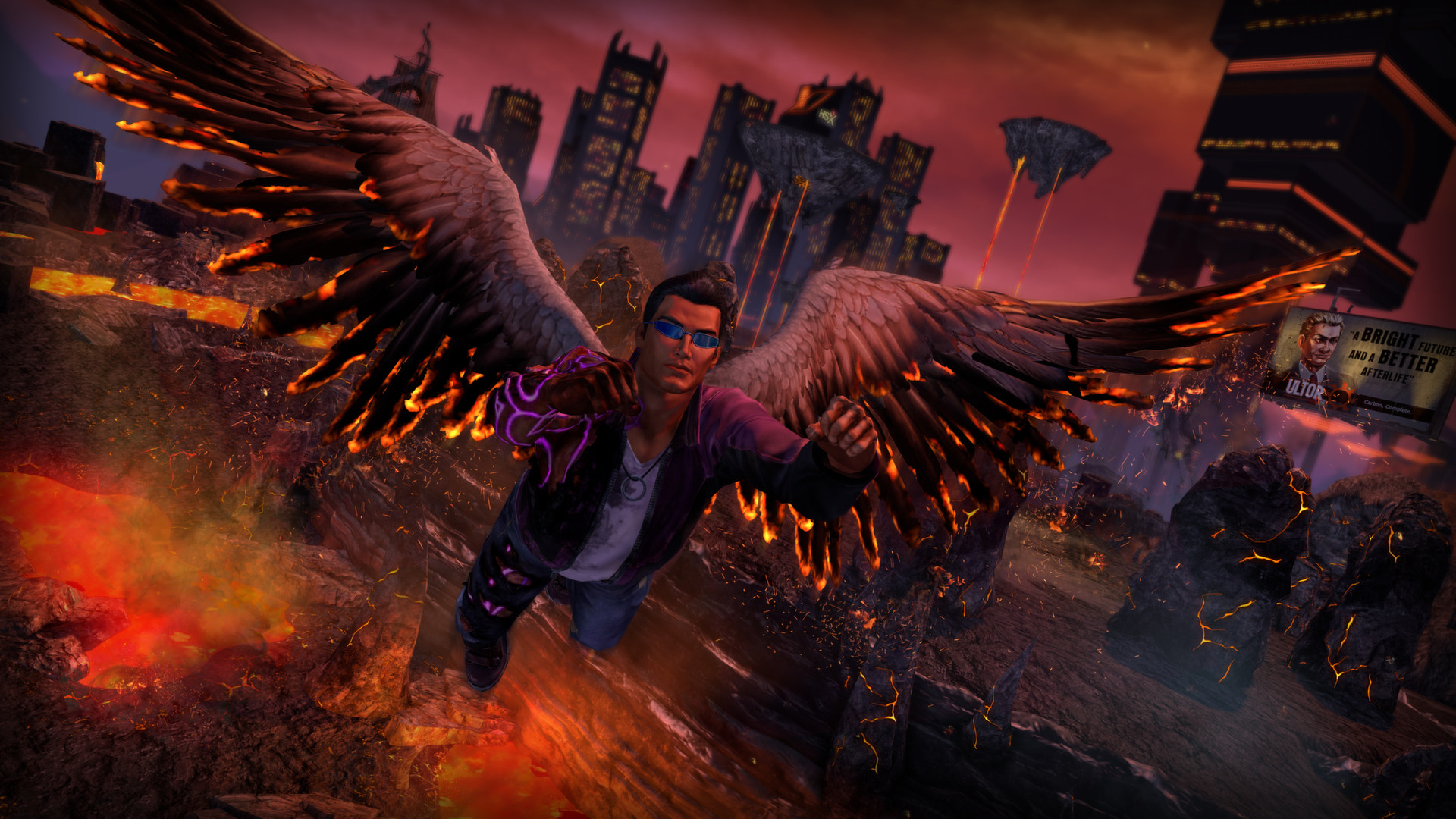
Activities are central to the campaign’s structure. New Hades offers familiar forms of open-world challenge with changes suited to the setting: Mayhem rewards destruction, Survival asks the player to endure waves of enemies, and Torment Fraud turns traffic collisions into a way to shorten a condemned soul’s sentence. Flight also shapes Trail Blazing races, which route the player through airborne checkpoints and tight passages. Other diversions involve catching falling souls before they hit the ground or holding locations against Hell’s inhabitants. These tasks are not merely optional space between a long sequence of conventional missions. Causing enough mayhem raises Satan’s Wrath, shown by a meter that gates further story scenes. Choosing activities therefore determines how the narrative advances as well as what the player does in the city.
The people Johnny and Kinzie encounter connect the open-world tasks to their goal. Dane Vogel, Ultor’s former chief executive, guides them through parts of the operation, while Hell’s roster includes figures such as William Shakespeare, Vlad the Impaler, Blackbeard and the DeWynter Twins. Rescuing notable allies and completing loyalty quests develops those relationships and adds new requests to the activity loop. The tone treats historical names and Saints Row regulars as inhabitants of a deliberately strange underworld, where a ruler’s court, soul-processing sites and hostile demons all coexist. The city’s ordinary encounters and its named characters serve different purposes: the former supply repeatable challenges and Wrath, while the latter give the rescue effort a cast of contacts with their own place in the conflict.
Weapon acquisition works differently in Hell because ordinary shops are absent. Sinterpol Armoury vending machines provide the available guns, including the Exodus SMG, which launches life-draining locusts, and Lil’ Croaker, which fires explosive frogs. The deadly-sin weapons add other bizarre functions, such as the armchair that becomes a drivable weapons platform. Weapons can then be improved using cash: the frogs from Lil’ Croaker gain longer tongues, while the Impaler crossbow’s stakes can become explosive. This creates a weapon-progression track alongside the arcane powers. Finding an armoury machine and deciding which weapon to purchase gives exploration a practical purpose between activities, while upgrades strengthen individual tools without relying on a conventional shop network.
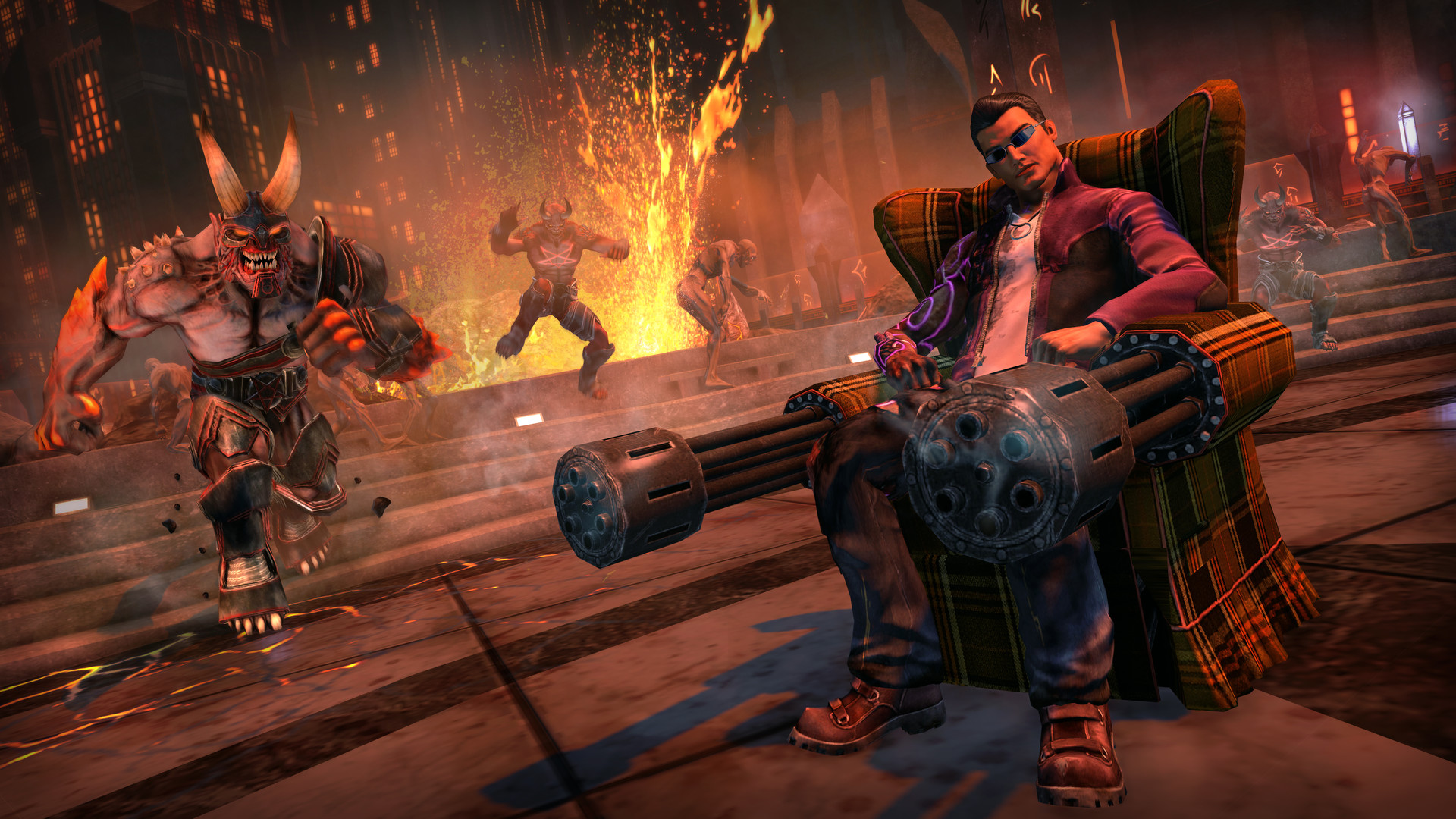
Some progression sites turn an upgrade into a combat encounter. Activating a hidden glyph with a power starts a fight against waves of powerful enemies; surviving with that ability and weapons earns access to a new power. In dark chasms, other glyphs open teleport gateways around Hell, but their activation also draws out high-powered demons and a Legionnaire miniboss. Altars add a further step for the four existing powers: after activating one and surviving a demonic assault, the player can unlock modifications that change how those abilities work. These encounters make exploration a choice about when to take on a concentrated fight in exchange for a new tool or a faster way across the map. They also require the player to use the same abilities that the reward will expand.
- Developer
- Deep Silver Volition and High Voltage Software
- Genre
- Standalone open-world action expansion with third-person shooting