
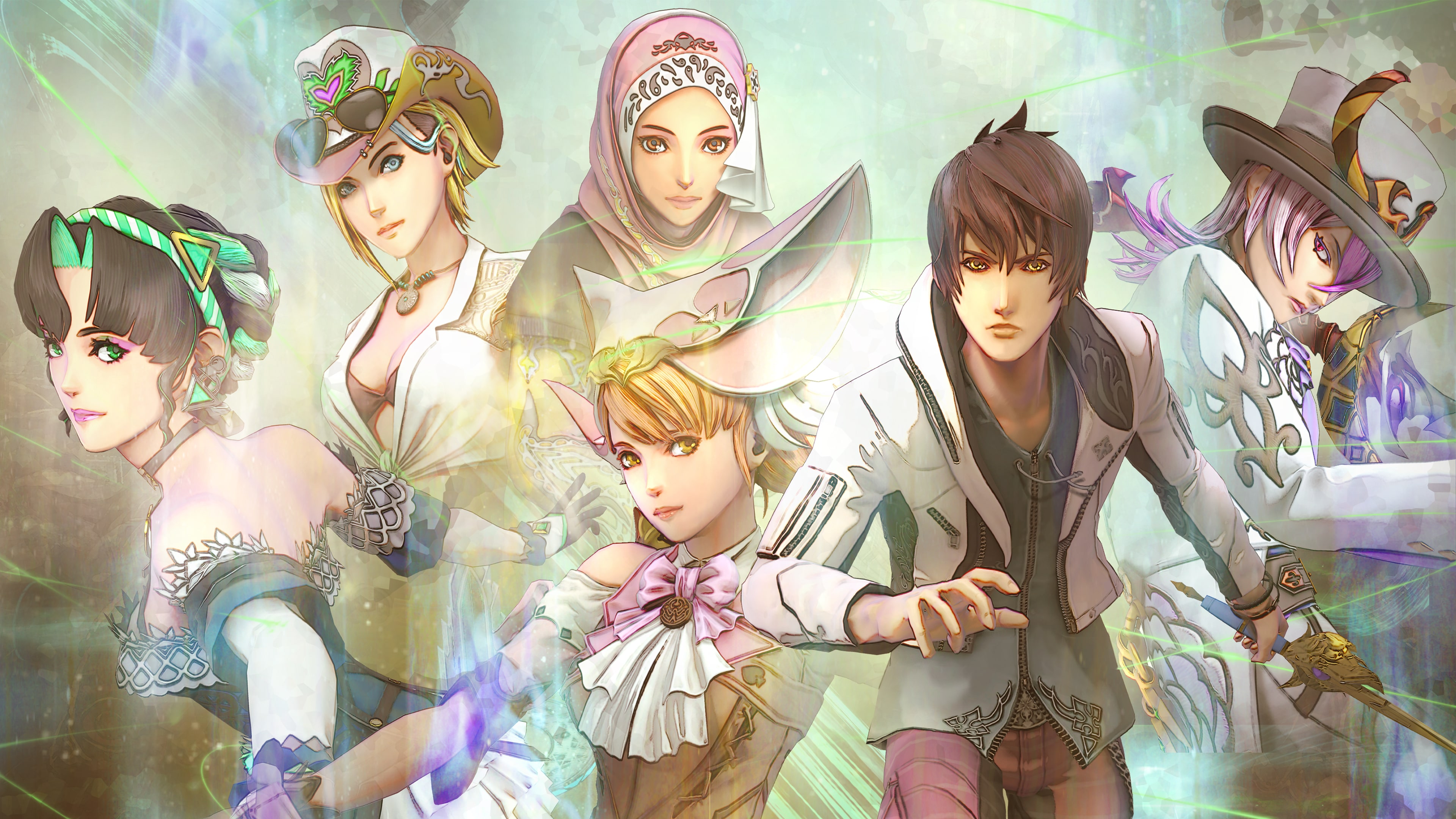
About SaGa Emerald Beyond
Follow five story routes led by six protagonists across 17 worlds linked by the Junction. Each journey develops through choices and revisits, while turn-based battles show enemy actions on a timeline that players can reshape to connect allies' skills, interrupt foes and trigger new abilities.
SaGa Emerald Beyond begins with a choice of whose journey to follow, then opens onto a network of 17 worlds connected by the Junction. Five story routes belong to six protagonists because one route follows two people together. Mysterious emerald waves guide travelers between these places, but the route is shaped by both circumstance and player decisions. The worlds have distinct landscapes and social orders: a forest of tightly packed skyscrapers, a lush habitat covered in plant life, a land governed by five witches, and a world ruled by vampires are among the examples. This variety is more than a change of scenery. Each destination brings its own people and situation into the protagonist’s ongoing story, and returning to a world can reveal different events. The structure asks the player to move between contained settings and follow the consequences of what happens there, rather than traverse one continuous map. The Junction gives the journeys a shared point of connection, while the worlds keep their own identities and conflicts.
The six leads have sharply different reasons to travel. Tsunanori Mido is tasked with protecting the barrier that defends his city and can control sentient puppets called Kugutsu. Ameya Aisling is a young witch who loses her powers after an attack and continues her journey disguised as a schoolgirl while trying to reclaim them. Siugnas, the Dismal King, is an immortal vampire driven from his throne in Yomi and folded into another king’s army as he seeks a way back to power. Diva No. 5 is a songstress mech whose memory and singing function are locked after she performs a forbidden song; she abandons her humanoid body and leaves Avalon with an extradimensional task force. Bonnie and Formina are rookie police officers investigating an assassination attempt on their world’s president. Their paired route adds a working relationship to the central mystery. The cast therefore spans a threatened city, lost magic, a displaced ruler, a damaged performer and an investigation, giving each route a distinct starting problem before the group reaches unfamiliar worlds.
Choice and repetition shape how those starting problems develop. The story branches according to where the player goes and what they do there, and events can change as a world is visited again. A route is not simply a fixed sequence of chapters: the order of destinations and local decisions can open different developments, scenes and possible endings. Even choosing the same protagonist for another playthrough can lead to new events and a different path. That variation gives the Junction a practical narrative role: it connects places whose cultures and conflicts can be encountered in different contexts. The player’s task is to follow the current lead, decide how to respond to situations and see how the resulting route intersects with the protagonist’s purpose. The game’s many branches mean that no single journey represents every route or ending. Its framework stays recognizable across playthroughs, but the arrangement of events can shift with the protagonist, destination order and choices made along the way.
Travel between worlds is presented through the Junction and the emerald waves that lead the protagonists onward. Within the broader journey, the player reaches individual worlds, encounters their inhabitants and follows the story events available there. The journey is nonlinear, and world order and decisions influence what happens next. Each setting presents its own available events rather than a fixed checklist repeated across all destinations. This is important to how the adventure is paced: movement through the game is tied to following a route and responding to its events, while exploration includes discovering how a familiar destination changes in another context. The destinations range from dense urban growth to plant-filled environments and societies governed by witches or vampires. Their differences include culture and outlook as well as appearance. The player is consequently moving through a set of worlds with distinct identities, not just crossing interchangeable scenery between battles. The available route and encounters can vary, so the journey is best understood as a sequence of connected, choice-shaped episodes.
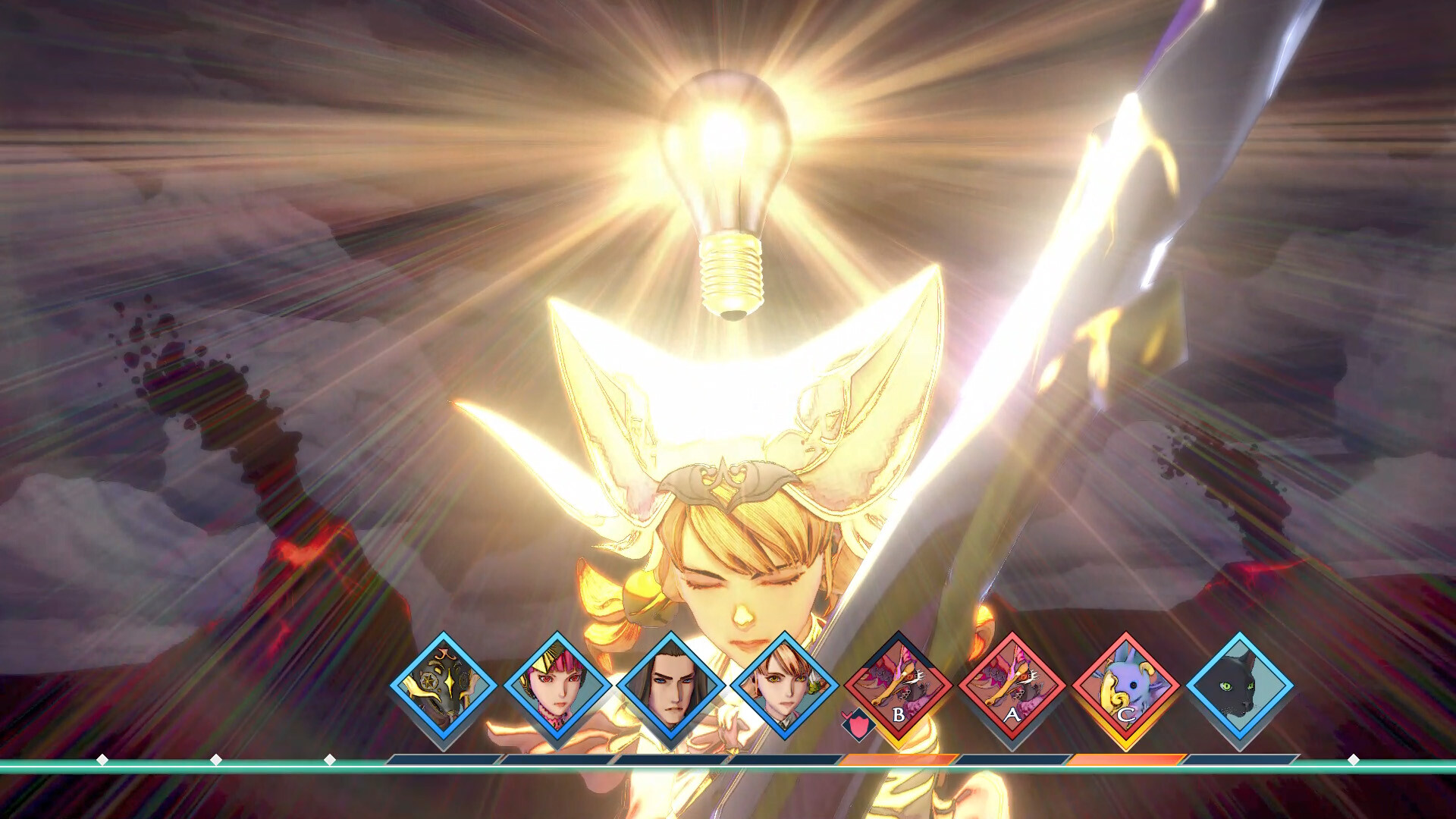
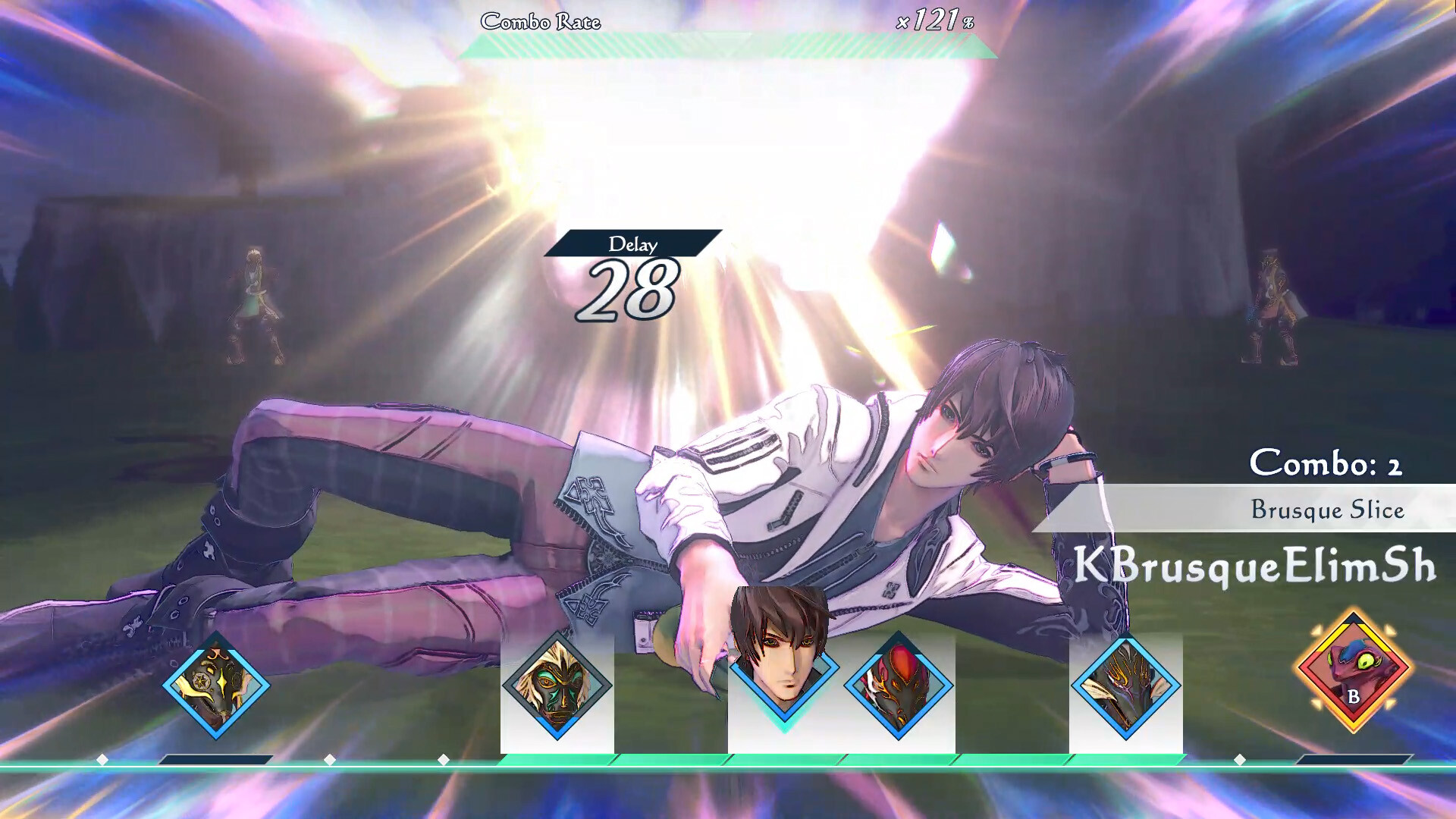
Combat uses a turn-based timeline that displays enemy actions and their order before a turn begins. The player can alter the timing of actions with selected skills, then decide whether to link allied moves or disrupt the enemy’s planned sequence. Each ability has a range on the timeline for connecting with other actions; when compatible skills meet, they form a chain that increases damage. Enemies can create chains too, so the same planning problem applies to both sides: build an allied sequence or break up the opposing one. This makes the visible order useful information rather than decoration. A command can matter because of where it lands in the sequence, which moves it enables afterward and whether it leaves an enemy combination intact. United Attacks are the connected ally chains, and the player can support party members or interrupt enemy actions while arranging them. Instead of choosing each attack in isolation, the player reads the coming order and uses the available actions to shape the turn’s pattern.
Other battle systems add choices about party roles and future options. Formations give allies an arrangement with different effects; the official system guide describes formations that can reduce the cost of a central skill or draw attacks toward particular characters. Glimmers let a character spontaneously learn a new weapon-related technique during battle, with the newly discovered move available from the following turn. A character’s race also affects how techniques, spells and growth work, so a party drawn from humans, mechs, monsters and vampires can bring different development patterns into combat. These features connect preparation and adaptation: formation influences how a party can act now, while new Glimmers can change the moves available in later turns. Since growth and technique learning differ by race, choosing whom to bring also affects which skills and spells a party can develop. The result is a link between party composition and the tactical options available when arranging a timeline. The player must consider the lineup as well as the timeline, since compatible actions, skill costs and the protection of particular allies all affect what sequence is possible. Combat progression is not described as a single shared path for every character; the systems emphasize using each participant’s traits and the abilities that emerge during the journey.
SaGa Emerald Beyond is a standalone entry in the SaGa series, released in 2024. The Steam edition is a single-player PC release, and the same game is also listed for PlayStation 5, PlayStation 4, Nintendo Switch, iOS and Android. Steam separately offers a demo using the opening of Diva No. 5’s story; its page says the demo save can transfer to the full game. The full game’s five routes, six protagonists and 17 worlds define a much broader structure than that opening sample. The visual presentation supports the setting’s variety with distinct landscapes and character designs across its humans, witches, vampires, mechs and monsters, while the musical identity is particularly visible in Diva’s story as a performer. Across those differences, the Junction supplies continuity and the timeline battles give the group a shared tactical language. The player alternates between shaping a longer journey through connected worlds and arranging a shorter sequence of actions within each fight, with both story and battle outcomes responding to the choices made.
- Developer
- Square Enix
- Genre
- RPG