
About Rogue Legacy 2
In Rogue Legacy 2, a family of adventurers keeps returning to a shifting kingdom as each heir inherits the last expedition’s gains and setbacks. Each child arrives with a class, abilities and traits, while gold can grow the family Manor between runs. Explore distinct biomes, uncover permanent heirloom powers and build a legacy to challenge the kingdom’s bosses.
Rogue Legacy 2 follows a family whose members take turns venturing into a kingdom that changes its layout, monsters and traps between expeditions. When an heir dies, one of their children inherits the task, turning the failed run into the start of another generation rather than a complete reset. The descendants vary in class, abilities and traits, so the next adventurer can approach familiar rooms with a different toolkit or a different limitation. The story follows the kingdom’s collapse and the people connected to it, with new lore and relationships continuing across later playthroughs. Its central structure links a side-scrolling journey through the castle to the inheritance and decisions waiting at the family home.
At the Docks, the player chooses an heir and spends inherited gold on the Manor, a branching collection of upgrades that improves the family over time. Manor purchases can raise attributes, add services and unlock further classes, giving later heirs stronger starting conditions. Gold can also fund equipment and rune improvements through the kingdom’s residents, while traits can modify the amount carried home from a run. The choice of heir is therefore more than a cosmetic generation change: their class determines core attacks and talents, and their traits can alter how a run works. A Colourblind Archer or a Pacifistic Chef, for example, combines an unusual trait with a class identity, so the player weighs the trait’s effects alongside the heir’s combat tools before entering the castle. One Manor service, the Sage Totem, adds class Mastery XP; as classes gain mastery, their improvements persist and contribute across the family rather than belonging only to one character. The Offshore Banking upgrade slowly accumulates gold toward more expensive purchases, adding a reserve that can make a longer-term Manor improvement reachable.
Exploration is built around jumping, attacking, casting spells and using a class talent while crossing rooms filled with enemies and platform hazards. The Spin Kick provides a recurring movement and combat action: striking suitable objects or enemies can bounce the hero upward, letting the same move help cross gaps and extend an attack sequence. Each class adds a distinct weapon style and talent, and a run also assigns a spell that supplies another way to deal with enemies or obstacles. Weapon and spell attacks have skill-critical conditions, such as striking at a particular point in an attack or combining a dash with an attack. Learning those timings changes how combat feels without removing the need to read a room, manage space and avoid incoming damage.
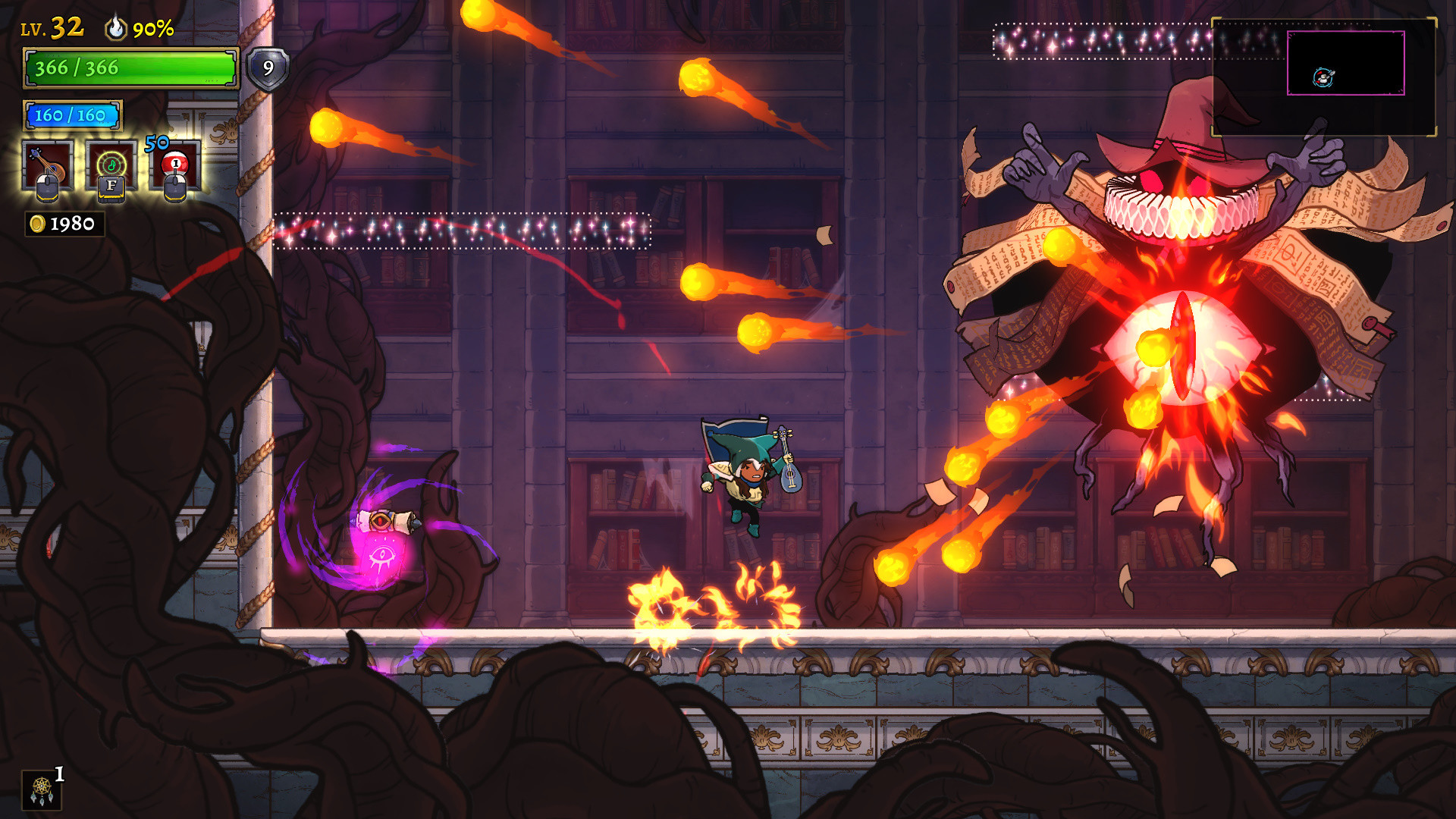
The kingdom is divided into biomes with different architecture, hazards, creatures and visual identities. Rooms branch into treasure, challenge spaces and routes toward bosses, while fairy-room challenges test movement under special conditions. Heirlooms are permanent ability discoveries found through dedicated trials; gaining one gives future heirs a new way to move through the world, opening routes and changing how earlier abilities combine with the environment. Because these powers alter traversal, returning to an area after finding an heirloom can reveal paths that were previously unreachable. Biome layouts and room arrangements vary across entries, so knowledge of the world’s broad structure helps without making every expedition an identical route through a memorized map.
During an expedition, relics can be found that add a particular effect or ability for the current run. Taking one reduces Resolve, a resource that represents how much the heir can carry from these temporary powers; when Resolve falls below its normal threshold, maximum health is reduced. Relics therefore ask the player to weigh their effect against a smaller health reserve, and some can impose a further condition or reward a particular approach. Equipment weight also interacts with Resolve, connecting armor choices to the same decision. A hero can pursue a more protective loadout or keep equipment lighter to preserve room for relics. If the heir dies, run-specific relics are lost, while gold and other eligible rewards feed into the next inheritance and permanent upgrades. Relics vary in function: some modify stats, some impose a special challenge, and others grant a new ability. Their value therefore depends on how the effect fits the current heir and the route still ahead.
Progress continues after major victories. The Manor and class Mastery provide lasting growth, while successive New Game Plus journeys let players choose added challenges, including biome hazards and special boss encounters. House Rules offer adjustable settings for damage, contact damage and other parts of the experience, allowing players to alter difficulty and some platforming demands. These systems sit alongside optional challenges and characters encountered around the kingdom, rather than replacing the expedition loop. A run can end with a new heir, more gold for the Manor, a discovered heirloom or a boss defeated; each outcome changes what the next generation can attempt. The game’s long arc is built from those connected attempts, with inherited traits and upgrades shaping a changing route through a kingdom whose secrets unfold across multiple generations.
- Developer
- Cellar Door Games
- Genre
- Action adventure platformer with roguelite progression