
About Rise of the Tomb Raider
Rise of the Tomb Raider follows Lara Croft into Siberia as she pursues the secret of immortality and the lost city of Kitezh. Trinity is searching for the same ancient mystery. Traversal, hunting, crafting, stealth, firefights and puzzle tombs shape Lara’s expedition through hostile landscapes and buried history.
Rise of the Tomb Raider continues Lara Croft’s story after the events of Tomb Raider (2013). Lara follows the legend of an artifact tied to immortality and the lost city of Kitezh. Her investigation takes her to Syria and then into the Siberian wilderness, where the armed organization Trinity is pursuing the same secret. Lara’s friend Jonah Maiava remains part of the human side of the story, while the conflict around Kitezh draws her into a much older history. The mystery is delivered through expeditions, conversations, documents and discoveries in the landscape, rather than through a separate hub of exposition. The campaign’s central question is what the promise of eternal life means to the people and institutions trying to claim it, as Lara becomes more capable of facing the world that first overwhelmed her.
Movement links cliffs, ruins, forests and interiors. Lara climbs with her axes, jumps between handholds, uses rope arrows to make lines across gaps, and later gains a grappling axe that catches designated ledges. The axes also help pry open barriers and interact with obstacles, so traversal gear can solve a route problem without being a separate menu activity. Camps and landmarks connect larger spaces into an expedition route: a path may lead toward the story objective, a side activity or a sealed area that becomes reachable after Lara gains the right tool. Siberia’s snow, steep rock and unstable structures make the ground itself a changing hazard. In some sections Lara swims underwater, using the limited underwater passages available in this game to move through submerged spaces. Returning through established camps lets her fast-travel between known points and revisit areas with newly available access.
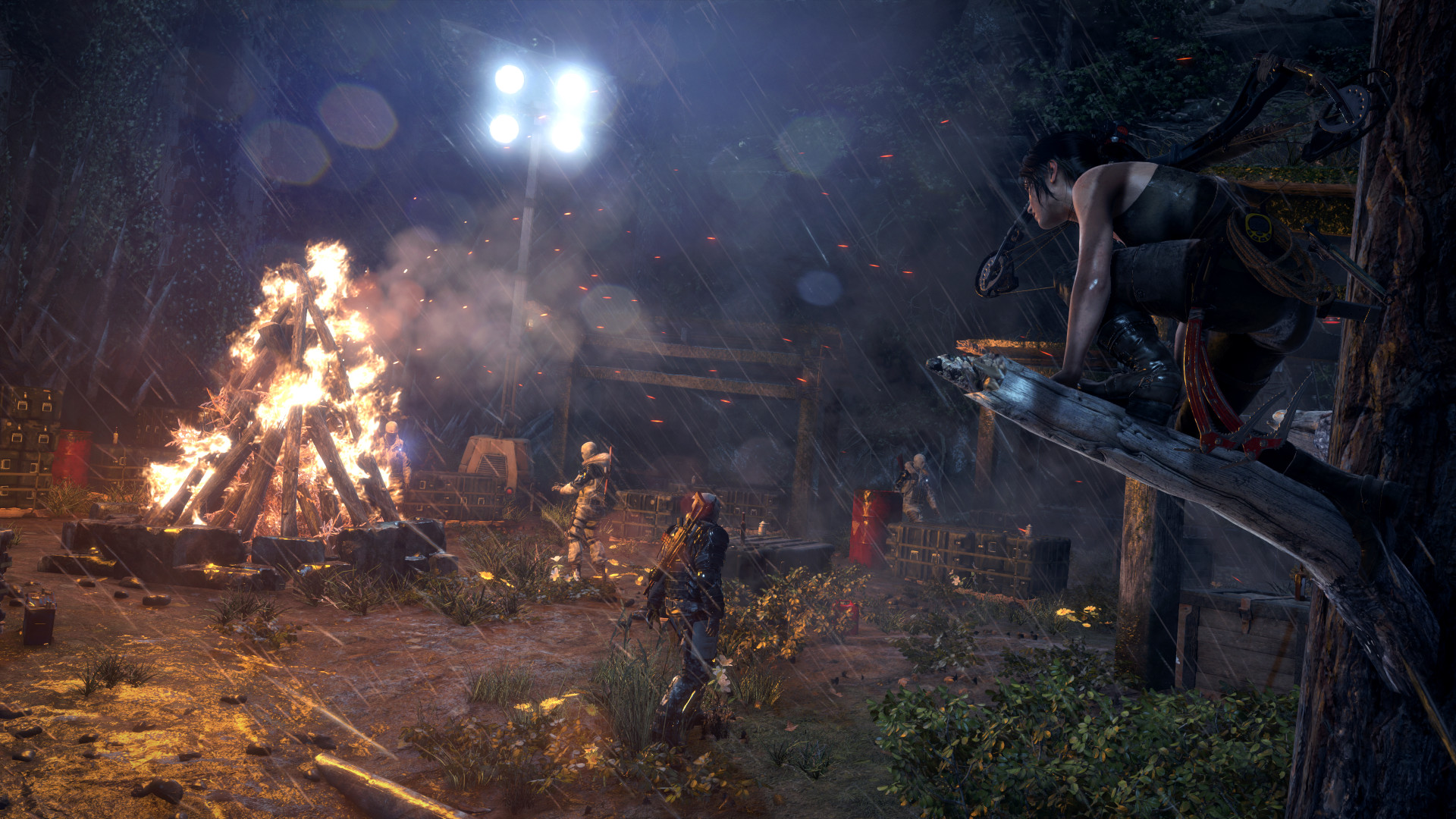
Combat allows Lara to approach Trinity soldiers quietly or enter a direct firefight. She can crouch in vegetation, use trees and elevated positions, and move through water to avoid or surprise enemies. Her bow supports silent shots and several specialized arrow types, while pistols, rifles and shotguns cover louder engagements at different ranges. Weapons have distinct models and statistics, and camps provide a place to select and upgrade the firearms she carries. Ammunition and equipment can also be crafted during the journey, including improvised explosives for a fight that has become too crowded. This means combat preparation is tied to whatever Lara has gathered: a player can conserve ammunition with stealth, spend crafted supplies to disrupt a group, or use heavier firearms once an alarm has turned an encounter into open combat. The route through a hostile camp therefore often has more than one workable approach.
Hunting and scavenging feed the survival and crafting loop. Animals provide materials, plants and other finds supply ingredients, and exploration turns those resources into usable ammunition or gear. Lara can craft at a base camp or make certain items while moving, so the same collected materials support both planned upgrades and immediate responses. The inventory category at a camp includes ammunition and equipment crafting, while the weapons category handles firearm selection and improvement. Base Camps also serve as save points and allow fast travel, outfit changes and skill spending. These functions make a camp a pause in the expedition where a player can review what has been found, spend accumulated skill points and prepare the loadout for the next stretch. The world’s hazards and enemy presence give materials practical purpose: gathering is linked to remaining equipped, opening routes and keeping options available when a fight or traversal challenge changes the plan.
Experience earned during the adventure becomes skill points that can be spent at camps across three branches: Survivor, Hunter and Brawler. Those branches develop different parts of Lara’s toolkit, from survival and resource handling to combat capabilities, so progression grows out of exploration and encounters rather than a single linear level increase. The weapon system also offers choices within categories: multiple bows, pistols, shotguns and rifles have different characteristics, and upgrades can be selected to suit the player’s preferred approach. At camp, the combination of skills, weapon selection, ammunition crafting and fast travel creates a clear preparation step between excursions. A player who has found materials and earned experience can leave with a different mix of capabilities than before, while the same systems remain accessible throughout the campaign. Lara’s development is therefore shown through new tools and learned abilities that alter how she can manage later spaces.
Tombs put environmental puzzles at the centre of particular expeditions. Larger tombs can use nested puzzles, where several smaller mechanisms contribute to one goal; the Flooded Archives, for example, centers on a multipart physics puzzle inside a waterlogged ruin. Some challenge tombs are optional, and their entrances let Lara continue the main route or investigate a side opening. Completing a tomb can reward maps, weapon upgrades, experience or a special skill, giving puzzle-solving a direct connection to character progression. The campaign also places tomb spaces along its main path, so raiding is part of the story’s forward motion as well as an optional detour. In these rooms, the player observes how mechanisms interact and navigates traps; combat arenas instead ask for weapon and movement decisions under pressure. Both use the environment, but they ask Lara to read it differently.
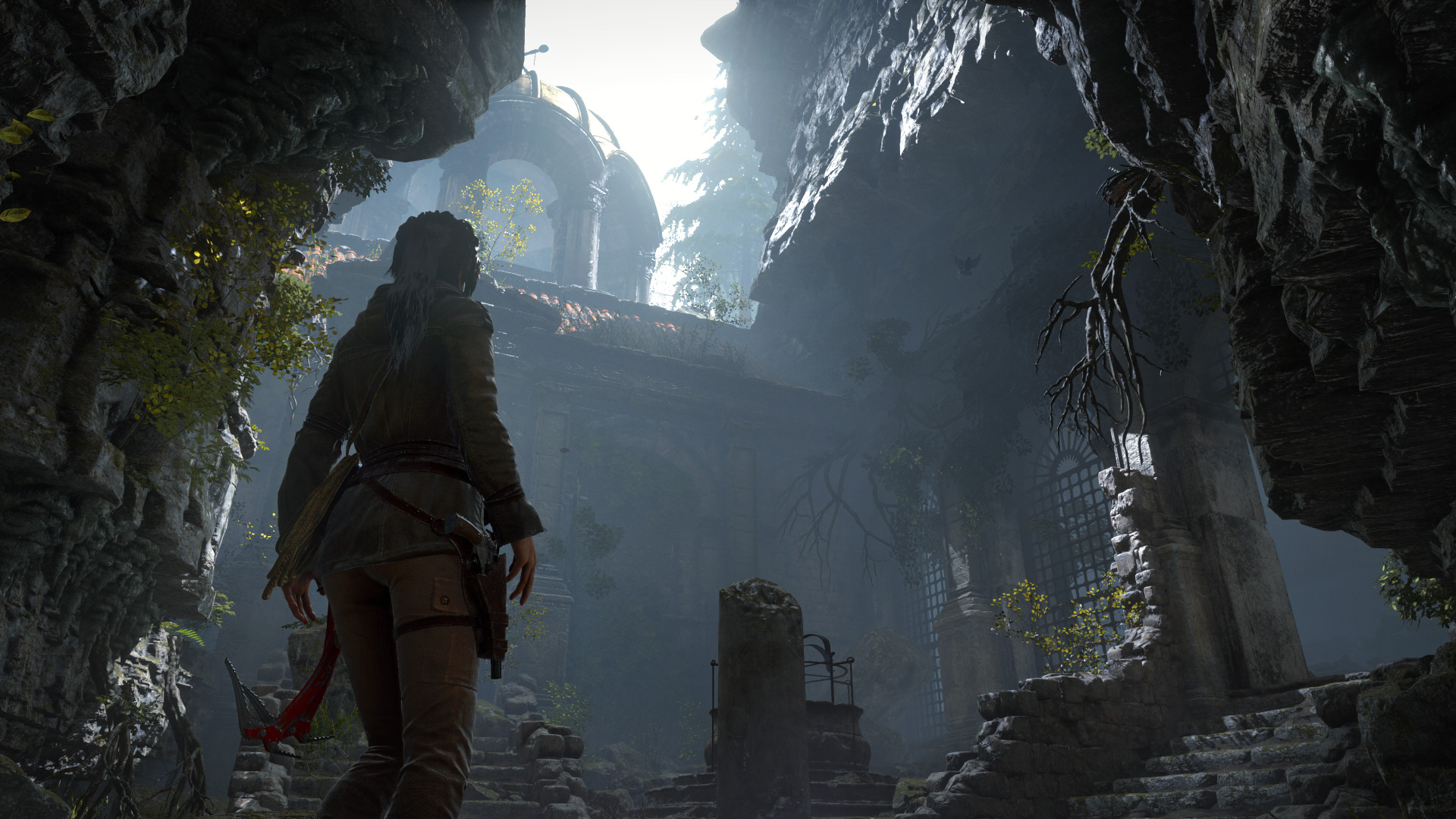
Smaller discoveries add another layer to each region. Documents and relics record fragments of local history and the expedition’s past; some relics can be examined closely for details that are easy to miss at a distance. Challenge tombs are not the only optional destinations: Rise also includes crypts, which provide distinct rewards without the puzzle structure of a tomb. Those differences give side exploration varied purposes, from solving a large environmental mechanism to entering a quieter burial space and uncovering its contents. Caches and hidden routes can also be revisited after Lara’s equipment improves. Together, these optional spaces make investigation part of the expedition alongside the main search for Kitezh.
- Developer
- Crystal Dynamics and Eidos-Montréal
- Genre
- Action-adventure