
About Resident Evil Revelations
Set between Resident Evil 4 and 5, Revelations follows BSAA agents Jill Valentine and Chris Redfield as a bioterror investigation leads to the Queen Zenobia, a supposedly abandoned cruise ship, and the ruined city of Terragrigia. Its episodic campaign alternates characters and locations, pairing limited supplies with the Genesis scanner and a separate Raid Mode.
Resident Evil Revelations opens with Jill Valentine and Parker Luciani searching for Chris Redfield after the BSAA loses contact with him. Their trail leads across the Mediterranean to the Queen Zenobia, a vast cruise liner presented as abandoned. Jill and Parker find the ship crowded with infected creatures and evidence connected to a new bioterror threat. Elsewhere, Chris and his partner Jessica Sherawat investigate events in a snowbound region, and the campaign moves between their operations as more of the case emerges. The mystery concerns the T-Abyss virus and the earlier destruction of Terragrigia, so the ship investigation links a contained rescue mission to a wider account of biological weapons and institutional conflict.
The cast gives the investigation more than one point of view. Jill and Parker work aboard the Queen Zenobia, while Chris and Jessica pursue another lead; BSAA commander Clive R. O’Brian coordinates their operation. Raymond Vester, an FBC agent with ties to Parker and Jessica, and FBC commissioner Morgan Lansdale complicate the relationship between the agencies. The manual identifies the BSAA as an organization formed to respond to bioweapon emergencies and the FBC as a secretive government commission, establishing why the agents’ evidence has political stakes. Their conversations and changing assignments supply context between encounters, while the player’s immediate responsibility stays with whichever operative is currently moving through a dangerous location.
Campaign progression is divided into episodes, and each episode contains scenes that can change both the playable character and the setting. Results screens and recaps mark those shifts, giving the investigation a serial structure: a scene follows one team’s evidence or danger, then the next may pick up another thread elsewhere. The Queen Zenobia’s cabins, corridors and service areas make navigation close and enclosed, while mountain routes and other locations change the kinds of spaces the teams cross. Checkpoints and scene or episode saves organize progress around these segments. Because the campaign alternates between teams, weapons and equipment are managed for the active character rather than through a single uninterrupted journey by Jill or Chris.
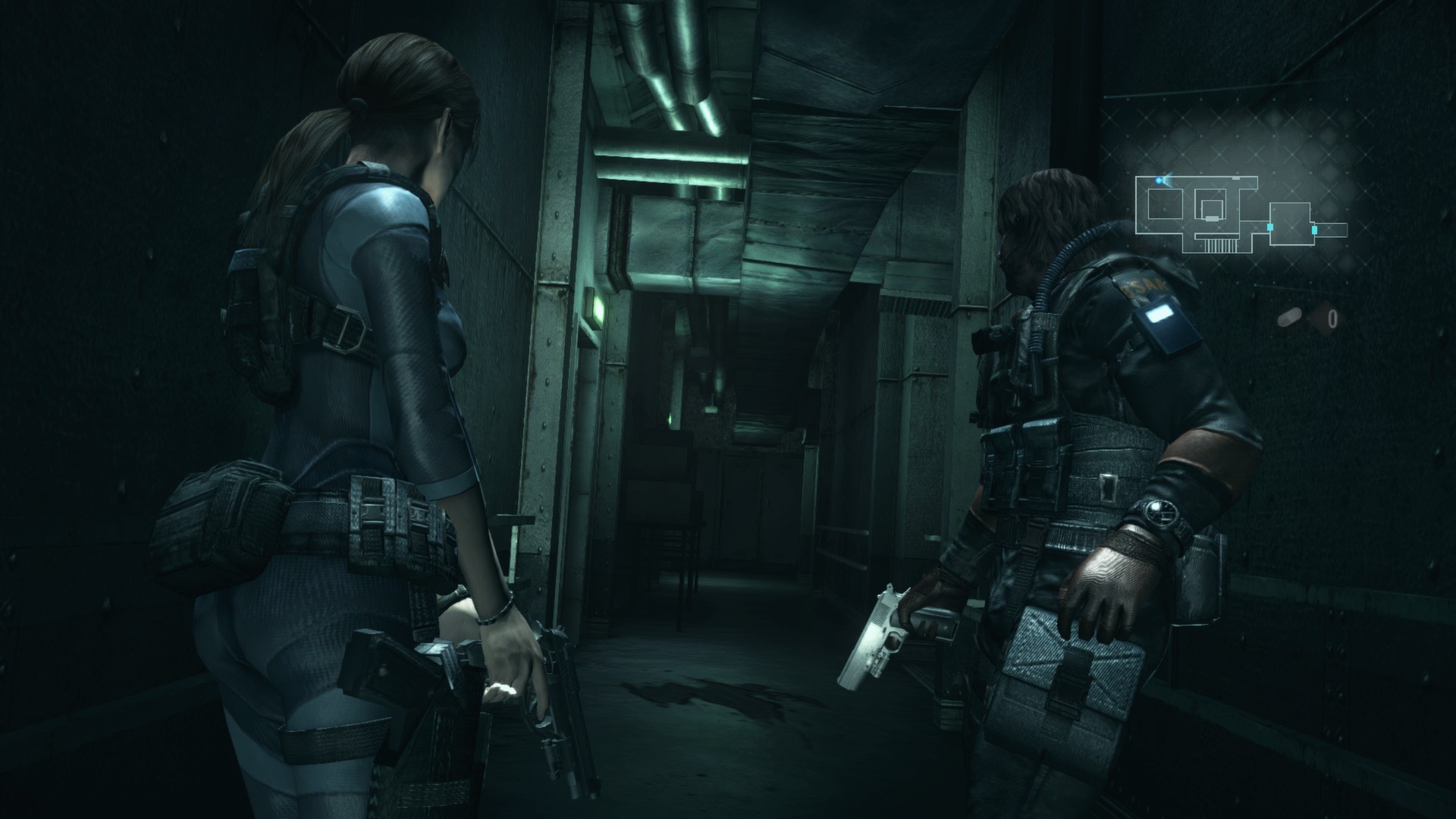
Genesis, a BSAA bioscanner, turns searching into an active part of survival. In campaign scenes where it is available, the player equips the device and sweeps the view across rooms and enemies to analyze targets or reveal objects that are difficult to see unaided. Scanning living or defeated creatures contributes to a viral-analysis gauge; when it reaches its full threshold, the device generates a recovery herb, provided there is room to carry it. That makes inspecting an enemy after a fight potentially useful, but the player must lower the scanner and handle any immediate threat before using it safely. Genesis cannot be used in Raid Mode, where the same equipment slot and loop are absent. The scanner therefore links evidence gathering and resource recovery specifically to campaign exploration.
Fights ask the player to aim, manage ammunition and respond at close range when enemies grab or knock down the active character. Herbs restore vitality, and melee attacks can follow when a wounded enemy is close; evasion is performed with a directional movement just before an attack lands. Subweapons provide another limited option in combat, while the main weapon can be switched from the carried selection. The creature designs reflect the T-Abyss threat, including water-associated mutations such as the Wall Blister described for the HD release. Narrow ship interiors can make distance hard to maintain, whereas outdoor and mountain scenes provide different sightlines. The campaign’s available supplies and weapons remain finite, so the player balances fighting through a room against avoiding damage and preserving ammunition for later threats.
Weapon customization gives collected parts a continuing role across campaign encounters. The weapon box stores main and subweapons, and a character can carry up to three main weapons at once. Custom parts improve particular properties, such as a weapon’s performance, and can be installed or changed through the equipment interface; the available slots depend on the weapon. This makes a firearm more than a fixed pickup: the player can shape a loadout around the weapons being carried and the next kind of encounter. Mission objectives also track campaign and Raid Mode accomplishments and award rewards when their conditions are met. In the campaign, these systems sit inside the investigation; the player still explores, searches, fights and moves from one scene to the next rather than pursuing upgrades as the main story goal.
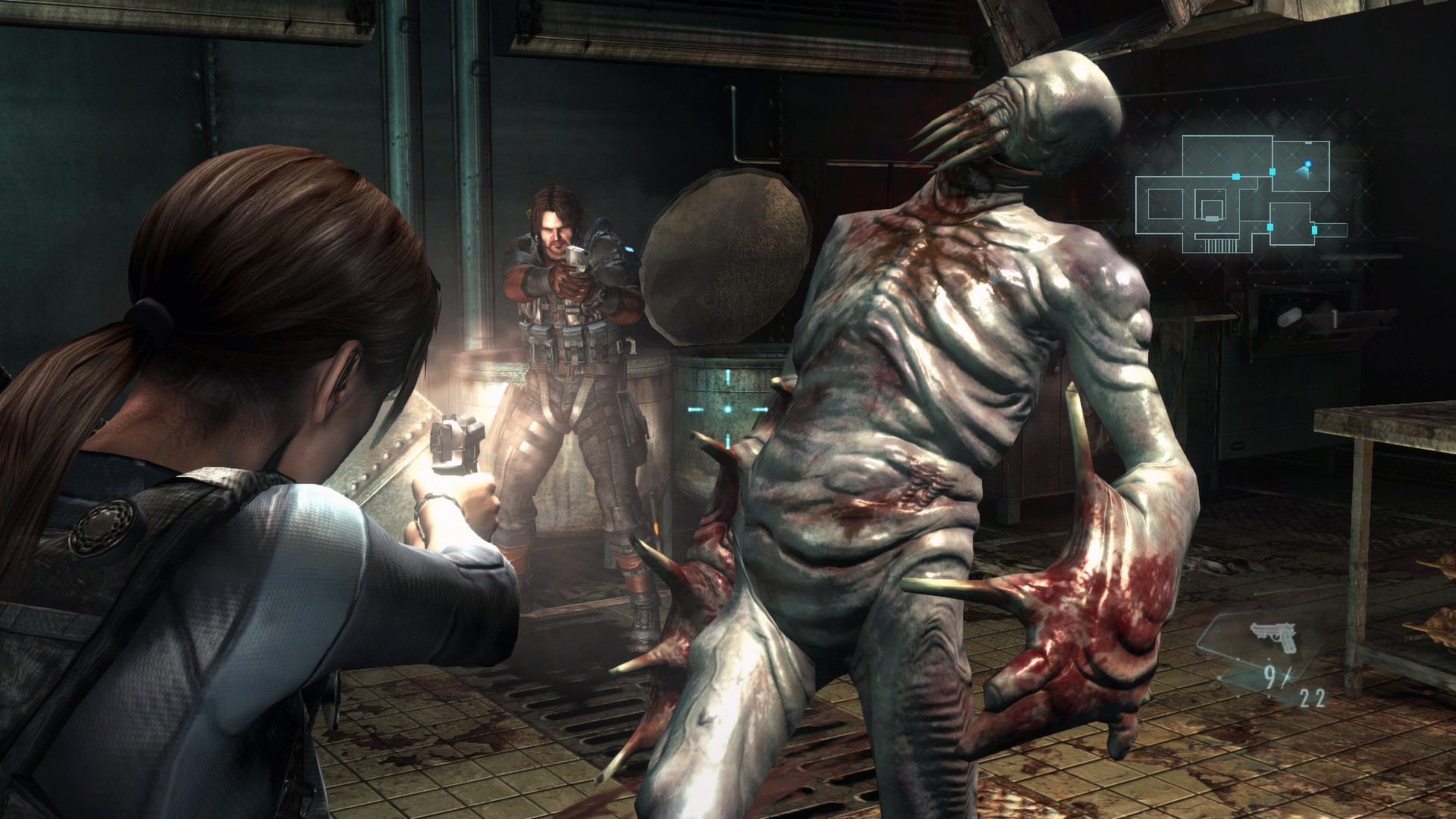
Raid Mode is a separate combat-focused progression track that unlocks after campaign progress. Instead of following the investigation’s scene order, the player selects a stage and character, fights successive groups of enemies and reaches a marked goal to finish the run. Results award Battle Points and experience: experience raises the character’s level, while points can be spent in the mode’s store on weapons, ammunition and custom parts. These supplies stay within Raid Mode and do not transfer to the campaign, keeping its economy distinct. The mode supports solo play and was also designed for two-player cooperative runs. Its stages reuse areas and opponents in a challenge structure that emphasizes combat, character development and loadout adjustment, providing another way to engage with Revelations without confusing it with the separately titled Revelations 2.
- Developer
- Capcom
- Genre
- Survival horror / third-person shooter