
About Resident Evil 7 Biohazard
Ethan Winters travels to a decaying Louisiana plantation after receiving a message from his missing wife, Mia. Inside the Baker family’s home, exploration, puzzles and dangerous encounters shape a first-person survival horror campaign where ammunition, healing supplies and carrying space must be managed carefully.
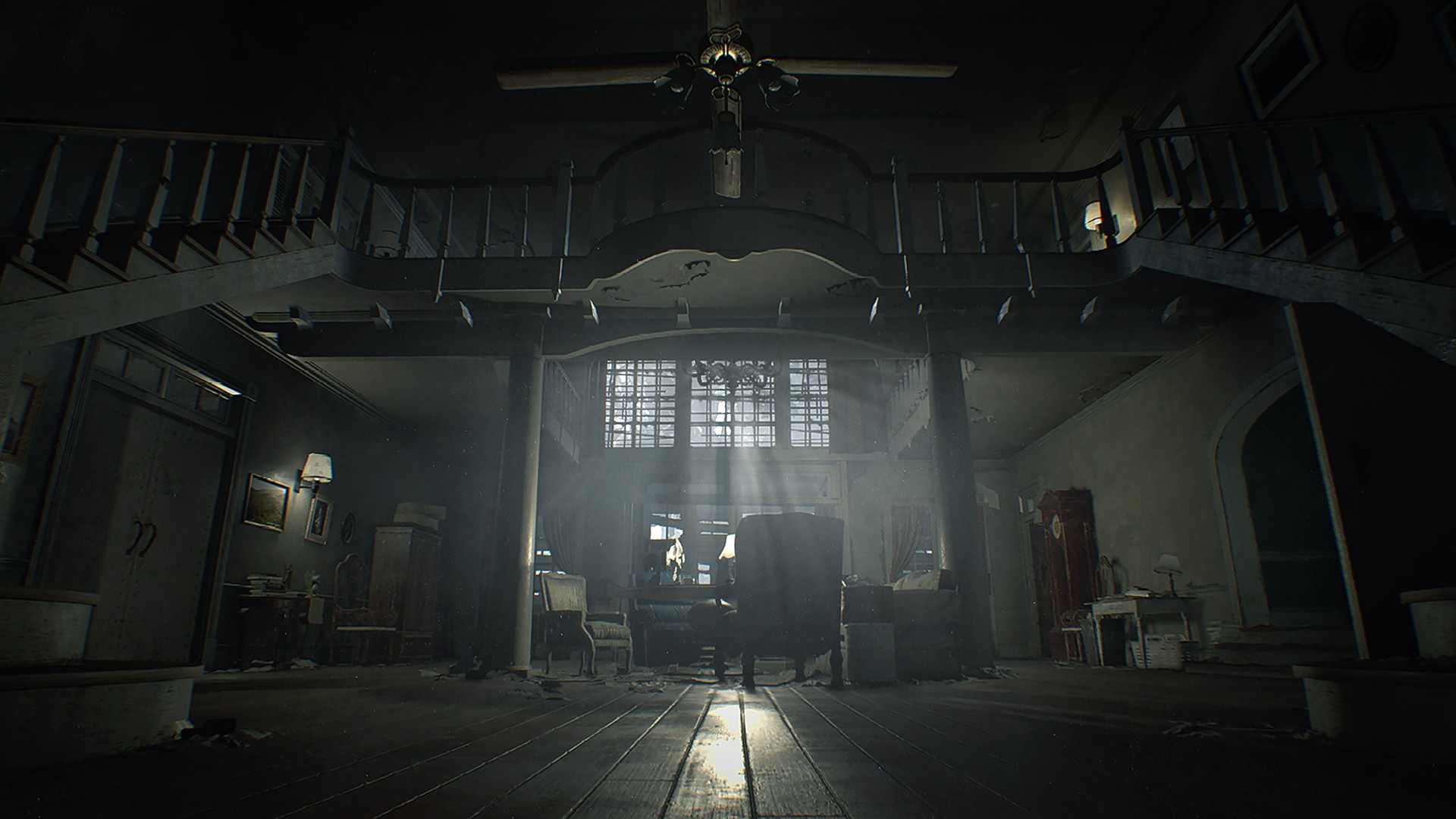
Ethan Winters arrives in the parish of Dulvey, Louisiana, following a message connected to Mia, his wife who has been missing for years. The search draws him to an isolated plantation and its decaying house, where the Baker family has become a threat and the surrounding property hides further dangers. Ethan is an ordinary civilian caught in circumstances he cannot control, which shapes the scale of the story: the campaign keeps close to his limited viewpoint as he searches rooms, reacts to pursuit and tries to understand what happened. Capcom returned the series to survival horror and uses first-person perspective throughout the core campaign, placing doors, objects and enemies directly into Ethan’s field of view. The setting’s domestic spaces, bayou grounds and neglected outbuildings become connected parts of one unfolding escape attempt.
The Baker household is presented through distinct dangers rather than as a single opponent. Jack Baker is a persistent physical threat whose appearances turn familiar rooms into places where Ethan must choose between fighting, hiding or getting away. Marguerite’s sections emphasize caution and stealth, while Lucas’s traps introduce enclosed tests that require attention to the room and its objects. The family members’ different behavior changes the immediate problem the player must solve, even as the larger goal remains getting through the property and finding Mia. Other hostile creatures occupy the spaces between these confrontations, so a route that is clear one moment may become dangerous on a return trip. The campaign introduces its cast and threats through encounters and environmental clues, keeping the story centered on Ethan’s efforts to survive rather than on a broad ensemble of agents or soldiers.
Exploration is built around moving through rooms, finding supplies and interpreting what blocks progress. Locked doors, keys, objects and environmental puzzles connect separate portions of the house and grounds; maps help track discovered rooms, save locations, storage boxes and certain locked containers. Some locks use animal symbols, giving collected keys a clear purpose as new areas open. The route is largely directed, but optional backtracking can make earlier rooms useful again once Ethan acquires an item or key that changes what he can access. Looking closely matters because ammunition, healing items and crafting materials are placed within the environment, while doors and containers may signal that a later revisit is worthwhile. Puzzles are part of the pacing between threats: they ask the player to inspect surroundings and use found objects, giving exploration a practical role beyond simply moving toward the next encounter.
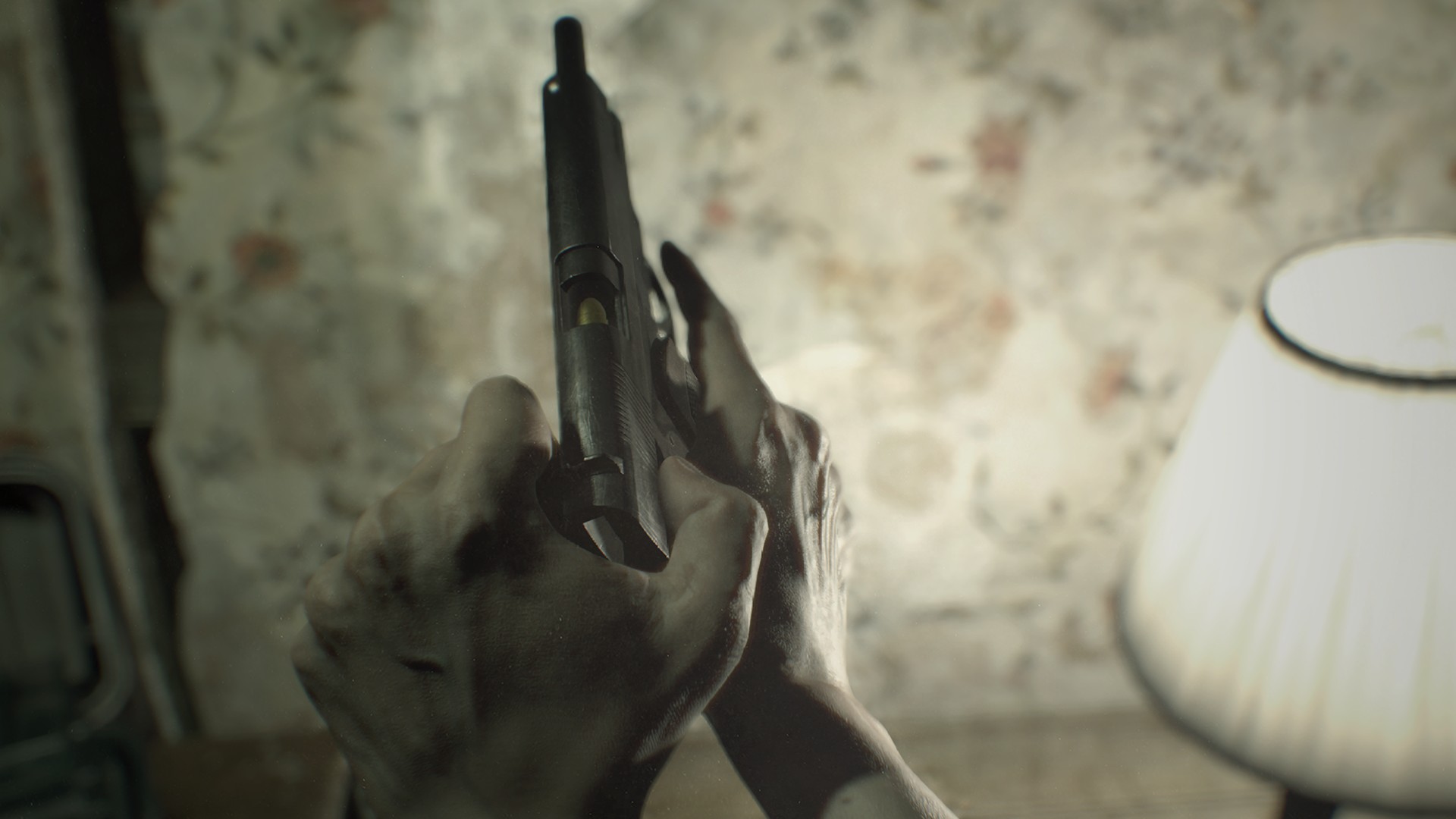
Combat revolves around scarce resources and short windows to respond. Ethan gradually finds firearms and other weapons, but ammunition remains limited enough that every shot competes with the possibility of saving it for a later threat. When an enemy closes in, blocking reduces incoming damage and can create a brief opportunity to reload or reorganize, though it does not make Ethan invulnerable. Running away or using the environment to avoid a confrontation can preserve supplies that would otherwise be spent on a fight. Different family encounters call for different responses: a direct attacker can force defensive timing, while a pursuer who has not spotted Ethan may be easier to evade by crouching and moving behind substantial cover. These choices keep weapons useful without turning the campaign into a straightforward action shooter; fighting is one tool for escaping, and sometimes conserving resources is the more effective response.
Inventory management ties scavenging to survival. Ethan carries a limited selection of items, so the player must decide which weapons, ammunition, healing supplies, keys and crafting materials are worth taking at a given moment. Chem fluids combine with other items to create useful supplies: ordinary chem fluid can be paired with an herb for a first aid med or with gunpowder to make handgun ammunition, while strong chem fluid and an herb make stronger healing medicine. Solid fuel combined with ordinary chem fluid makes burner fuel; combined with strong chem fluid, it makes flame rounds for a different weapon. The recipes make one resource serve competing needs, so crafting involves a choice about what would help most in the current stretch. Items left behind can be retrieved from shared storage boxes in safe rooms, allowing the player to reduce carried clutter and return for tools or supplies when the route calls for them.
Safe rooms provide a pause from the surrounding threats and connect saving with item storage. A save point lets the player record progress, while the storage box makes deposited items available from other boxes found later. This creates a rhythm of leaving a secured room, searching unfamiliar areas, solving obstacles and returning with objects that unlock further routes. Maps reduce uncertainty by marking discovered locations and selected points of interest, including locked drawers that can later be opened with lockpicks. Psychostimulants offer another temporary aid: taking one reveals nearby items, including objects that are otherwise hard to see, helping a search focus on supplies rather than every surface. These tools support deliberate exploration without removing the need to budget space and materials. The campaign’s progression is therefore both spatial and practical: the player learns the plantation’s layout while accumulating the keys, resources and knowledge needed to push deeper.
Videotapes add playable episodes from other characters’ viewpoints. Ethan can find a tape and use a VCR to enter a recorded moment, taking control within that earlier scene rather than watching it as a conventional cutscene. The change in perspective provides context about the plantation and its history, and a tape can preview an area or offer information relevant to what Ethan later faces. Because the player acts during these recordings, details learned there can affect how a later puzzle or location is understood. Tapes also briefly alter the campaign’s usual rhythm of exploring as Ethan, creating a self-contained experience within the larger search.
- Developer
- Capcom
- Genre
- Survival horror