
About Resident Evil 6
Resident Evil 6 follows several investigators as C-virus attacks spread across North America, Eastern Europe and China. Four linked campaigns shift among Leon Kennedy, Chris Redfield, Jake Muller and Ada Wong, with different partners and overlapping events. The action blends firearm combat, close-range moves, item management and optional cooperative play.
Resident Evil 6 expands its story across a series of C-virus attacks in North America, the Eastern European state of Edonia and the Chinese city of Lanshiang. The outbreak produces several kinds of infected, including zombies, J’avo and Chrysalids, while the crisis draws together familiar agents and new characters. Leon S. Kennedy, Chris Redfield, Jake Muller and Ada Wong each have a part in uncovering what connects the incidents. The events are presented through four distinct but interwoven campaigns, so the player sees the wider crisis from more than one perspective. The setting changes between streets, public buildings, military zones and other enclosed or exposed spaces, with chapter objectives moving each character group through the emergency. Its scale comes from crossing locations and storylines, rather than from one continuous open-world map.
Each campaign has its own lead and partner arrangement. Leon is paired with Helena Harper, Chris with BSAA colleague Piers Nivans, and Jake with U.S. agent Sherry Birkin; Ada’s storyline is structured for one player. The stories intersect at key points, and the connections let scenes or shared situations be revisited from the other side. Campaign select and chapter select allow players to begin a storyline or return to a chapter, while saved progress tracks the chosen campaign. Moving among the four threads changes who is on screen, the immediate objective and the style of the encounter. The campaign structure gives the global outbreak several concurrent viewpoints: government response, a BSAA operation, Jake and Sherry’s journey, and Ada’s independent investigation. The narrative is designed to be pieced together across those strands, without requiring every chapter to use the same pair or location.
Leon and Helena’s chapters place a government agent and a colleague with her own urgent reasons inside the North American part of the crisis. Their route links civilian spaces with more restricted facilities, and their objectives often involve getting through an active outbreak while learning why the incident has spread. The pair move through rooms, streets and underground areas, searching for supplies and access points while hostile infected interrupt progress. Leon’s campaign uses the familiar survival-horror vocabulary of doors, keys, environmental clues and limited healing resources, but the controls also let the player respond with quick movement and close attacks. Helena is an active partner in the campaign rather than a character who appears only in story scenes. Their chapters contribute one strand of the larger investigation, and later crossings place that work alongside events followed by other protagonists.
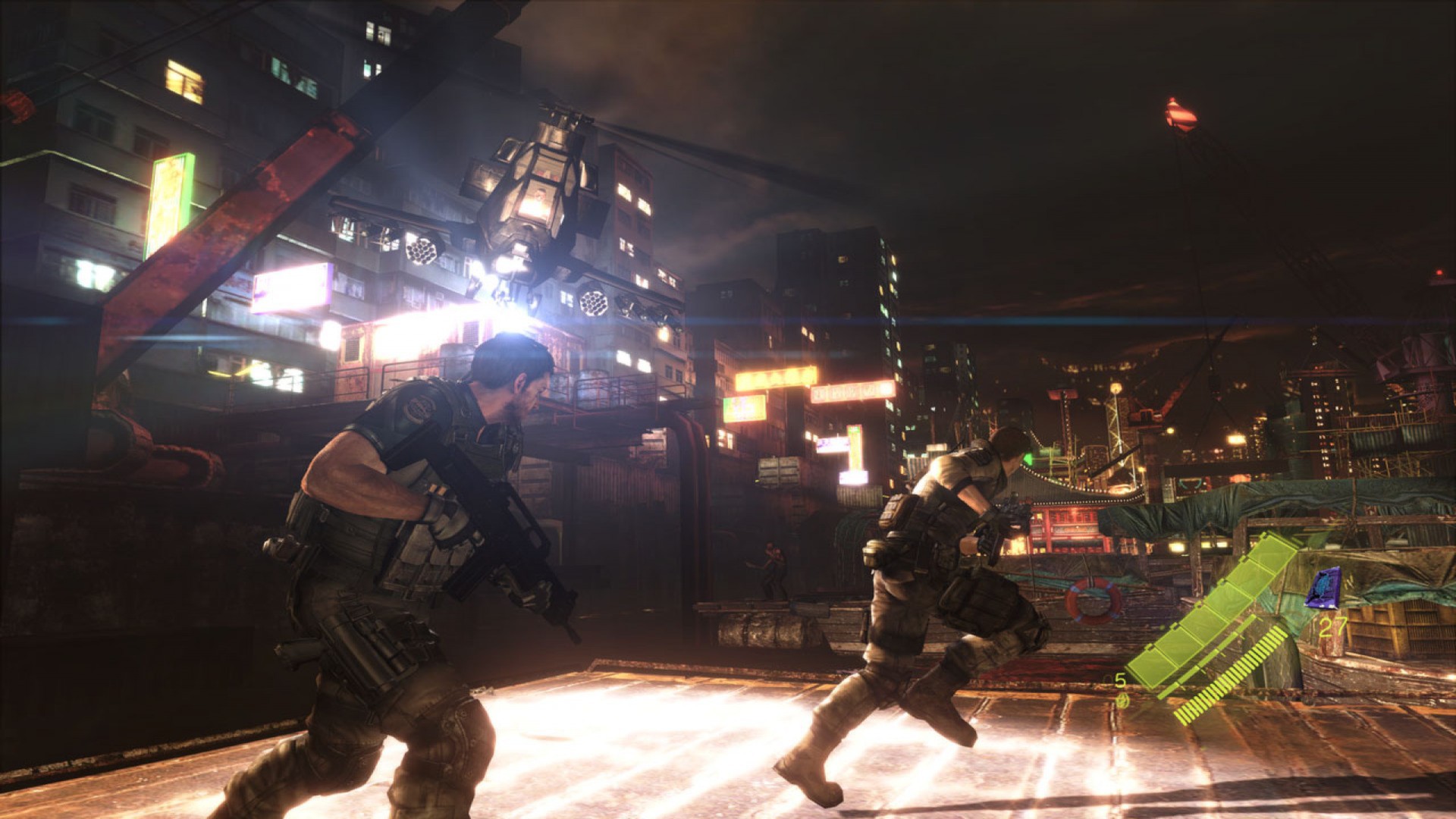
Chris and Piers bring the BSAA’s field response to the foreground, with their chapters emphasizing armed encounters and movement through conflict zones. Their partnership is built into the action: the player can fight alongside the partner, use partner actions, and take part in cooperative sequences that depend on timing or position. Jake and Sherry form another two-character campaign, connecting a new protagonist to a returning character whose history with biological research shapes her role in the crisis. Their route crosses hostile territory and brings them into contact with the same worldwide threat seen elsewhere. These differences in focus do not create four unrelated games; important encounters and story intersections link the separate campaigns. The alternating perspectives let the player see people and events that a single route would leave outside view, while the central threat and named allies carry across the chapters.
The combat system is more mobile than the stationary aiming associated with earlier entries. The player can aim and fire while moving, dash, slide, roll in different directions, take cover and use enhanced melee attacks. Enemies react differently to where they are hit, so a shot can create an opening for a follow-up rather than simply reduce a health bar. Zombies, J’avo and other C-virus mutations present different attack patterns and pressure the player to change weapons, distance or movement. Firearms and items are selected from the item slots; the player can cycle between weapons, grenades and healing supplies, reload, pick up objects and discard something that is no longer needed. Context actions still appear during traversal and combat, so awareness of nearby threats matters while interacting with doors, ladders and other objects.
Healing uses herbs converted into tablets, alongside first-aid sprays. A tablet restores part of the vitality gauge and replenishes the physical-combat gauge; combining herbs before storing them can yield more tablets than processing each one separately. Using tablets or a spray near a partner can restore that partner as well, linking position to recovery. Defeating enemies also earns skill points. Between chapters, points can buy skills that improve qualities such as firearm damage, reload speed, defence or item drops, and the player equips a limited set for the campaign. Skills and healing give the chapter loop a preparation step: collect and spend supplies in the field, then decide which purchased abilities suit the next stretch. The route guide can show objectives and the direction to proceed when the environment becomes difficult to read.
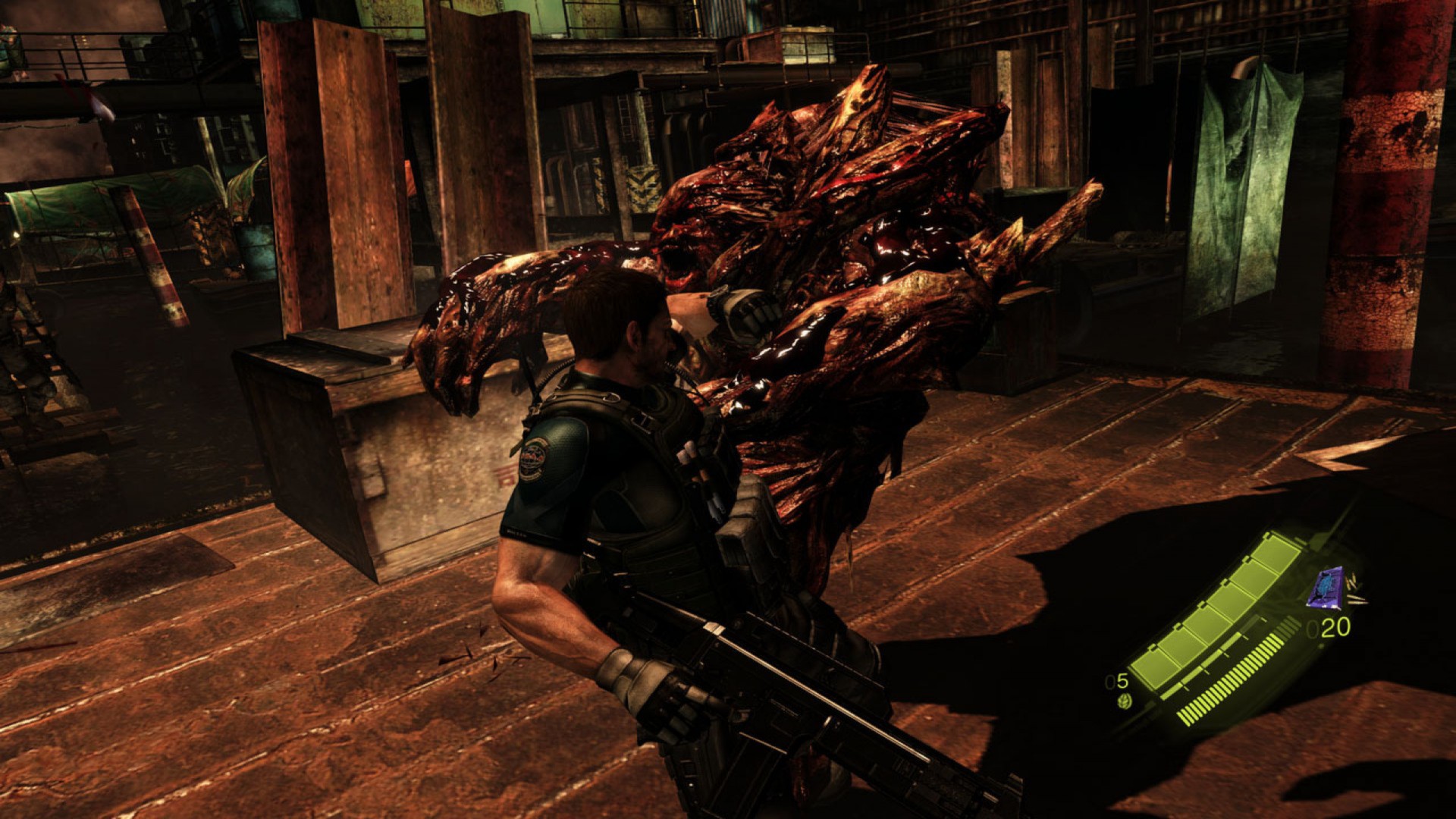
Resident Evil 6 supports solo play and two-player cooperative play, with local split-screen and online options identified by Steam. At certain campaign intersections, the crossover system brings two pairs together for situations that can involve up to four players online. Ada’s campaign is the exception to the usual paired campaign format and is listed as one-player. Separate from the story campaigns, The Mercenaries asks players to score points by defeating as many enemies as possible within a time limit, while Agent Hunt lets a player enter an active campaign as an enemy creature. These modes reuse the game’s movement and combat systems for different objectives. The core campaign remains a chapter-based action-horror story, with its character pairs, weapon choices, partner support and skill setup shaping how each section is approached.
- Developer
- Capcom
- Genre
- Action, adventure; survival horror