
About Resident Evil 5
In Capcom’s 2009 action horror game, BSAA agent Chris Redfield and local agent Sheva Alomar investigate a bio-organic weapons threat in Africa. Explore hostile settlements, fight infected Majini, coordinate with a partner, share supplies and improve weapons as the chapter-based campaign follows their investigation.
Resident Evil 5 follows Chris Redfield, a member of the Bioterrorism Security Assessment Alliance, on a mission in Africa to investigate a biological agent that is turning people into aggressive creatures. Local BSAA agent Sheva Alomar joins him as his partner. Their investigation begins in the Kijuju region, where the two encounter hostile Majini and evidence of a broader bio-organic weapons operation. The story unfolds across connected episodes that move from settlements and market streets into industrial facilities, waterways and older ruins. Chris and Sheva remain the campaign’s central pair, and the player’s progress is measured through chapters and checkpoints. Their partnership is the thread connecting each change of location: new enemies and environments alter the immediate danger, while the two agents continue tracing the source of the threat.
The campaign is built around two characters acting together. A second player can take Sheva in cooperative play where that feature is supported; when playing alone, the game controls her as Chris’s companion. Either way, the partner is present during encounters, can help attack threats and can be called to assist with actions such as moving obstacles or reaching a nearby object. The pair’s position matters when enemies close in: staying near one another makes it possible to help a partner who has been grabbed or incapacitated, and some interactions require both characters to cooperate. Combat areas often ask the pair to cover different approaches or push forward while the other character provides support. The partnership therefore affects movement, combat and how equipment is carried. Chris’s mission is not structured as a solo trek through a hostile landscape; Sheva is part of the moment-to-moment play as well as the story.
Fights use a third-person aiming and shooting system in which firearm choice and distance shape how the pair handles groups. Pistols provide a general-purpose option, while shotguns, machine guns, rifles and grenades each offer different ranges or effects. Some enemies react to shots in ways that create an opening for a close-range melee follow-up, allowing the player to stun or knock down a target and then use a contextual strike. Other threats require sustained fire or attention to an exposed vulnerability. The player can issue partner commands to have Sheva stay close and provide cover or move ahead to attack, and can respond to context-sensitive prompts together. Healing is also shared: when the partners are close, restorative items can help both, while a nearby partner may assist if one enters danger. These systems turn positioning and coordination into part of every firefight rather than a separate menu task.
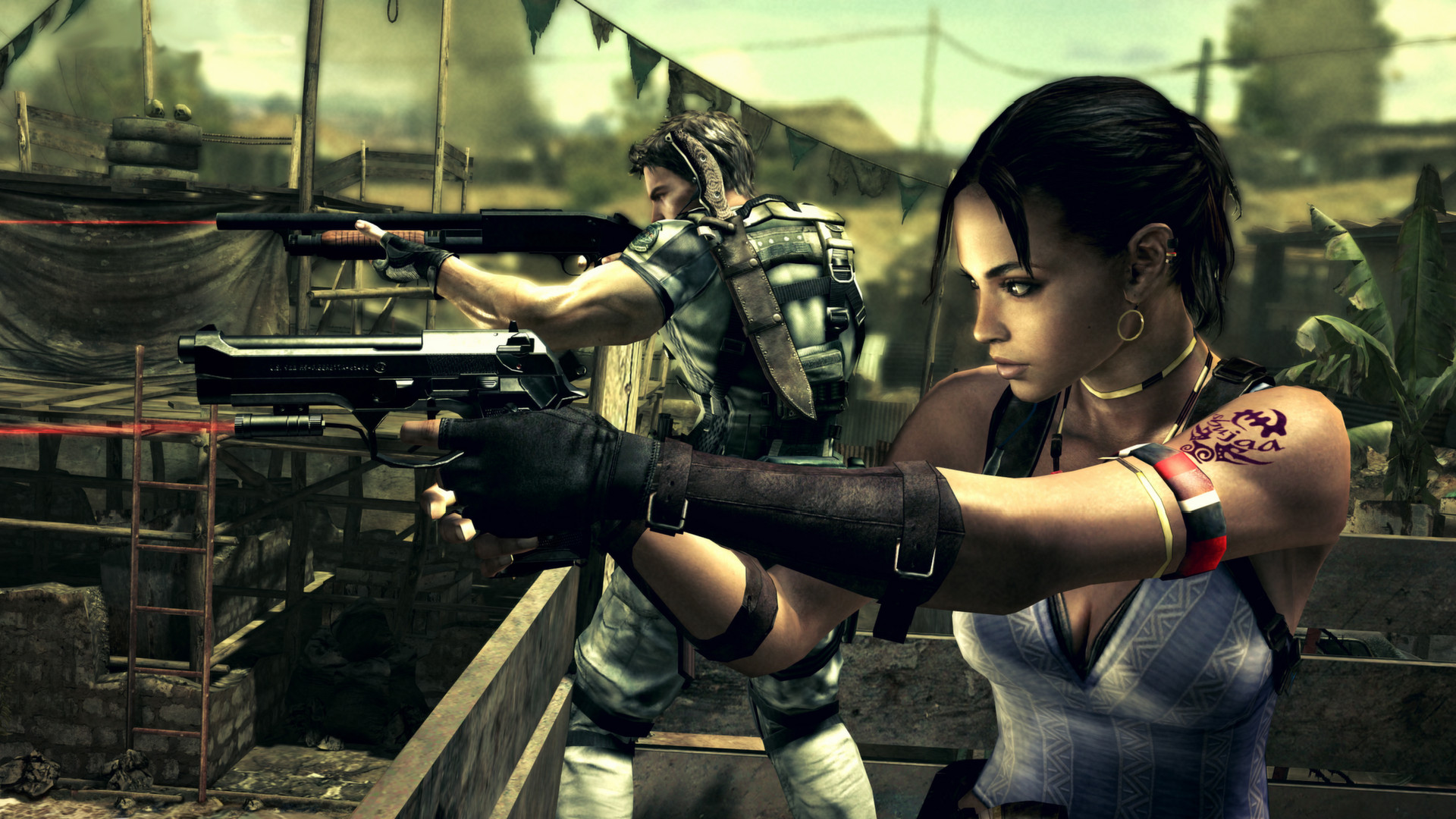
Resident Evil 5 uses a compact, real-time inventory: each character carries a limited number of slots, and opening the item screen does not pause the action. Weapons, ammunition, healing items and grenades each occupy a slot, so a loadout has to leave room for useful supplies found along the way. The player can assign carried items to quick-access directions, move items between Chris and Sheva, combine certain herbs, reload by joining ammunition to a weapon, or discard something to make space. That screen remains available during danger, so a prolonged reorganization can leave a character exposed. The two inventories can be planned together: one character might carry a weapon type while the other carries a different one, reducing competition for the same ammunition. Giving an item to a partner can also free a slot. Decisions made in the pause-free field inventory directly shape which responses are ready when enemies press in.
Each chapter places the pair in new spaces with objects and supplies tucked into containers, rooms and side paths. Breaking wooden crates or barrels with the knife can reveal ammunition, healing items or money without spending bullets, and searching the environment can uncover treasure as well as equipment. Documents, maps and locked doors help frame where the mission is heading, while some routes ask Chris and Sheva to act in sequence or cover one another. The setting changes the kind of pressure in each encounter: narrow passages limit movement, open spaces can expose the pair to attacks from several directions, and environmental hazards can be used against enemies. Exploration is focused on gathering what will support the next fight, understanding the space and moving toward the current objective. Optional pickups add resources for later preparation, but the story advances through its chapter objectives rather than a free-roaming map.
Between chapters, an item-management screen lets the player organize the two characters’ equipment, buy or sell items, and upgrade weapons using money earned in the campaign. The stockpile keeps acquired equipment that is not currently being carried, so preparation means choosing what to take into the next section. Weapon improvements can adjust qualities such as firepower, capacity and reload speed, while newly found guns provide alternatives for different situations. Treasures can be sold to add funds for purchases and improvements. Completing chapters also makes earlier sections available for replay, letting the player revisit a stage with the campaign’s equipment system and pursue its objectives again. These steps provide a clear progression loop: search during a chapter, manage limited space in the field, then use the results to configure and strengthen the pair between missions.
- Developer
- Capcom
- Genre
- Action, adventure