
About Remothered: Tormented Fathers
Rosemary Reed arrives at Richard Felton’s house to investigate the disappearance of Celeste, but her questions expose a dangerous household and a relentless stalker. Explore the mansion in third person, solve realistic puzzles, and use stealth, distraction or brief attacks to survive. Audio cues and careful observation help Rosemary judge when to hide, move or escape.
Remothered: Tormented Fathers follows Rosemary Reed, a 35-year-old woman who comes to Richard Felton’s house while investigating the disappearance of Celeste. Gloria, the nurse caring for the elderly doctor, receives her, but Felton soon realizes that Rosemary has another reason for being there. The visit becomes a struggle to uncover what happened inside the household while avoiding the people and dangers that stand between Rosemary and the truth. The game is a third-person survival-horror adventure set primarily in the mansion. Its story focuses on a small group of characters whose ordinary roles conceal histories and motives that Rosemary must piece together through exploration, dialogue and evidence.
The mansion functions as both a place to investigate and a space to navigate under threat. Rooms, connecting passages and doors create routes to explore, but they also determine how Rosemary can evade a pursuer. The player searches for clues, useful objects and puzzle solutions while keeping track of where danger may be. Environmental puzzles are designed around plausible objects and settings rather than abstract symbols, so progress depends on noticing details and understanding how parts of the house relate. The camera follows Rosemary from a third-person perspective, keeping her movement visible while the surrounding environment supplies clues about a stalker’s position and possible escape routes.
When an enemy is nearby, survival can involve stealth, misdirection, flight or calculated action. Rosemary can hide from a stalker’s sight, study its behaviour and path, or lure it toward another area of the house to create room to move. She can also attack and improve the effectiveness of her items, but confrontation is one tool among several rather than a dependable way to clear the mansion. Keeping distance and breaking line of sight are often central to surviving an encounter. These options let the player respond to a pursuit in different ways, but every choice depends on reading the space and acting before the stalker reaches Rosemary.
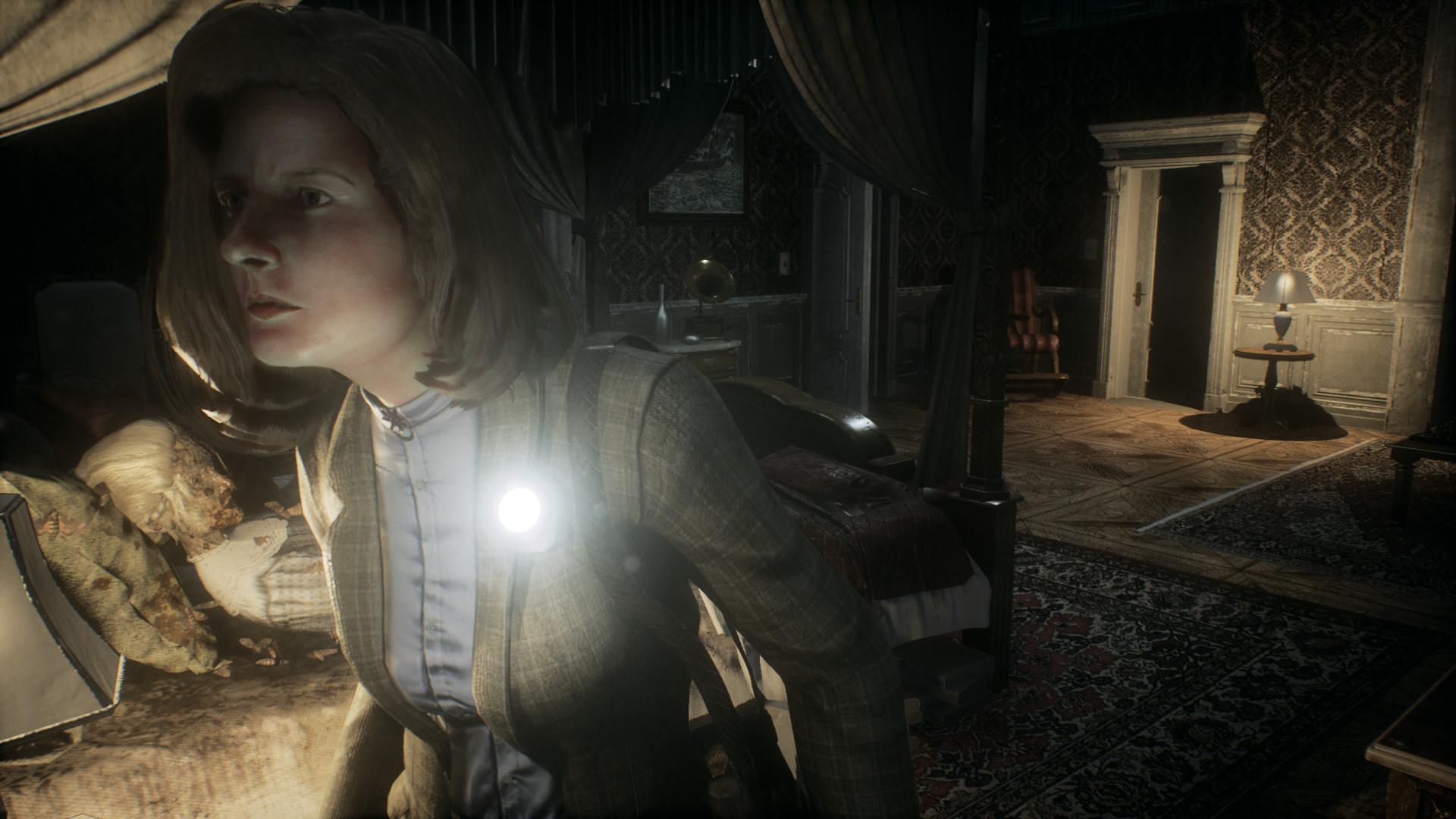
Sound provides information that the camera may not show. The game uses music and three-dimensional audio effects as clues to a stalker’s approach, so listening can help determine when to wait, hide or move. There are no health bars; Rosemary’s body gives the player an indication of her condition. This keeps survival tied to what is happening in the scene rather than a separate interface meter. Together, audio and animation make awareness part of the core loop: explore when there is room, interpret signs of danger, and change course when a threat draws near. The mansion’s continuous exploration also means that evasion and investigation occur within the same environment.
Items have a practical role in both puzzles and encounters. Rosemary can use objects to distract or obstruct a pursuer, and some items can be made more powerful for defensive use. Choosing whether to spend or preserve an item depends on the immediate situation: using it may create an opening to escape, while saving it can leave more options for a later threat. A stalker’s movement offers clues about where it may go next, so the player can plan around its path instead of reacting only after it appears. The available tactics are designed to mix together; hiding, running, strategic diversions and attacks can form parts of the same encounter.
The story’s psychological horror comes from the uncertain line between familiar people and frightening behaviour. Rosemary’s investigation asks what connects Celeste’s disappearance to Richard Felton and the household around him. The characters are presented as people with complex histories, not as simple monsters detached from the plot. Cutscenes carry the narrative between stretches of exploration, and conversations and discoveries add context to what Rosemary sees. The game withholds a complete explanation while the player searches, making the mansion’s objects and rooms part of the account of the family’s past. The mansion’s layered history gives the investigation its direction as Rosemary searches room by room.
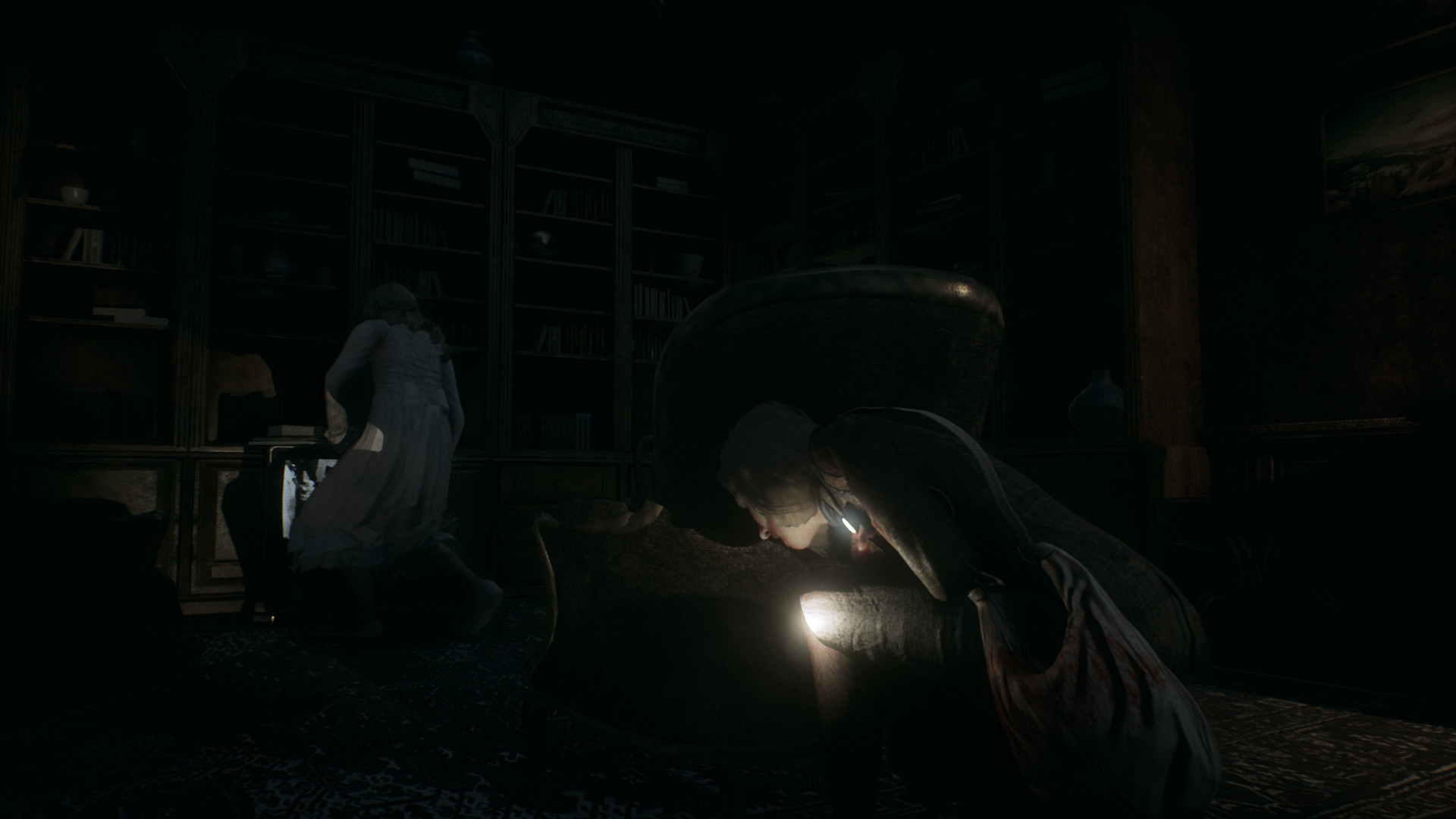
Celeste’s disappearance gives the household a shared history that Rosemary has to reconstruct. Celeste disappeared in autumn 1971, and the case remained in the news for two years. Rosemary arrives later to investigate, while Gloria is already inside the house as Richard Felton’s nurse. Gloria’s reserved manner and fear for her safety leave uncertain how much she knows about the family. Those details make the investigation depend on reading people as well as rooms: the same conversation can offer a clue while leaving questions about what a character will admit. Rosemary must distinguish what the public record says from what the people in the house are prepared to tell her.
Richard Felton’s background adds another layer to Rosemary’s visit. He left a notarial career after a serious illness worsened and took up gardening, a quiet occupation that contrasts with the danger inside his home. His wife, Arianna, withdrew from public life after Celeste disappeared, and the family’s circumstances remain part of what Rosemary is trying to understand. The game presents these histories through character details, investigation and cutscenes rather than a separate narrator explaining the household. Environmental puzzles keep the search grounded in the mansion’s objects and rooms, while the characters’ incomplete accounts shape what those spaces mean. Rosemary’s own reason for coming under false pretences gives the investigation a personal complication from its first meeting.
- Developer
- Stormind Games
- Genre
- Third-person survival-horror adventure