
About Red Faction II
Five years after the Mars revolt, Red Faction II follows Alias, a nano-enhanced demolitions expert who turns against Chancellor Sopot in the Commonwealth. This first-person shooter pairs explosive Geo-Mod combat with squad support, vehicles, stealth and puzzle objectives, and endings shaped by the player's treatment of civilians.
Red Faction II moves the series from Mars to twenty-second-century Earth, five years after the first game’s miners’ rebellion. The Commonwealth has spent years under Chancellor Victor Sopot, whose campaign to unite with the neighboring United Republic has brought bloodshed and poverty. Public propaganda presents his rule as a string of victories, even as soldiers die and communities live under state control. You play Alias, a demolitions specialist in a squad of six super-soldiers enhanced with nanotechnology. After years fighting for Sopot, the group turns against the government and joins the Red Faction resistance in an effort to bring down the chancellor. Although the story follows the Martian revolt by five years, the Earth conflict introduces its own characters and can be followed without knowing the first game's plot. Pre-rendered cutscenes punctuate the campaign alongside Alias's playable operations.
Alias has five companions whose specialties cover stealth, electronics, demolition, sniping, heavy weapons, vehicle handling, and armed combat. They act on their own instead of accepting direct squad orders. Different roles respond to the situation: at a broken door, the electronics expert begins repairs automatically; in a large room of enemies, a sniper may move ahead and engage them. Teammates also give spoken cues about the objective, including a ventilation shaft as an alternate route or a wall that can be breached. Alias remains responsible for his own movement and gunfire, using those reactions and suggestions to read the immediate encounter. Enemy forces also act in squads and adapt their response to each combat situation, so Alias faces coordinated opposition alongside the help of his own specialists.
The Geo-Mod system returns in a revised form. Explosives can cut through supported parts of walls, floors, ceilings, and other non-metal surfaces, allowing Alias to make openings through parts of the combat space. The destruction is bounded by the level design, but it changes how a firefight can unfold: a wall can become an entry point, a blast can expose another angle, and some objectives make demolitions useful beyond simply damaging enemies. The campaign uses action, stealth, and puzzle-oriented tasks, so the squad’s advice and the surrounding architecture can help identify how to proceed. Geo-Mod links Alias’s specialty directly to navigation and combat.
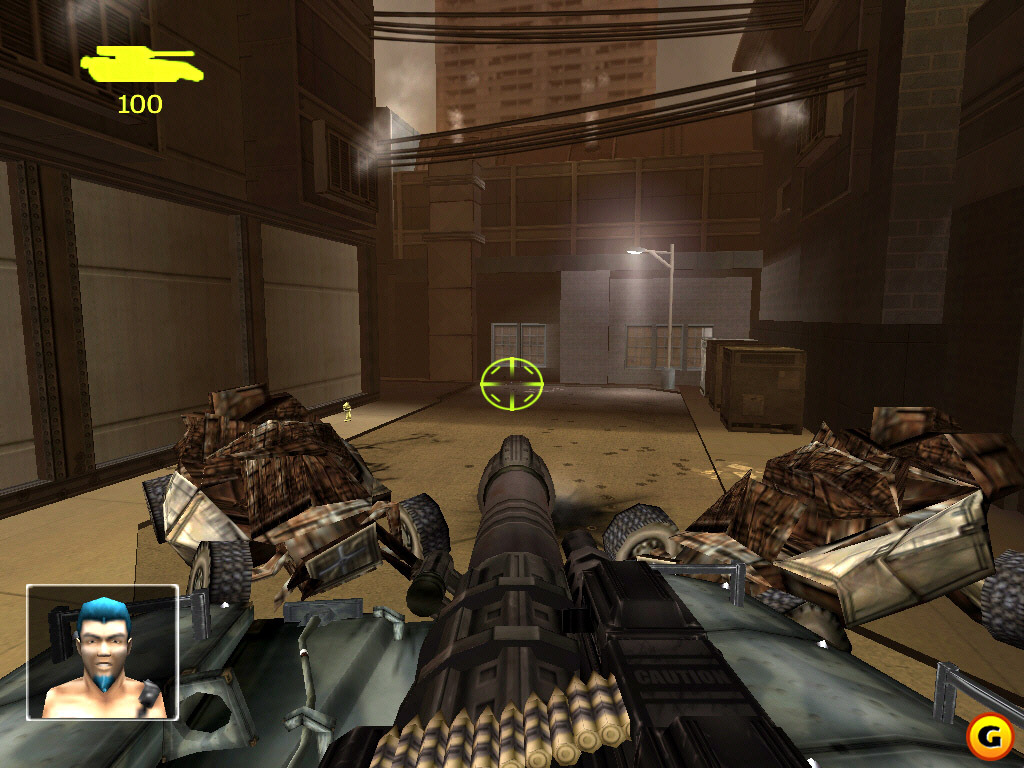
The first-person combat centers on fourteen specialized weapons, including combinations that let Alias carry a weapon in each hand. With dual guns, the left and right triggers can fire each weapon independently, giving the player control over how the pair is used rather than treating them as one automatic stream. Grenades and other items can also be thrown without first holstering the main weapon. The arsenal includes conventional firearms and larger explosive tools, while the inventory adds health kits, night vision, and several grenade types. Enemy encounters therefore ask the player to switch between direct fire, explosives, equipment, and the destruction opportunities in the room.
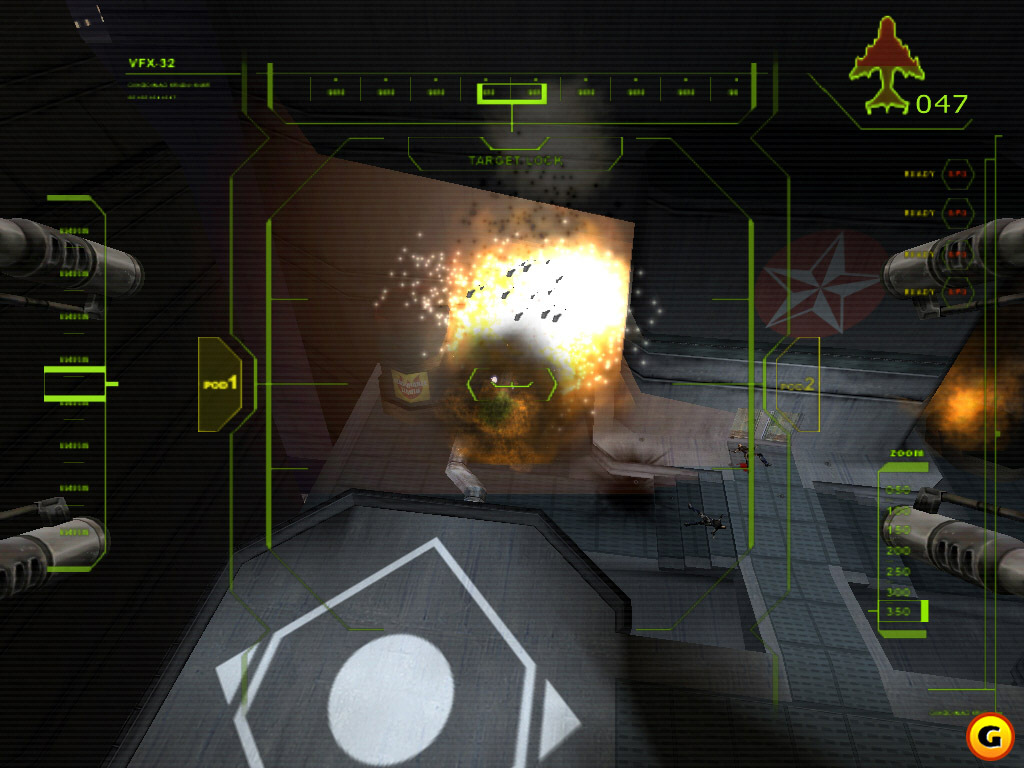
Vehicles also become part of the mission sequence. Four combat vehicles appear, including a tank, a hover flyer, and a submarine. Each changes the player's role for a stretch of a level, shifting from foot combat to operating a vehicle's weapons and movement. In an early hover-flyer sequence, Alias mans the craft's guns while moving through a city and engaging enemy flyers with missiles and machine-gun fire. The sequence makes the vehicle a combat platform, with a different movement space and targets from the ground engagements around the squad.
Combat choices influence the campaign's ending through a karma system. The game distinguishes between attacks on armed opponents and actions that harm innocent bystanders: killing civilians pushes the outcome toward a worse ending, while sparing them supports a better one. An indiscriminate shot can therefore affect the story even when the player is focused on another target. This gives the player a combat decision with a longer consequence: the result of the campaign depends in part on how Alias behaves when civilians are caught in the conflict.
The setting makes propaganda and wartime losses visible in the Commonwealth. Sopot's Public Information Building, erected as a tribute to the chancellor, broadcasts claims of victory as soldiers continue to fall. The game places this spectacle beside the poverty and bloodshed caused by Sopot's attempted unification with the United Republic. Alias's squad joins the Red Faction resistance and fights through the government's controlled spaces, moving between direct action, stealth, and puzzle-solving missions. This is a different political landscape from Ultor's mining colony on Mars: the sequel's central struggle concerns the Commonwealth government and Sopot's military rule.
Campaign progression also uses multiple boss battles as points where Alias acquires superior firepower. These encounters expand the tools available during the story, adding new weapons to the choices made in ordinary firefights. The weapons sit alongside health kits, night vision, and grenades in the inventory, so combat draws on both newly acquired firepower and useful items. This gives the campaign a progression tied to its major confrontations, while its stealth, puzzle, vehicle, and squad sections change the setting in which that equipment is used.
- Developer
- Volition
- Genre
- First-person action shooter