
About Red Faction Guerrilla Re-Mars-tered
On a terraformed Mars ruled by the Earth Defense Force, miner Alec Mason joins the Red Faction after the occupation reaches his family. This remastered edition follows his campaign across six sectors, where story missions, guerrilla actions and the destruction of EDF infrastructure all contribute to a planet-wide uprising.
Red Faction Guerrilla Re-Mars-tered returns to the 2009 open-world action game, presenting its Martian revolt with updated graphics. In 2125, the Earth Defense Force controls Mars and forces miners to send the resources they extract back to Earth. Alec Mason arrives to work alongside his brother Dan, but an encounter with the occupying military turns him toward the Red Faction, a resistance movement that has risen again. The conflict is fought among mining towns, industrial compounds and the sparse terrain connecting them. Alec's role is not simply to move from one firefight to another: his campaign helps shift the balance of control over the planet, and the settlements around him respond to the pressure on the EDF. The premise keeps the struggle grounded in labour, occupation and organized resistance while giving the player a broad Martian landscape to cross.
Mars is divided into six sectors, each tracking the EDF's strength and the morale of local colonists. Alec can travel around the connected open world, take on available story missions, or interrupt his route for guerrilla actions and attacks on EDF property. Those activities serve the wider campaign: reducing EDF control opens the next story opportunities in a sector, while higher morale means colonists are more likely to take up arms when a fight breaks out nearby. Missions include defending settlements, joining raids on controlled facilities, intercepting shipments and destroying military assets. They share the same territory and political measures, so clearing a sector is a gradual process of disrupting the occupying force rather than a single mission marker. The order of optional jobs is flexible, but the story's advance remains tied to weakening the EDF's hold on the regions it controls.
Destructible construction is central to how encounters work. The sledgehammer can break walls and supports at close range, while charges, rockets and specialized guns let Alec attack structures from a distance. Buildings are assembled from parts with different physical properties, so damage to a supporting column can matter more than simply scattering damage across every wall. A tower can be brought down by weakening its frame; an elevated walkway can be removed to strand or drop troops; a bridge can be destroyed to obstruct vehicles. Because cover can collapse, a position that protects Alec or an EDF squad may disappear during the exchange. That also means a firefight can be approached through the architecture: attack the enemy's shelter, cut off a route, or make a structure fall into the area where troops are gathering. The terrain itself is not freely sculpted; the defining destruction applies to man-made objects and structures.
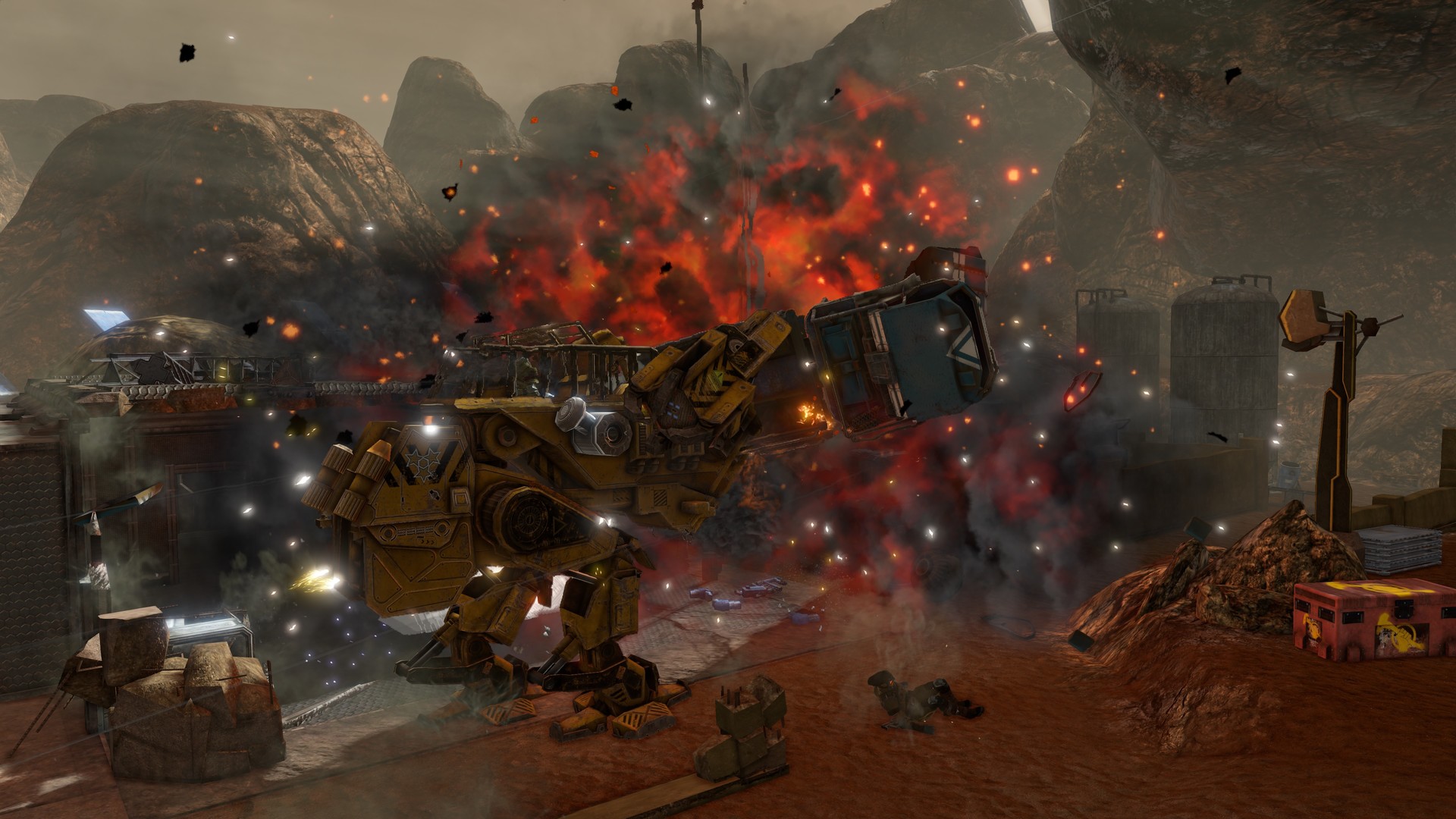
The arsenal supports both direct combat and demolition. Alec carries a sledgehammer alongside a limited selection of firearms and explosives, changing weapons to suit the distance and target. Conventional choices include pistols, automatic weapons, shotguns, sniper weapons and rocket launchers; more unusual tools include the Grinder, which fires spinning blades, the Arc Welder, which sends electrical pulses, and the Nano Rifle, whose nanites corrode the object or person they strike. A weapon's value can depend on what surrounds its target: an explosive can start a collapse, while a precise shot at a beam can remove a building's support. Vehicles broaden movement and combat, from small transports and trucks to heavier mining machines and armed vehicles. Some missions put driving and demolition together, letting the player strike EDF installations while moving through a pursuit or assault.
The campaign links individual actions to the liberation effort. Completing missions, destroying EDF property and taking part in local resistance activities can lower control in a sector; some actions also raise civilian morale. These measures affect what becomes available and how colonists respond. A liberated region changes the resistance's position against the military and its control of the map. Salvage provides a separate practical reward: wreckage and other sources can be converted into weapons, equipment and upgrades through the game's purchase system. The resulting loop connects destruction to both the conflict and Alec's capabilities, though different tasks contribute to different measures. Civilians also matter during combat; harming them can undermine morale, while a population willing to fight may assist when EDF troops arrive. The campaign therefore asks the player to consider both the military footprint of an action and its effect on the people living under occupation.
Away from the story campaign, Wrecking Crew turns the destruction system into a score-based challenge. Players choose a loadout and settings such as the time limit, then try to bring down structures efficiently in a selection of arenas; challenge runs add leaderboard competition. Re-Mars-tered keeps the original game's missions and destructive systems while revising its presentation. The 2018 edition reworks textures, shadows, lighting, shaders and post-processing, and adds native 4K support on PC. Those visual updates distinguish this release while its campaign and building physics remain the foundation inherited from Guerrilla.
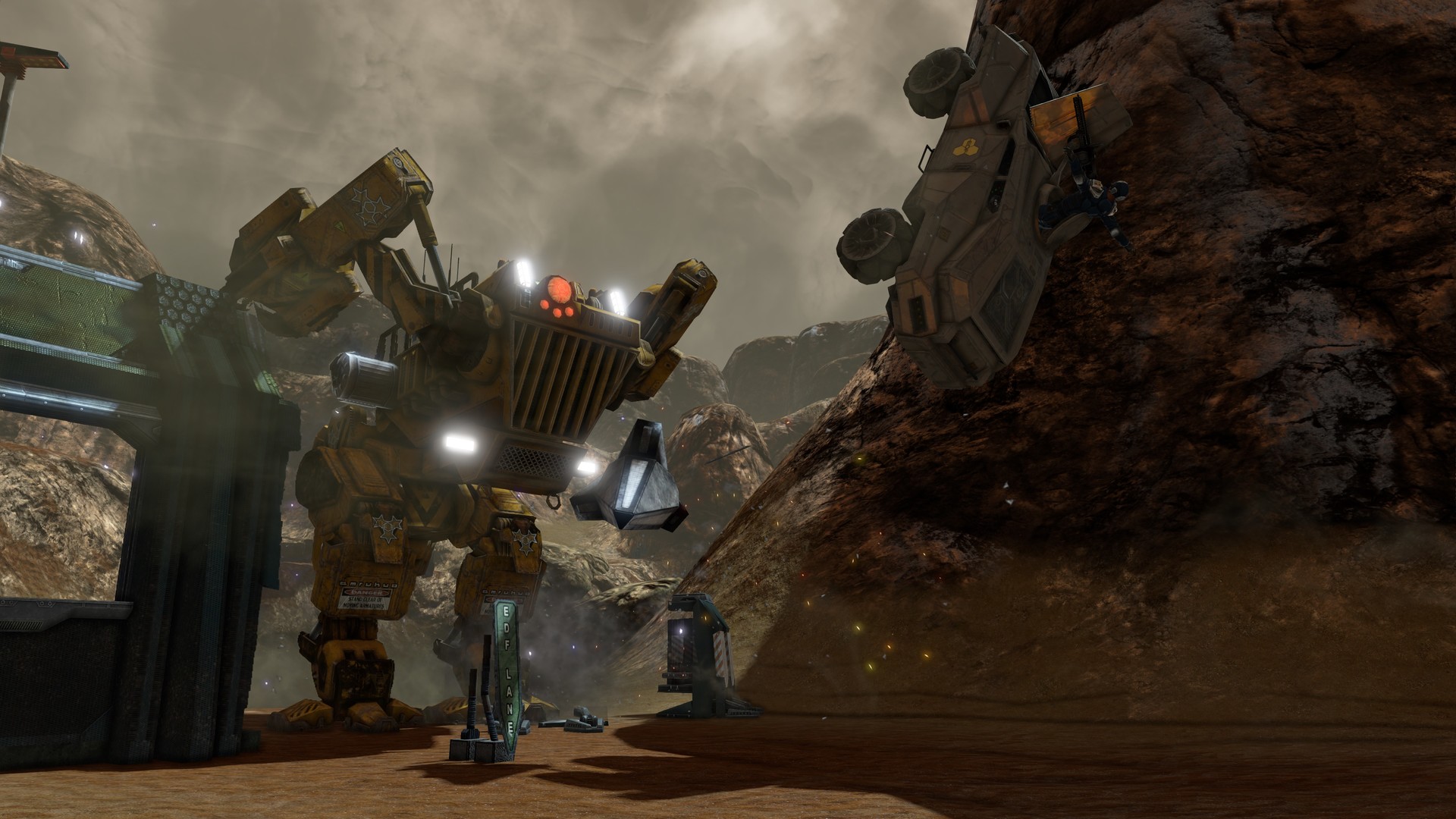
- Developer
- Volition (original game developer, as identified in contemporary coverage); Re-Mars-tered publisher THQ Nordic
- Genre
- Third-person action shooter with open-world campaign and destructible environments