
About Psychonauts
Young psychic Razputin Aquato slips into Whispering Rock Psychic Summer Camp, hoping to train with the Psychonauts, an international corps of psychic agents. When other campers are endangered, he enters their minds, where platforming, puzzles and psychic powers turn each character’s inner world into a place to explore and understand.
Razputin Aquato, usually called Raz, arrives at Whispering Rock as a young psychic with a particular ambition: to join the Psychonauts, an elite organisation of international psychic secret agents. The camp is their hidden training facility, but the other cadets are not simply classmates. An emergency involving the campers’ brains turns Raz’s wish to train into a rescue effort, and reaching them means learning what psychic agents can do. The premise moves between ordinary campgrounds and the minds of people Raz encounters there. That shift gives the adventure two kinds of space to navigate: a shared physical place with cabins, paths and training areas, and private mental worlds shaped by their owners. Raz’s task links the two, as he develops his abilities in the real world and then puts them to use inside minds.
The grounds around the camp act as a hub for movement, conversation and practice. Raz runs, jumps and climbs through the terrain, speaks with other campers, and finds objects that can support his psychic training. His Journal gathers information about the adventure and tracks discoveries, while a menu lets him select and assign powers for quick use. Coach Morceau Oleander introduces basic training, while agents Sasha Nein and Milla Vodello teach Raz particular psychic abilities. This physical hub matters because progression is not confined to a menu: Raz returns to familiar paths as new talents make additional routes and interactions possible. The real world also establishes the cast before a mind level reframes them. A character’s thoughts can turn personal concerns into architecture, enemies and obstacles, so details learned in camp can give context to the surreal environments without reducing them to ordinary locations.
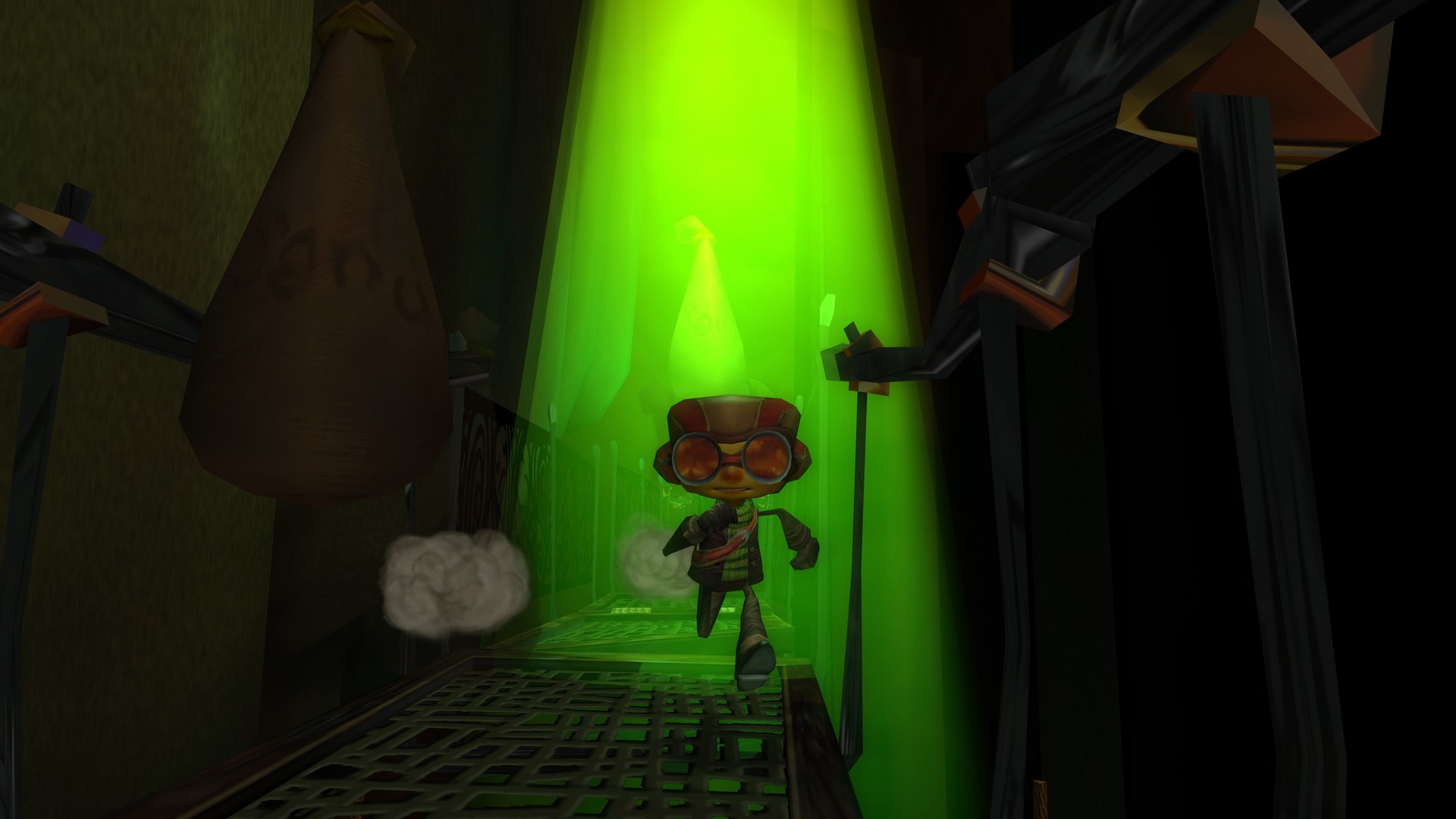
Inside a mind, the perspective becomes a platform adventure through an environment built from the character’s imagination. A level can arrange rooms, surfaces, hazards and enemies according to an inner logic rather than the camp’s geography. Raz must judge jumps, move along narrow routes, use bounce surfaces and look for ways through blocked passages. Checkpoints matter because losing all of his mental health can cost an astral layer; if those layers are exhausted, he is expelled from that mind and returned to the real world. The result is a traversal loop in which movement and combat share space with observation. A route may lead toward the immediate objective, while a ledge or side room holds a figment or another discovery. The journal records figments found in the current area, making exploration visible without turning the adventure into a separate checklist game.
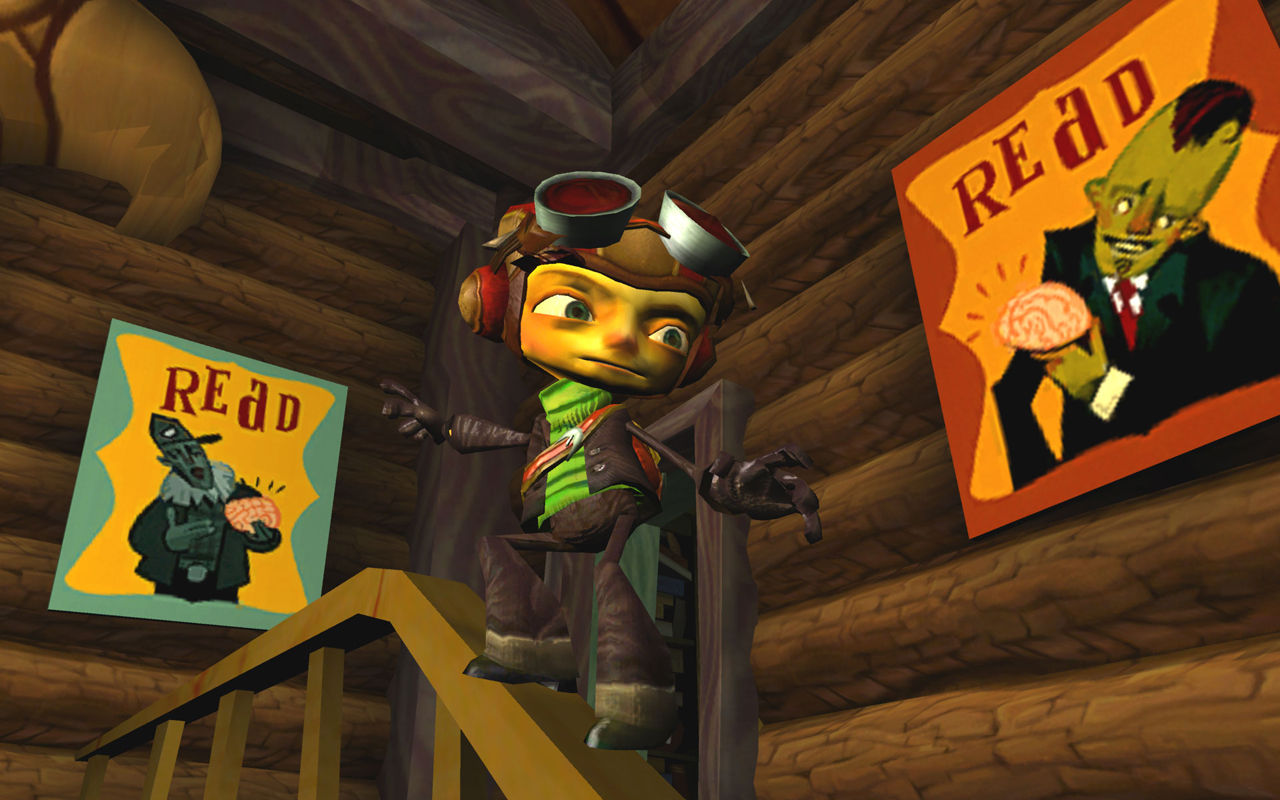
Psychic powers change what Raz can do in both traversal and encounters. PSI Punch is a close-range attack, while PSI Blast sends energy toward targets; Telekinesis can manipulate objects, and Pyrokinesis applies psychic fire. Levitation creates a thought bubble Raz can ride, adding a way to travel and control a fall. Clairvoyance lets him see through another person’s eyes, and powers such as Shield, Invisibility and Confusion offer different ways to respond to threats or obstacles. Raz does not begin with every talent: training and later rank milestones add to his repertoire. He can map a small selection of learned powers to quick-access controls and change that assignment through the power menu. That limited ready set makes choosing an ability part of the action, while the level’s objects, gaps or opponents signal when a different psychic tool may be useful.
Collecting things in a mind feeds Raz’s rank and gives each area several kinds of optional discovery. Figments are fragments of imagination scattered through a level; their point values accumulate, and 100 figment points raise Raz’s PSI Cadet Rank. Emotional Baggage requires two related finds: Raz locates a luggage tag and then reunites it with its matching suitcase, purse, trunk, duffel bag or hatbox. A completed set reveals a short memory sequence associated with that mind. Memory Vaults also open brief memory material, while bright mental cobwebs can be collected after Raz acquires the Cobweb Duster. Turning those cobwebs into PSI Cards lets him combine cards with a PSI Challenge Marker for rank progression. These systems reward looking around and revisiting routes as new abilities become available, but they are distinct from the immediate platforming and rescue objectives.
The adventure’s encounters use the same psychic vocabulary as its movement, but different situations call for different responses. Raz can punch at close range, aim PSI Blast at distant targets, use a shield to guard himself, or apply other powers where their effects fit the obstacle or opponent. Some powers are earned through rank milestones, while others arrive through training or story progression, so the available toolkit expands over time. Mental health is a resource to protect during these excursions: collecting its replenishments helps Raz stay in a mind, and astral layers provide limited recovery after he loses all health. Each mental level supplies its own setting and arrangement of hazards, figures and secrets, while the camp remains the place to meet the cadets and develop. Psychonauts therefore alternates between a grounded training space and imaginative interiors, with Raz’s growing skill connecting the two.
- Developer
- Double Fine Productions
- Genre
- Platformer and adventure