
About Prototype
In Radical Entertainment’s open-world action game, Alex Mercer wakes in Manhattan with no memory and a body that can reshape itself. As a Blacklight outbreak spreads through the city, he pursues the people connected to his transformation, using consumed identities and memories to move between the infected streets, Gentek, and Blackwatch.
Prototype begins with Alex Mercer emerging from a morgue into a city already collapsing under a viral outbreak. He remembers little about his life, while Blackwatch troops and infected creatures turn Manhattan into a battlefield. Gentek, the biotechnology company tied to the crisis, becomes part of Alex’s search for answers. Missions gradually connect his missing past with the outbreak and the military response, while the wider city shows the consequences of those events. Alex is both the person investigating the conspiracy and a being whose powers make him a target of the organisations he is trying to understand.
Manhattan is the game’s continuous open-world setting, with streets, rooftops, military installations and infected districts linked by free movement. Alex can sprint, leap across wide gaps, run up building walls and glide over blocks, so reaching an objective often involves crossing the city directly rather than following its roads. A mini-map marks mission objectives and nearby important targets; the world also supports optional events alongside the central missions. Military alerts can escalate as Alex fights or draws attention, bringing more forces into an encounter and making escape, concealment or a change of disguise relevant to traversal as well as combat.
Alex’s central ability is to reshape his body into weapons and protective forms. The power selection lets the player switch among offensive, defensive and sensory abilities, while his movement remains part of the same fluid action system. Claws and other biological weapons handle close combat differently from ranged or defensive forms, and heavier threats can require a change of approach. He can also take ordinary firearms and military weapons from the world. This range makes combat a sequence of selecting a useful form, striking or evading, and repositioning before enemies can surround him, rather than relying on one conventional weapon throughout every encounter.

Consumption also feeds the Critical Mass meter, linking recovery to the game’s most forceful attacks. As consumption fills the meter, the lower threshold enables Adrenaline Surge’s limited invulnerability, while reaching the top makes a Devastator attack available. A player can therefore decide whether to consume to rebuild health and move toward a powerful area attack, or hold back and keep a different ability active. Devastator variants can be performed on the ground or in the air, and the available inputs include a tendril-based barrage. This resource loop gives encounters an escalation point beyond ordinary strikes: survival actions can create the conditions for a larger offensive move.
Consumption connects survival, disguise and investigation. Absorbing a person restores Alex’s health and lets him assume that person’s appearance; consuming key individuals can also provide memories and information. A military identity can get him through a guarded entrance, while a change made out of sight can help him lose an alert. Disguise actions include stealth consumption and other abilities that become available during play. The tactic has limits: hostile actions expose the disguise, so infiltration asks the player to separate an approach through a protected area from the violence that may follow once an objective is reached.
The story’s Web of Intrigue gives the investigation a second structure. Marked figures hold fragments connected to the outbreak and Alex’s past; consuming them reveals those memories as separate pieces rather than replacing the main mission path. The result is an optional thread of character and conspiracy detail woven into Manhattan’s encounters. Players can pursue these targets when they appear, then return to the larger objectives. Because the Web is assembled from individual memories, it rewards noticing and reaching key people in the city without turning every street encounter into a required story beat.
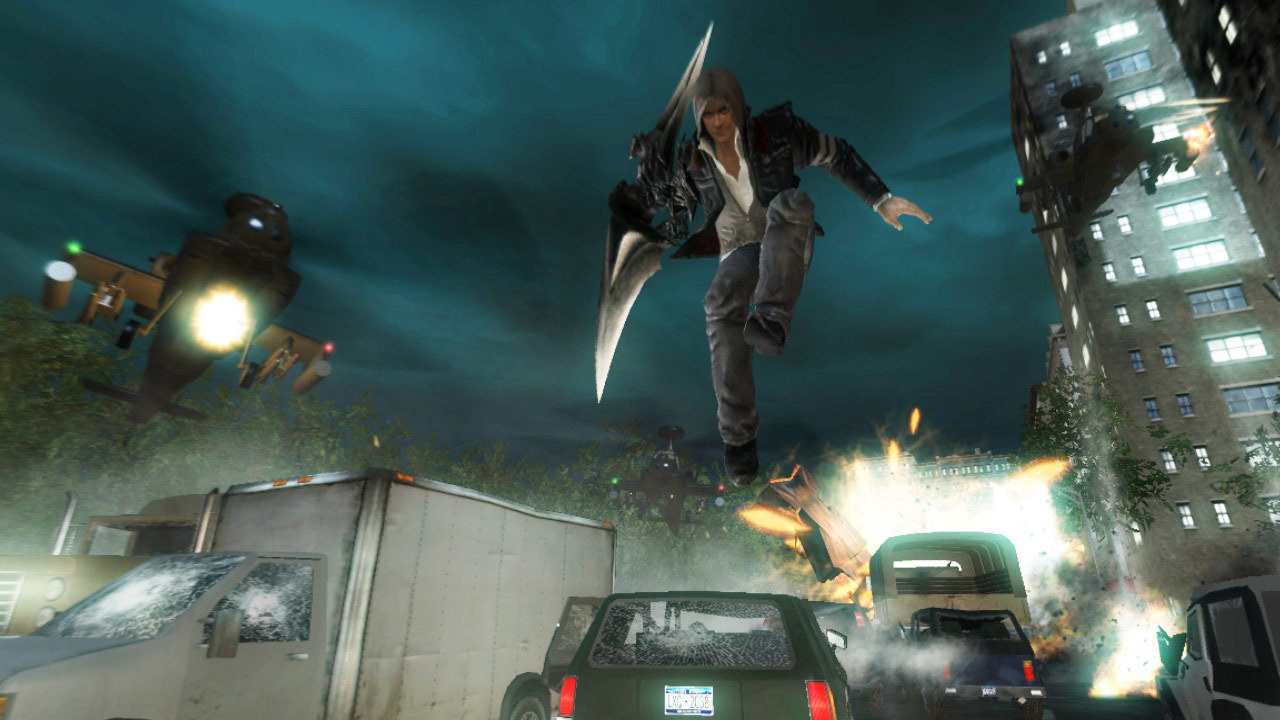
Missions mix direct combat with infiltration, pursuit, protection and the use of military equipment. Objectives may ask Alex to enter a base under a suitable disguise, reach a named target, take control of a vehicle or attack an infected structure. The changing task matters because each situation emphasizes a different part of his abilities: movement can get him to an elevated route, a stolen identity can pass a checkpoint, and a weapon or vehicle can help deal with armor. Red targets on the mini-map identify important enemies for some missions, while blue objective markers keep the larger operation legible during fast movement.
Progression is recorded through Evolution Points, earned by defeating or consuming enemies and by completing missions and events. Those points feed upgrades, allowing Alex’s growing abilities to support later challenges; the interface tracks selected powers, disguise actions and the resources needed for high-impact attacks. On Normal or Hard, completing the campaign unlocks New Game+, which carries over powers, abilities and Web of Intrigue nodes already bought or found. That replay structure adds a concrete reason to return to Manhattan with a developed arsenal, while the first run ties each improvement to the same combat, investigation and movement systems used across the city.
- Developer
- Radical Entertainment
- Genre
- Open-world action-adventure