
About Promise Mascot Agency
Exiled yakuza lieutenant Michi must revive a bankrupt mascot agency in the cursed coastal town of Kaso-Machi. With assistant manager Pinky, he recruits living mascots, negotiates their terms, sends them to jobs and uses Hero Cards when work goes wrong. Driving his upgradeable kei truck through town also brings him closer to the conspiracy behind his exile.
Michi arrives in Kaso-Machi with two problems that will not wait for one another. He is a disgraced yakuza lieutenant sent away after an ambush costs his organisation an enormous fortune, and the only business he has been given to run is a bankrupt mascot agency in a town with a lethal reputation for men like him. The money lost also threatens the clan's attempt to settle its conflict with rivals, putting weight behind Michi's assignment. Pinky, the agency's sharp-tempered assistant manager, is herself a living mascot. Their unlikely partnership sets up Promise Mascot Agency as both a business story and a crime mystery. Michi needs income to rebuild the company, but he also needs to understand who engineered his exile and whether the curse hanging over Kaso-Machi is as dangerous as everyone says. The town is a coastal place with faded businesses, abandoned corners and residents who have their own reasons to stay. Its mountain is associated with spirits and gods, while tales of ghost sightings and escaped sin talismans sit beside far more ordinary questions about work and money. This is not a management screen with a decorative plot attached. The agency's survival, Michi's standing with the people he meets and the town's future all feed into the reason he keeps taking jobs.
The central employees are mascots, but the premise insists that they are living beings with ambitions and peculiar demands, not people inside costumes. Michi has to find them in Kaso-Machi and negotiate before they will join the agency. One may want money, another recognition, and another something as specific as food from the local shop. Recruitment therefore begins with a conversation and a sense of the individual's priorities. Once hired, mascots can be trained and assigned to paid appearances for businesses and community events. The resulting income supports the company and gives those characters a place in town, while their experience grows through work. A roster is valuable because its members can take different assignments, yet it also becomes a collection of personalities whose fortunes the player has reason to follow. Pinky helps organise this work while remaining part of the game's comic, volatile relationship with Michi. The management loop is tied to the setting: a town with little money and declining businesses is not an unlimited source of customers. Making the agency viable is also part of bringing activity back to the streets it serves.
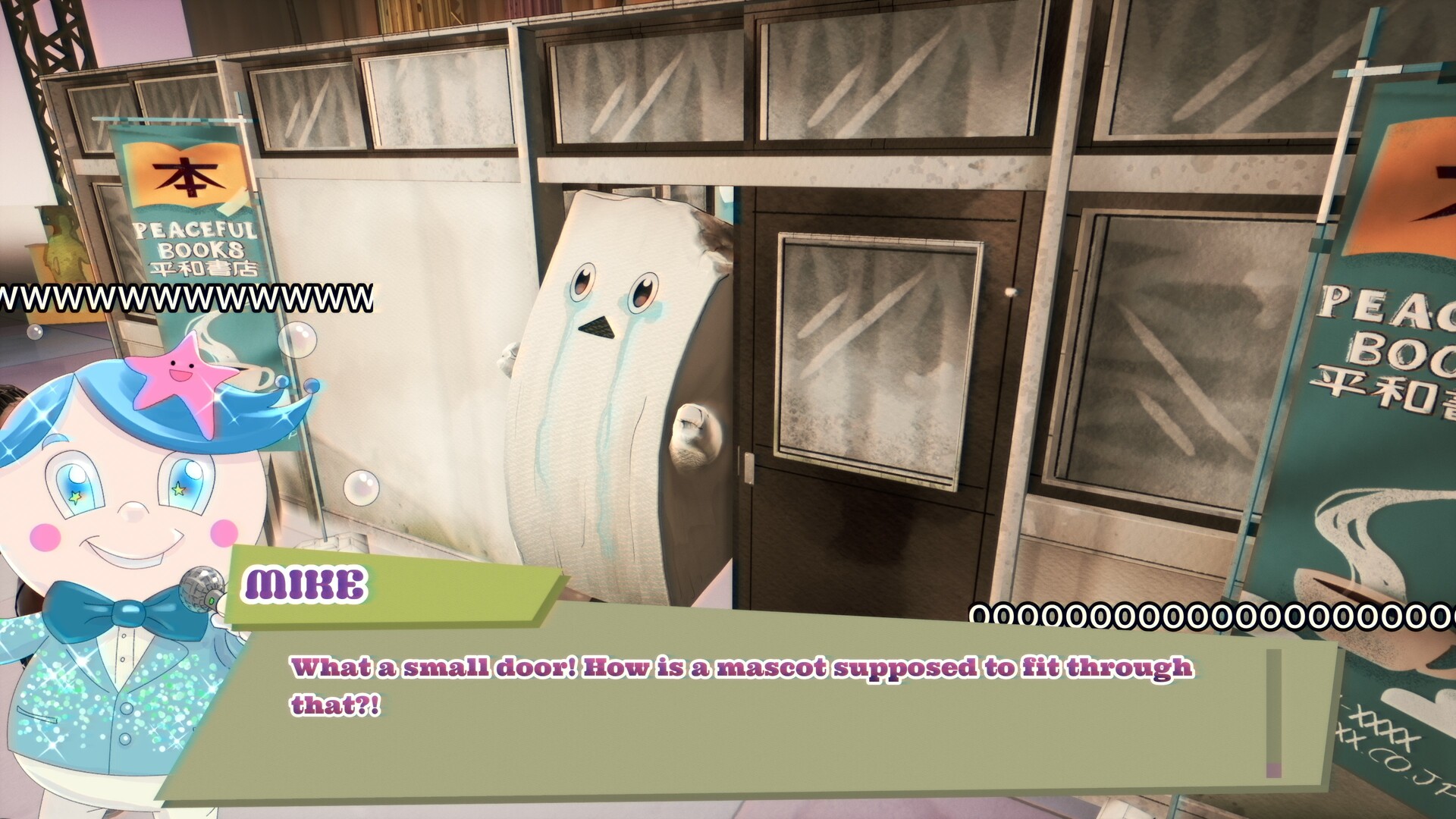
Even a straightforward booking can become an emergency. A mascot can get stuck at a narrow entrance, face a kitchen fire or run into something stranger than an unruly audience. To-Fu, a tearful tofu mascot, and Trororo, a cat with a taste for yams, illustrate how different an employee's trouble can be from another's. Michi's response is played through Hero Cards, which represent people he befriends around Kaso-Machi. Choosing a card at the right moment helps an employee overcome the particular crisis and finish the job. That makes time spent meeting townspeople useful to the agency as well as to the main story: relationships expand the set of interventions Michi can call on. The cards turn a mascot appearance into a small tactical problem rather than a timer the player watches from a distance. The underlying aim remains practical. A completed job means pay, experience and a stronger reputation; a failure has consequences for a company that cannot afford to waste opportunities. The game mixes this rescue system with the broader act of hiring, training and allocating work, so the player alternates between planning what the agency can handle and improvising when a particular mascot is in trouble. It is a different kind of conflict from the yakuza drama that sent Michi to town, but it is just as important to his daily survival.
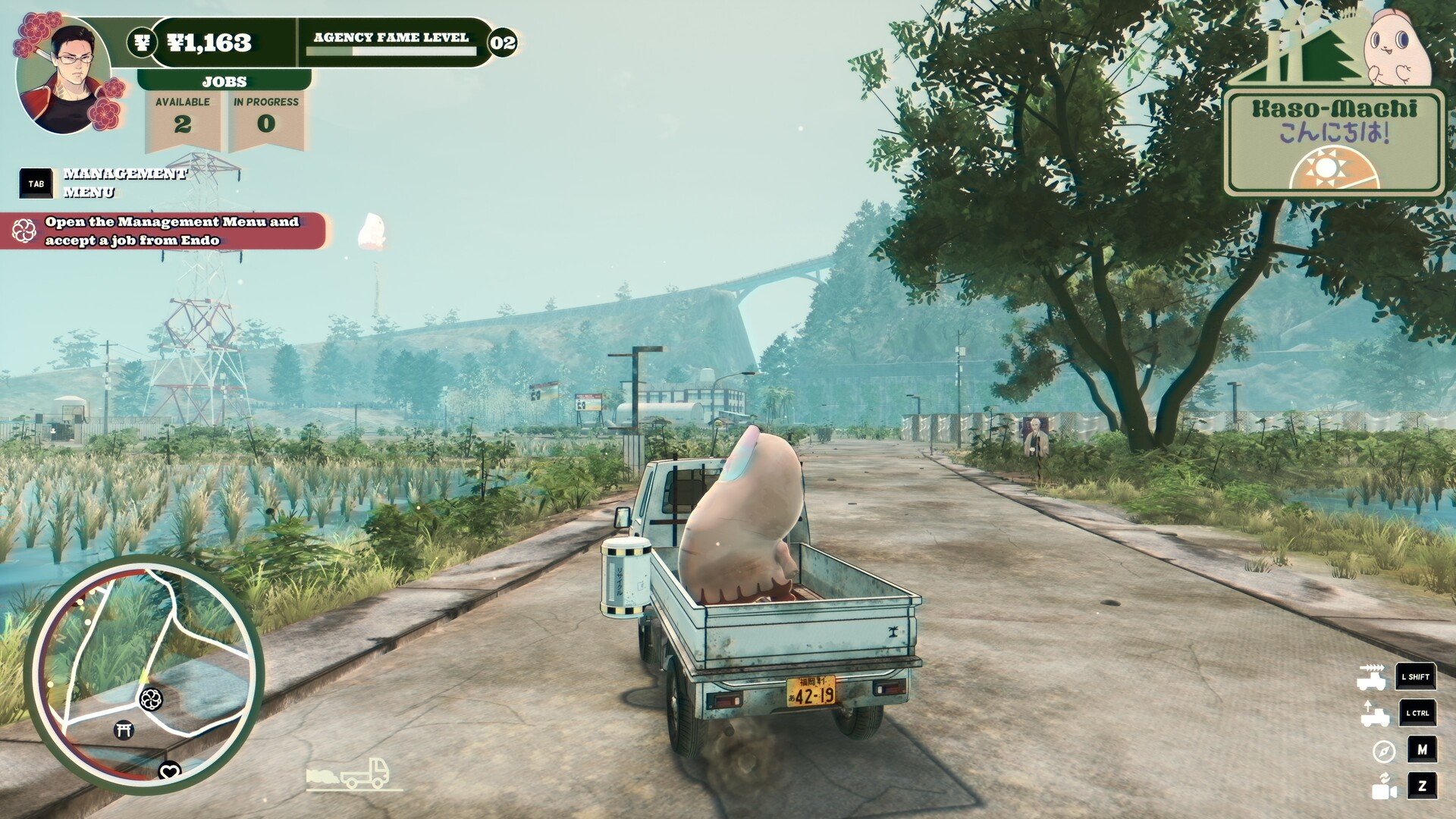
Kaso-Machi is explored in Michi's old kei truck, which can be upgraded as the player moves between jobs and stories. Driving gives the open world a particular scale: the vehicle is small enough to suit the backroads of a neglected town, while its later abilities turn a routine trip into another way of looking for routes and opportunities. Michi can meet residents, partner with local businesses, search for collectables and take on work that contributes to the town's revival. Work around neglected shrines and other local problems can help bring activity back to streets where fewer people now spend money. That civic side of the game makes a new shop or restaurant more than background scenery: a stronger town creates fresh reasons for mascots to be hired and for Michi to keep building relationships outside his office. The developer describes this as a place to spend time rather than a sequence of urgent markers that must all be cleared immediately. The player can follow the conspiracy, seek a new mascot or simply investigate a person and their surroundings at a chosen pace. A later free update added rail-grinding for an upgraded truck and mascot time trials; those are additions made after the original launch's basic driving and job systems were in place.
The town's eccentricity has a deliberate visual and dramatic frame. Kaizen Game Works collaborated with Japanese artists and musicians, including Ikumi Nakamura and Mai Mattori, while creating Kaso-Machi and its cast. Game director Oli Clarke Smith has connected the team's desired pace to older games that allowed players to spend time with characters between major plot beats. He has also cited the measured scenes and soft visual texture of older Japanese cinema as influences on the crime story. Those ideas explain why a sentient mascot can be funny without making the surrounding world feel disposable. Michi's criminal debt, the declining town and the strange rules of the curse all have room to coexist with an employee whose concerns are small and personal. The Japanese voice cast includes Takaya Kuroda as Michi and Ayano Shibuya as Pinky, giving the central pair a distinct exchange of stoicism and chaos. The agency's bright visual identity contrasts with the more troubled history beneath the town; the pleasure of meeting an outlandish new mascot is never wholly separate from the question of why this place has been left behind.
Promise Mascot Agency was developed and published by Kaizen Game Works, the studio behind Paradise Killer, and released in 2025 for PC, PlayStation 5, Xbox Series and Nintendo Switch. It is a single-player game with an open town, a management economy, tactical job rescues and a crime narrative running through those systems. The free Prepare to Grind update subsequently expanded the truck, added time trials and introduced further Hero Cards and difficulty options. Its time trials unlock after specific progress with Shiori and recruited mascots, with new cards among their rewards; they should be understood as added activities rather than the reason the whole agency exists. The game's distinctive hook is how often its systems meet. A resident may become a friend and then a Hero Card; a recruited mascot can take a job that brings money into the agency; a working agency gives Michi a reason to explore more of Kaso-Machi; and each trip may uncover something about the organisation that sent him away. The result is a crime drama whose everyday labour is unusually colourful and whose business decisions remain grounded in the people doing the work.
- Developer
- Kaizen Game Works
- Genre
- Open-world mascot-management crime drama