
About Prince of Persia: The Two Thrones
Returning to Babylon with Kaileena, the Prince finds his homeland devastated by war and himself hunted through its streets. This action-adventure follows his attempt to survive the invasion, confront the consequences of his earlier journey, and resist a darker persona awakened by the Sands of Time.
Prince of Persia: The Two Thrones brings the Prince back to Babylon after his voyage from the Island of Time with Kaileena. The city he expected to reclaim is under attack, its people caught in the advance of an invading army, and the Prince is treated as a fugitive in his own kingdom. The disaster links his present predicament to the events of The Sands of Time and Warrior Within, while the immediate journey follows his effort to cross a city at war. Kaileena remains central to the opening crisis, and the Prince's return also places him in the path of Farah, whose history with him began in the earlier adventure. The story uses these relationships to frame a conflict between the ruler the Prince might become and the destructive persona that the Sands awaken within him. Its main setting is Babylon: occupied streets, palace grounds, rooftops, caves, and other sections of the city form a connected route through the campaign.
Movement through Babylon is built from readable architectural actions: run along walls, leap between ledges, climb columns, swing from poles, mantle onto platforms, and descend using banners. The Prince must judge gaps and moving hazards while looking for switches, levers, doors, and passages that connect one chamber to the next. Some rooms use mechanisms to shift platforms or other pieces of the environment, so reaching the exit depends on understanding how the space changes as well as executing the climb. Traps turn that route into a timing problem: the player moves between safe surfaces while avoiding blades, spikes, and other hazards. The game often signals a path through the arrangement of handholds and surfaces, then asks the player to chain those movements without losing momentum. Exploration is therefore closely tied to traversal: the same wall run or pole swing that crosses a gap can also lead to a switch or position the Prince above an enemy.
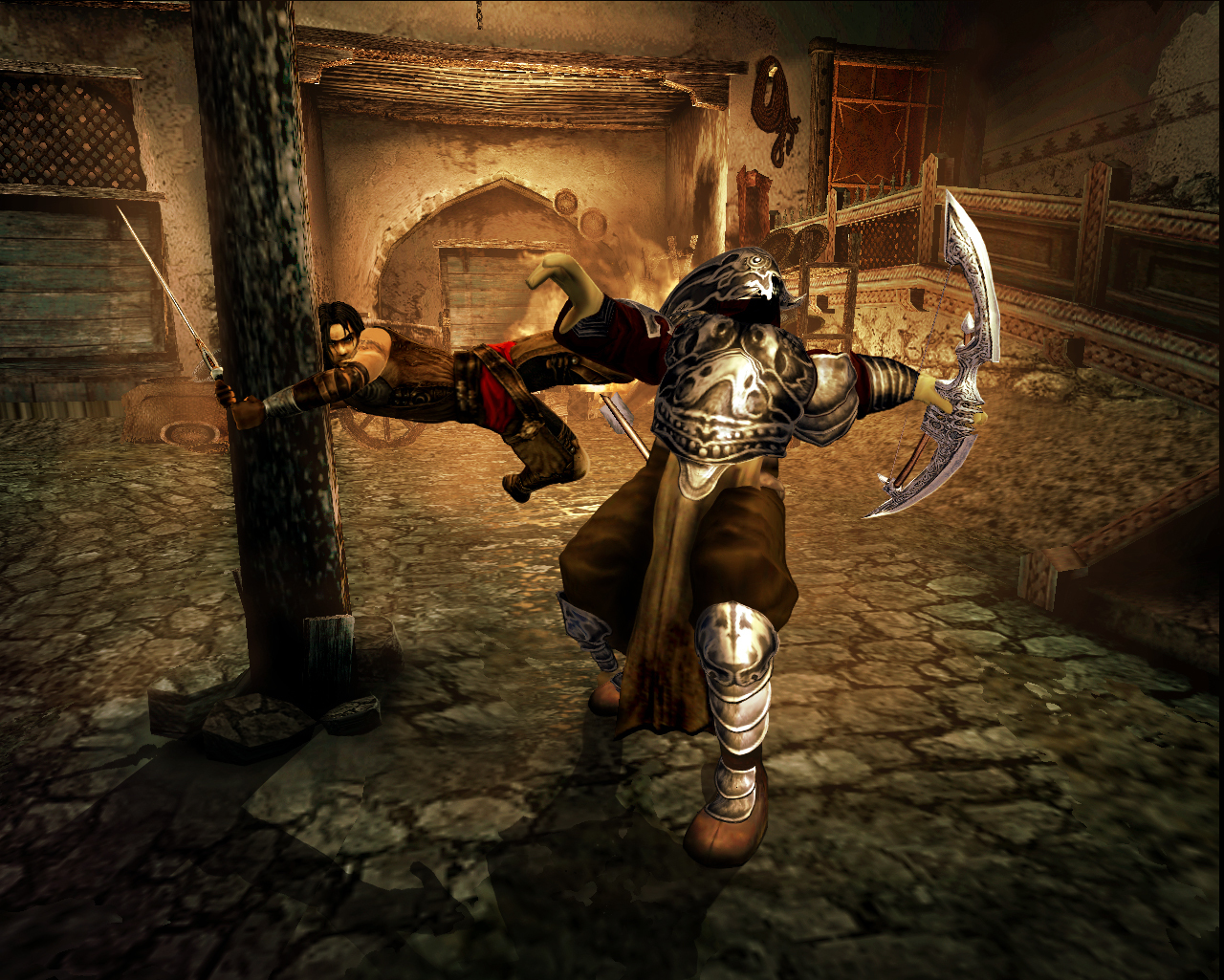
When combat becomes direct, the Prince relies on his dagger and a secondary weapon taken from a defeated enemy. The dropped weapon fits the off hand and opens stronger combinations; it lasts only a limited number of battles before its durability runs out. The player can perform timed attacks from a move list, vault from walls and poles into a strike, and use nearby enemies to extend an attack. Position in the room therefore affects which options are available: a pole or wall provides a launching point, while a group of opponents can be used to carry a sequence across more than one target. Choosing whether to spend a temporary weapon's remaining durability or fight with the dagger shapes the ordinary melee loop. These are the actions used when a guard spots the Prince and a fight begins, and they give direct combat its own spacing and timing decisions.
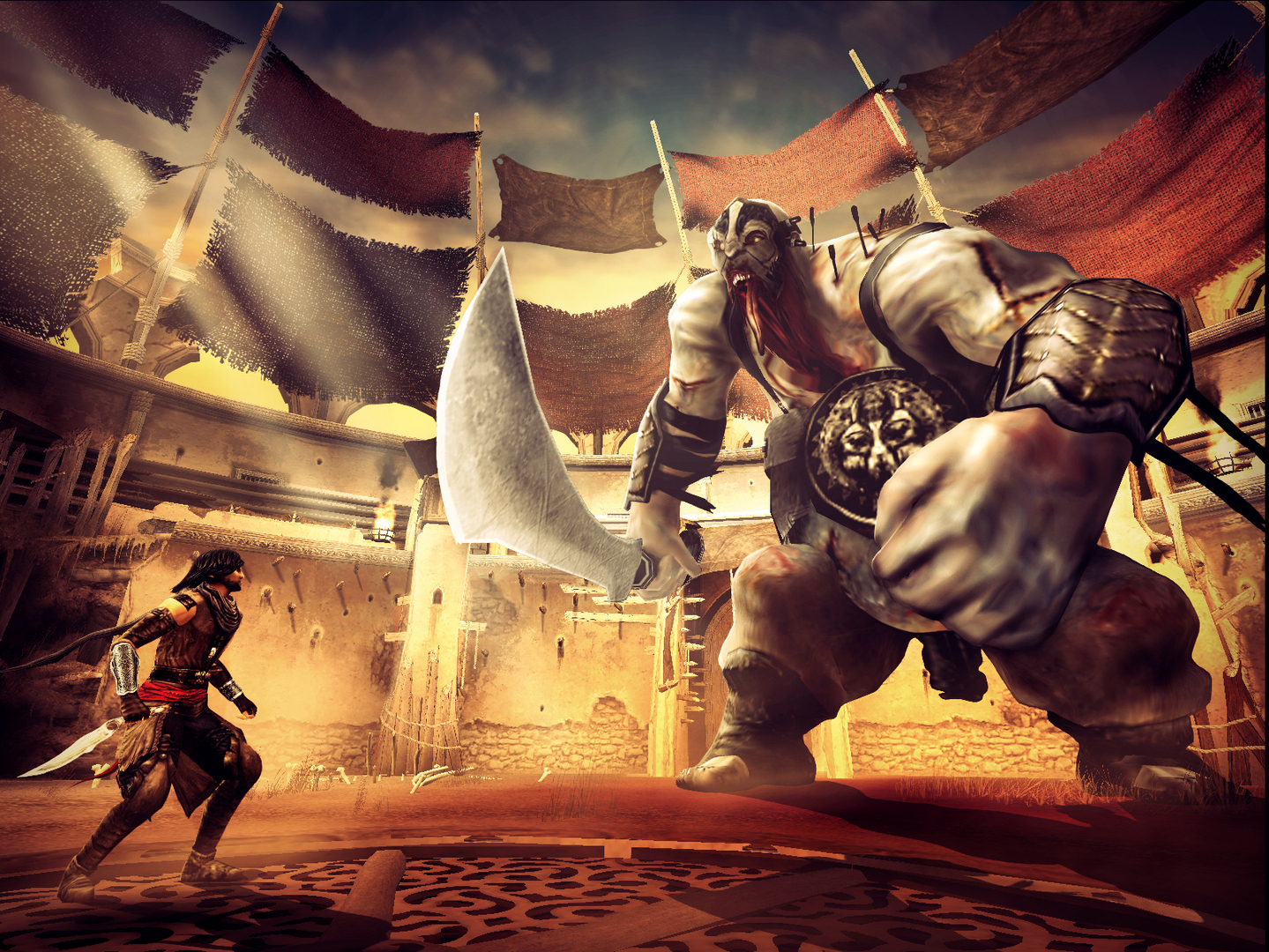
Speed kills are a timed attack sequence rather than a single automatic strike. Once an unaware enemy is in reach, the player starts the manoeuvre and watches for brief attack prompts during its animation. Each successful input advances the sequence; the number of strikes depends on the target, and a mistimed press breaks the attempt and leaves the Prince to fight normally. Nearby opponents can sometimes be caught in a double speed kill, so the approach and spacing of a group affect whether the move can continue across targets. The mechanic connects observation, stealth, and timing: the player needs to identify an opening before beginning, then react to the sequence once it starts. Several major encounters also combine these attacks with climbing and jumping, making the same timing system part of both combat and movement. The Prince can use his time-manipulating dagger to reverse errors, including a failed strike or a missed jump, if a sand charge is available.
The Dark Prince sections change both the Prince's movement and the pressure placed on the player. In this form, he fights with the Daggertail, a bladed chain that can lash at enemies, strike several targets, and hook onto bars or fixtures so he can swing across a gap. The weapon therefore serves as both an attack and a traversal tool, opening routes that are specific to these sequences. The transformation is temporary: the Dark Prince continually loses health, so the player must keep moving and replenish it by collecting sand from defeated enemies or by breaking objects such as jars and furniture. Sand is also needed for the Prince's time powers, which limits how freely those abilities can be used while transformed. The sections alternate aggression with urgency; fighting can restore the resource that keeps the form active, while hesitation during a platforming stretch has a cost. The two forms consequently ask for different rhythms even when they move through the same city.
Chariot races provide a distinct vehicle set piece within the Babylon campaign. The horses gallop automatically, leaving the player to steer the chariot through a fast-moving obstacle course. Rival chariots can enter the route; steering into them can force a crash before they ram the Prince. Foot soldiers may also jump onto the vehicle and try to slow it, and the Prince can use his dagger to remove them. A small mistake can kill him, so this section asks the player to read the approaching course and steer around danger while maintaining the chase. The shift from foot travel to a moving vehicle changes the task for the duration of the sequence: obstacles arrive at speed, enemies can attack from the road or board the chariot, and survival depends on the player's steering and quick dagger response. These races stand apart from Babylon's rooms and alleys as a dedicated chase sequence.
- Developer
- Ubisoft Montreal
- Genre
- Action-adventure